Replatform, rebuild, or hold: deciding when migration is worth the disruption

By Robin Laseur

The replatform-versus-rebuild decision is usually posed as a yes or no to migration, and it has three answers, not two: hold, rebuild on your current platform, or replatform to a new one. Which one is right turns on where the problem actually lives. A problem you could fix in place means hold. A problem in how the store was built, on a platform that is otherwise capable, means rebuild. A problem in the platform itself means replatform. Migration is disruptive enough that holding is often the right call, right up until the monthly cost of the status quo passes the one-time cost of moving, at which point holding becomes the expensive option. The decision is a sizing exercise, and it runs in both directions.
This piece is the framework for making that call honestly. Most content on the question is built to move you toward a migration, because migration is what the people writing it sell. The result is a decision flattened into replatform-or-not, which skips the option that resolves a large share of cases at a fraction of the cost and risk. What follows is the third option restored, the rule that picks between all three, and the two-sided arithmetic that tells you not only whether a move is worth it, but whether you have waited too long or would be moving too soon.
Three options, not two
Start by naming the three, because the middle one is the one that gets lost. Holding means keeping the current platform and the current build, and addressing the pain where it sits, by automating a task, fixing a process, or resolving an integration, without a major project. Rebuilding means staying on the same platform but re-implementing the store properly: clearing accumulated customization debt, re-architecting what was bolted on over the years, and shipping a clean build on a foundation that was never the problem. Replatforming means moving to a different platform entirely, with the full weight of data migration, integration rebuilds, search-continuity work, and organizational change that a move involves.
The three sit on a clear gradient of cost, disruption, and risk. Holding is the cheapest and least disruptive, and does the least. Rebuilding is a real project with real cost, but it stays on familiar ground: the same platform, the same admin, no migration risk to traffic or data. Replatforming is the largest, most disruptive, and most expensive of the three, and also the only one that can solve a genuine platform limit. The error most teams make is collapsing this gradient into a binary, replatform or do nothing, which quietly deletes the rebuild option. That deletion is expensive in both directions: it pushes some teams into a full migration to solve a problem a rebuild would have fixed, and it leaves others holding a broken build because the only alternative they considered was a migration they could not stomach.
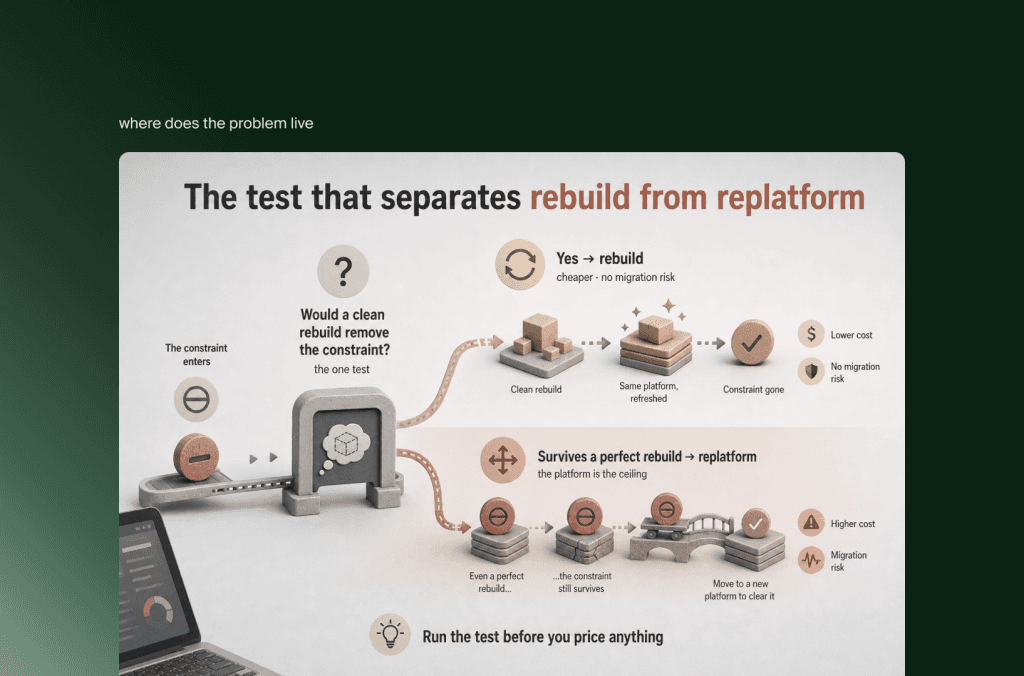
The question that picks the option: where does the problem live
One question sorts the three, and it is the same diagnostic the rest of this cluster runs: where does the problem actually live. A symptom like slow releases or a pile of workarounds does not name its own cause, and each of the three options answers a different cause.
If the problem is portable, a process with no clear owner, a task nobody has automated, an integration that could be built on the current stack, then it is not a platform problem or a build problem, and the answer is hold. Fix it in place. Neither a rebuild nor a migration is warranted to solve something that lives in your workflow rather than your technology. If the problem is in the build, the platform is capable of what you need but the implementation has become customization debt, where every change is expensive because of how the store was assembled rather than because of what the platform can do, then the answer is rebuild. A clean re-implementation on the same platform removes the constraint without the risk of moving. If the problem is in the platform, the architecture genuinely cannot do what the business now requires, or the platform is losing support, then no rebuild on that platform will help, and the answer is replatform.
The tell that separates rebuild from replatform is a single test: would a clean, competent rebuild on the current platform remove the constraint. If yes, rebuild, because it is cheaper and carries none of the migration risk. If the constraint would survive even a perfect rebuild, because it is baked into what the platform can architecturally do, then the platform is the ceiling and only a move clears it. Running that test before sizing anything keeps you from pricing a migration to fix a problem that never needed one.
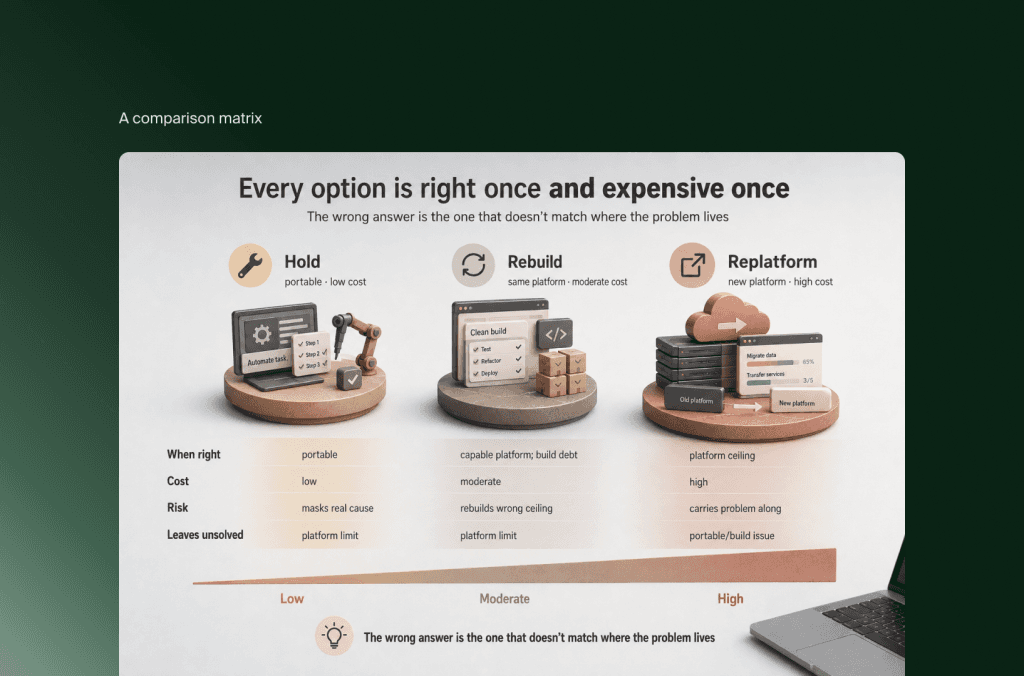
A comparison matrix
With the options defined and the sorting question in hand, the trade-offs line up cleanly.
The matrix makes those wrong-answer cases visible. Every option has a case where it is right and a case where it is the expensive wrong answer, and the difference is always whether the option matches where the problem lives. A rebuild aimed at a platform ceiling wastes a project and returns you to the same wall. A replatform aimed at a build problem pays the largest possible price to relocate an issue a rebuild would have solved. Holding aimed at a genuine platform limit simply runs the meter.
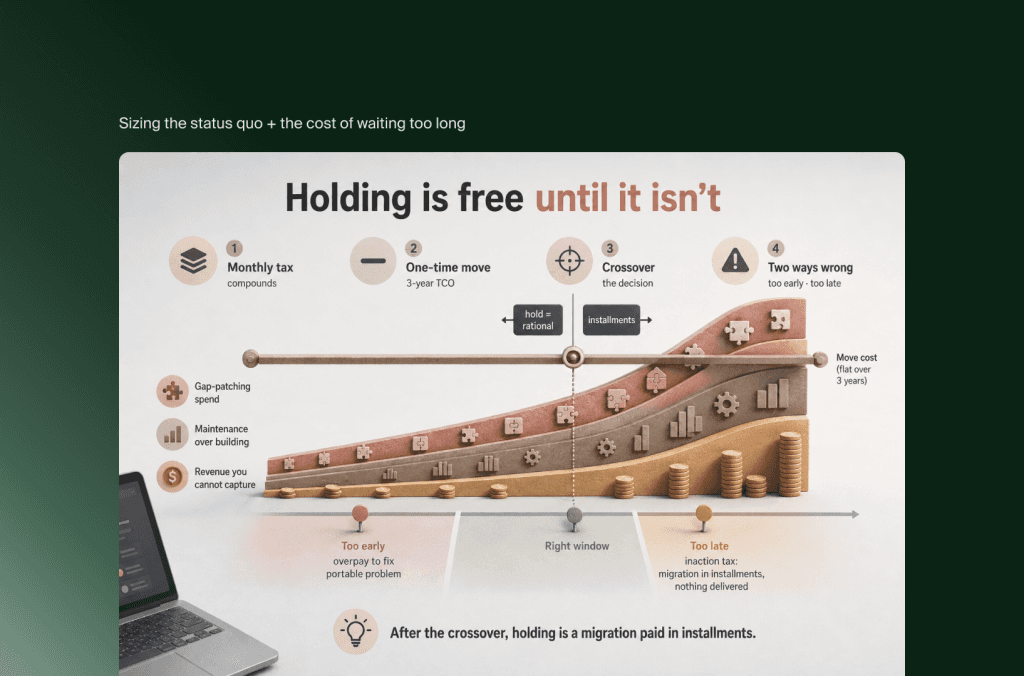
Sizing the status quo: the monthly tax
Once the right option is identified by cause, the timing question remains, and timing is where the sizing comes in. Begin with the cost of the status quo, because it is the number teams feel constantly and almost never total. Holding is not free; it charges a monthly tax, and the tax has three components you can actually add up.
The first is direct spend to compensate for what the platform does not do: the apps, connectors, and custom integration work that exist only to patch gaps. Add up the annual figure. The second is developer time spent maintaining rather than building. Track where engineering hours go over a 90-day window, and separate the hours spent keeping existing functionality alive from the hours spent building new capability; when the maintenance share dominates, the platform is taxing your roadmap, not just your budget. The true cost here rarely appears on the platform invoice, which is exactly why it goes uncounted. The third is the revenue you cannot capture because the store cannot yet do what the moment needs, the launch delayed, the market not entered, the feature quoted as a major project. Sum the three, annualize them, and you have the real monthly tax of holding, which is the figure the move has to be weighed against. Most teams find it is larger than the license line they have been treating as the cost of the platform.
Sizing the move, and the cost of waiting too long
The other side of the scale is the one-time cost of a move, and the honest version of it is bigger than the quote. A migration costs implementation, data migration, integration rebuilds, search-continuity work, training, and the downtime risk around cutover, and migrations frequently overrun, so a realistic figure carries a buffer for the fixes that surface after launch. The single most useful correction here is that the cost is shaped more by what you are moving away from than by the platform you are moving to: the complexity you have accumulated, the bespoke logic, the tangled integrations, is what sets the price, not the destination logo. Size a move over three years of total ownership, not against a license fee, or the comparison is not honest.
Then weigh it against the tax, in both directions, because there are two ways to get this wrong. Move too early and you pay the largest one-time cost available to solve a portable or build problem a cheaper option would have cleared. Hold too long and the monthly tax compounds into what platform strategists call an inaction tax: keep paying the drag past the point where it would have funded the move, and holding quietly becomes the most expensive choice on the table while feeling like the safe one. The crossover is the moment the accumulated tax of holding passes the one-time cost of moving, adjusted for the disruption a move imposes. Before it, holding is rational. After it, holding is just a migration you are paying for in installments without receiving. If the constraint is genuinely the platform, the destination decision, whether a move to something like Shopify Plus actually fixes your specific constraint, is the next question, and it deserves the same where-does-the-problem-live scrutiny as the decision to move at all. Sizing migration cost against the real drag of the status quo is the calculation worth running before committing either way, and as a Shopify Platinum Partner it is the one Flatline runs with a brand before recommending a move, precisely because the honest answer is sometimes rebuild, and sometimes hold.
Choose your current platform
If the sizing points to a replatform, the next question is what the move involves from the platform you run today. Each guide below covers the data, integrations, SEO and cutover risks specific to one source platform.
Current platform | Migration guide |
|---|---|
Magento / Adobe Commerce | |
Centra | |
SAP Commerce Cloud (Hybris) | |
PrestaShop | |
Salesforce Commerce Cloud | |
BigCommerce | |
WooCommerce | |
Shopware |
Before you open a guide, confirm whether you have genuinely outgrown your platform, and if you have, plan the migration around revenue so the paths that earn most move first and each phase helps fund the next.
If you want a team to scope and run the move with you, see how our Shopify migration service works.
Frequently asked questions
Should I replatform or rebuild on my current platform?
Ask whether a clean, competent rebuild on your current platform would remove the constraint. If it would, rebuild, because it costs less and carries no migration risk to your data, traffic, or integrations. If the constraint is baked into what the platform can architecturally do, so it would survive even a perfect rebuild, then the platform is the ceiling and only a replatform clears it. The deciding factor is whether the problem is in the build or in the platform.
When is it better to hold than to replatform?
When the problem is portable, meaning it lives in your process, ownership, or a fix you could build on the current stack, holding and fixing it in place is correct, because neither a rebuild nor a migration addresses a workflow problem. Holding is also right when the monthly cost of the status quo is still below the one-time cost of moving. It stops being right at the crossover, where accumulated drag passes what a move would cost.
How do you calculate whether replatforming is worth it?
Size both sides. On one side, total the monthly tax of holding: annual spend on apps and custom work that compensate for platform gaps, the share of developer hours spent maintaining rather than building, and the revenue you cannot capture. On the other, size the move over three years of total ownership, including migration, integration, training, downtime risk, and a buffer for overrun. When the accumulated tax passes the one-time cost, adjusted for disruption, the move is worth it.
What’s the difference between a rebuild and a replatform?
A rebuild re-implements your store on the same platform: it clears customization debt and re-architects a messy build without changing the underlying technology, so there is no data migration and no traffic risk. A replatform moves you to a different platform entirely, with migration, integration rebuilds, and search-continuity work. A rebuild fixes a build problem on a capable platform; a replatform is for when the platform itself is the constraint.
Is replatforming always more expensive than rebuilding?
Generally yes, because a replatform carries migration, integration, and change-management costs a same-platform rebuild does not. That is exactly why the rebuild option matters: for a problem that lives in the build rather than the platform, a rebuild solves it at lower cost and lower risk. Replatforming is worth its higher price only when the constraint is the platform itself, which a rebuild cannot lift.
Key takeaways
The replatform question has three answers, not two: hold, rebuild on the current platform, or replatform. Collapsing it to replatform-or-not deletes the middle option that resolves many cases cheaply.
The option is chosen by where the problem lives: portable means hold, a build problem means rebuild, a genuine platform ceiling means replatform. The test for the last is whether a clean rebuild would still leave the constraint.
Size the status quo as a monthly tax: compensating app and integration spend, developer hours spent maintaining rather than building, and revenue you cannot capture. It is usually larger than the license fee teams treat as the platform cost.
Size the move over three years, not against a license line, and remember the cost is set more by what you are moving away from than by the destination. Budget a buffer, because migrations overrun.
The decision fails in two directions. Moving too early pays the largest cost to fix a smaller problem; holding past the crossover turns the inaction tax into a migration paid in installments with nothing delivered.
The reason to hold all three options open is that the honest answer changes case by case, and a framework that only knows how to say “migrate” cannot find it. Some stores are running a portable problem they should fix on Monday and keep their platform for years. Some are carrying a capable platform under a build that needs replacing, and a rebuild will feel like a new store without the risk of a move. Some have genuinely hit the ceiling, and every month they wait is an installment on a migration they will make anyway, later, for more. Locate where your problem lives, size both sides of the scale, and the replatform-versus-rebuild decision stops being a leap of faith and becomes a number you can defend.
Related articles


