Centra to Shopify Plus Migration: Cost, Timeline and the Fashion Workflows You Need to Preserve

By Robin Laseur

A Centra to Shopify Plus migration means rebuilding your commerce operation around a different product, storefront and order model. For fashion brands, the deciding questions are whether Shopify can preserve style and size identity, wholesale commitments and market-specific selling rules while reducing the work required to run and improve the store.
The difficult part may not be importing a dress in four colours. It may be preserving the stock promised to a wholesale buyer while the same dress launches direct to consumer in three markets.
That distinction should shape the migration brief, budget and launch decision.
When does moving from Centra to Shopify Plus make sense?
Moving makes sense when a tested Shopify setup improves the way your team trades without introducing disproportionate work elsewhere. Start with measurable operational problems, such as development-dependent campaign updates or duplicated integrations. Then compare the proposed solution with improving your current Centra implementation, including the cost of replacing capabilities you already use.
Centra is a SaaS commerce platform built for fashion and lifestyle, with headless architecture, product information management and DTC and wholesale capabilities. This is not automatically a move from outdated infrastructure to modern software. Both platforms can support a serious commerce business.
The business case is stronger when your current implementation creates identifiable constraints:
Merchandisers need developer support for routine campaign and storefront changes.
Custom frontend maintenance consumes budget that could fund trading improvements.
Your preferred customer-service, marketing or retail tools require integrations you would otherwise avoid.
Wholesale requirements are relatively straightforward, or an existing ERP already owns the complex order processes.
These are hypotheses to test, not guaranteed Shopify benefits. Ask the future store team to complete real tasks in the proposed setup: launch a colourway, change a regional promotion and correct a product attribute without developer intervention.
Staying with Centra deserves equal consideration when its fashion product model, seasonal wholesale processes or existing headless experience closely match your operation. Replacing those capabilities with several applications and custom services may increase ownership cost.
Does the project actually require Shopify Plus?
Do not select Plus simply because you sell wholesale. Shopify’s current documentation lists B2B features across multiple plans. Plus adds capabilities including unlimited B2B market catalogs, direct catalog assignment to companies and company locations, and certain advanced payment features. Evaluate your requirements against the current B2B features by plan.
The decision should identify the specific Plus capabilities you need, the operating work they remove and the commercial terms that apply to your business. A platform label is not a requirements document.
How should Centra’s fashion product model map to Shopify?
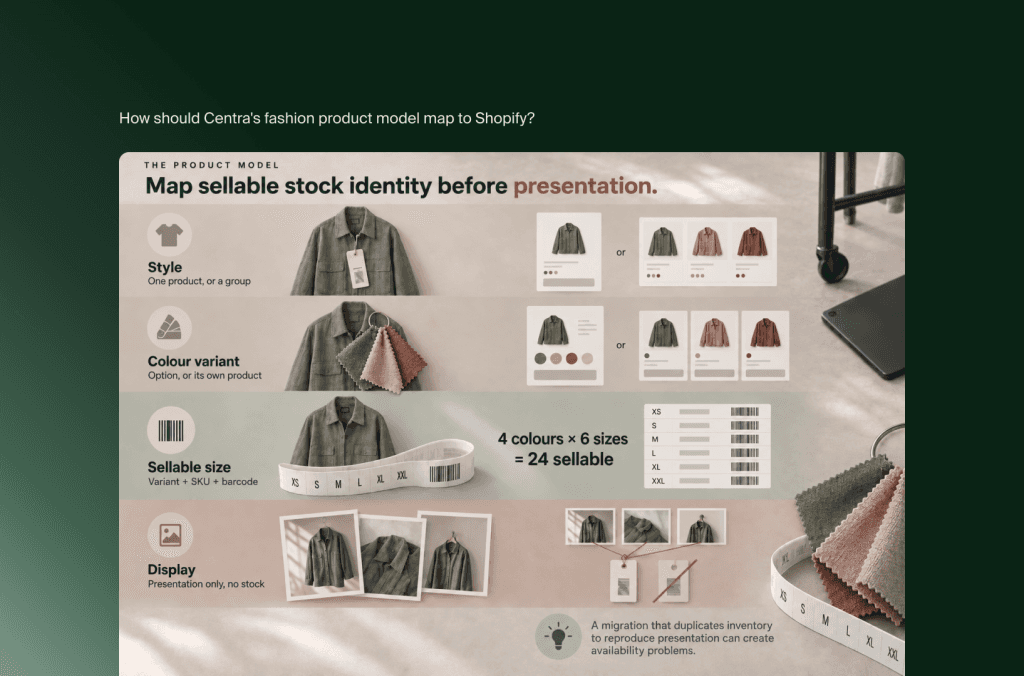
Map sellable stock identity before deciding how products should appear on the storefront. Preserve the relationship between style, colour and size, then design product pages, filters and merchandising around that structure. A migration that duplicates inventory to reproduce presentation can create availability and fulfilment problems even when every product page looks correct.
Centra distinguishes products, variants and sizes: a product typically represents a style, a variant commonly represents a colour or material, and sizes carry physical stock and GTIN information. Displays provide a separate presentation layer. Those distinctions matter when translating the catalog. See Centra’s product model.
The following is a proposed mapping framework, not a native one-click conversion:
Test the model with a representative style
Consider an illustrative jacket with four colours and six sizes per colour. It has 24 sellable combinations. The same jacket appearing in several campaigns should not create additional physical inventory records.
One Shopify product with colour and size options may suit a unified product page. Separate products for each colour may suit distinct imagery, collection merchandising and search intent. Neither choice is universally better. The decision changes URLs, feeds, product recommendations and reporting, so make it before importing the full catalog.
Shopify currently supports up to 2,048 variants and three options per product. Compatibility still needs checking across themes, applications and sales channels, particularly when products exceed 100 variants. A platform limit is not proof that the complete storefront will support your catalog correctly. See Shopify’s variant documentation.
If linked colour-specific products are important, evaluate Shopify Combined Listings against its current requirements and limitations. Do not assume a product-grouping feature reproduces every behaviour of a Centra display.
Run the prototype with awkward examples: a missing size, an archived colour, a regional product restriction and a bundle whose components have their own stock. Ask merchandising and warehouse teams to approve the same mapping. A clean import count alone cannot do that.
How do wholesale delivery windows and stock commitments survive?
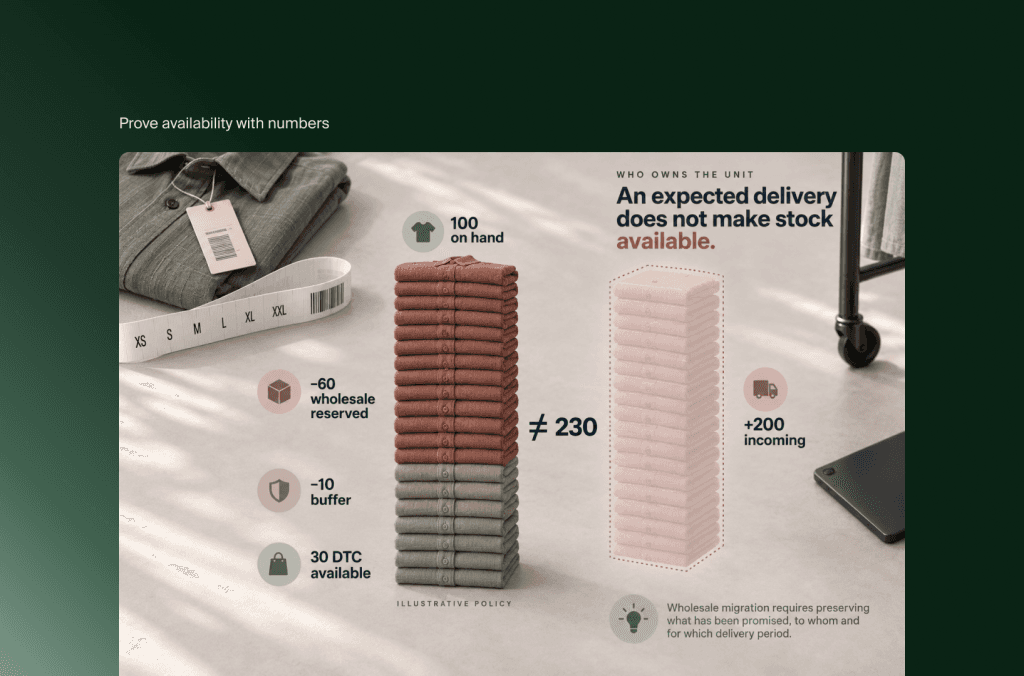
Wholesale migration requires preserving what has been promised, to whom and for which delivery period. Distinguish current stock, incoming supply, reservations and unfulfilled order quantities. Then decide which system owns each commitment after launch. An application that accepts a preorder is not, by itself, proof that your seasonal wholesale process has been replaced.
Centra’s delivery windows can distinguish selling periods from delivery periods and associate products, markets and allocation rules with those windows. A buyer ordering for a future drop is therefore not necessarily placing the same kind of transaction as an immediate replenishment order. See Centra’s delivery-window setup.
Translate those behaviours into testable requirements. For example, can the target setup prevent a buyer from ordering outside the agreed assortment? Can it preserve the delivery period after an order amendment? What happens when an incoming shipment is delayed?
Treat open wholesale orders as operational state
Centra also documents allocating newly received stock to existing wholesale orders containing preorder items. That is a process spanning multiple events, not just a field to copy. See allocation to existing orders.
For each open order line, establish the ordered, cancelled, allocated, shipped and outstanding quantities. Link the line to the buyer, delivery period, payment status and fulfilment reference where relevant. Finance and operations should agree which system handles subsequent amendments, invoices, returns and refunds.
One option is to complete existing commitments in their current operational system while placing new orders through Shopify. Another is to migrate those commitments through a tested integration. The right choice depends on system ownership and available capabilities; neither should be hidden inside a generic “order migration” allowance.
Prove availability with numbers
Suppose a warehouse holds 100 units of a size, 60 are reserved for wholesale and your operating policy keeps a 10-unit buffer. Under that illustrative policy, DTC availability is 30 units. An expected delivery of another 200 units does not automatically make 230 units available for immediate shipment.
Now cancel part of the wholesale commitment, receive only part of the incoming shipment and place two consumer orders close together. The test should demonstrate how availability changes, which system authorises the change and how every channel receives it.
Shopify supports preorders through preorder applications, with payment-provider requirements and app-specific behaviour. That capability needs separate evaluation against your wholesale process; it is not evidence of delivery-window or allocation parity. Check the current Shopify preorder requirements.
If the proof fails, change the target architecture, retain the relevant wholesale system or reconsider the migration scope before building the rest of the store.
What changes across markets, storefronts and integrations?
Design the target architecture around operational ownership rather than copying the number of existing storefronts. Document which teams control prices, product content, customer relationships and stock. Then choose how consumer and wholesale experiences are separated, which frontend approach to use, and which systems remain authoritative after the commerce platform changes.
Separate commercial requirements from store count
For every market, record currency, language, assortment, price ownership, fulfilment source, selling entity and checkout requirements. Turn that information into representative buyer journeys. A country name alone does not tell you whether a separate Shopify store is necessary or whether the intended setup is feasible.
For wholesale, Shopify supports a blended store serving DTC and B2B, or a dedicated B2B store with a separate admin. These have different implications for branding, settings and inventory administration. Use the Shopify store-type guidance to evaluate the choice rather than assuming two channels always require two stores.
A useful acceptance test follows a wholesale buyer from login to an account-specific price, order placement and warehouse acknowledgement. Test the consumer journey separately, including what an anonymous visitor can see. Correct pricing in the admin does not prove correct access on the storefront.
Choose the frontend deliberately
Moving to a Shopify theme-based storefront may reduce the amount of custom frontend software your team maintains. That benefit depends on the design and application choices. Rebuilding an extensively bespoke experience can bring much of the development responsibility back.
Keeping a headless frontend is a different project. Existing designs and some content may be reusable, but Centra-specific API calls, cart behaviour, product references and checkout connections need assessment and replacement where necessary. “Keep the frontend” should never mean “assume the frontend works unchanged.”
If a CMS stays, identify every embedded product reference and establish how it resolves to the new catalog. Test campaign pages as well as standard product pages. Editorial content can remain visually intact while its commerce links point to retired identifiers.
Assign one authoritative owner per data domain
Create an ownership register covering product enrichment, price lists, stock, customer consent, order status and fulfilment. For each domain, name the source, destinations, update trigger and reconciliation method. Include who investigates failures after the implementation team leaves.
Centra’s Storefront API describes display items as product variants activated on a store display. A practical implication is that a storefront-facing extract should not be assumed to represent the complete master catalog or all channel data. Validate extraction coverage against administrative records. See Centra’s product-information API documentation.
Customer profiles also need a separate account-access plan. Shopify’s customer CSV import does not transfer passwords from another platform, and it is not an order-history importer. Select the target account experience and test the associated customer communication. See Shopify’s customer import guidance.
For integrations, build duplicate-event protection and scheduled reconciliation alongside event handling. Shopify explicitly advises against relying solely on webhooks for data synchronisation because delivery is not always guaranteed. The operational consequence is straightforward: someone must be able to find and repair a missing update. See Shopify’s webhook guidance.

How much does a Centra to Shopify Plus migration cost?
Cost depends on the target operating model, data quality, storefront scope and integration complexity. There is no defensible universal price for a Centra migration. Build an estimate from agreed work packages, then add platform and application costs separately. The calculation below is a hypothetical planning example, not a market benchmark or Flatline quotation.
Assume one brand, a theme-based storefront, a limited set of market configurations, retained ERP and warehouse systems, and defined integration access. Assume wholesale is limited to a proven replenishment workflow, while complex historical commitments remain in the existing operational system. A full replacement of seasonal wholesale planning is outside this example.
At an assumed blended rate of €120 per hour, that produces €96,000–€168,000 in implementation effort. Adding an illustrative 15% contingency produces a planning envelope of €110,400–€193,200, excluding tax. Both the rate and the effort allowances are assumptions constructed for this example.
The model excludes Shopify subscription charges, paid applications, transaction and payment fees, a new PIM, ERP transformation, substantial content production, internal staff time and any remaining Centra contract costs. It also excludes a bespoke headless rebuild and a custom replacement for advanced wholesale allocation or delivery-window functionality.
Actual quotations may fall outside this range. A small, clean DTC migration has a different scope from a multi-brand operation with bespoke wholesale ordering. Increasing the contingency does not adequately fund an undefined workstream; scope and price that work separately.
Compare recurring costs as well as the project fee
Build a three-year comparison covering subscriptions, application contracts, integration support, frontend maintenance, release testing and staff workload. Include any period when both platforms remain active. Count a saving only when a contract, task or dependency disappears.
Flatline’s overview of ecommerce total cost of ownership provides a broader framework for that comparison. Use current supplier quotations for your model rather than historical platform-price examples.
Ask each proposal to state what is native, what requires an application, what is custom-built and who supports it. Two bids with the same headline price can transfer very different amounts of ongoing work to your team.
How long should the migration take?
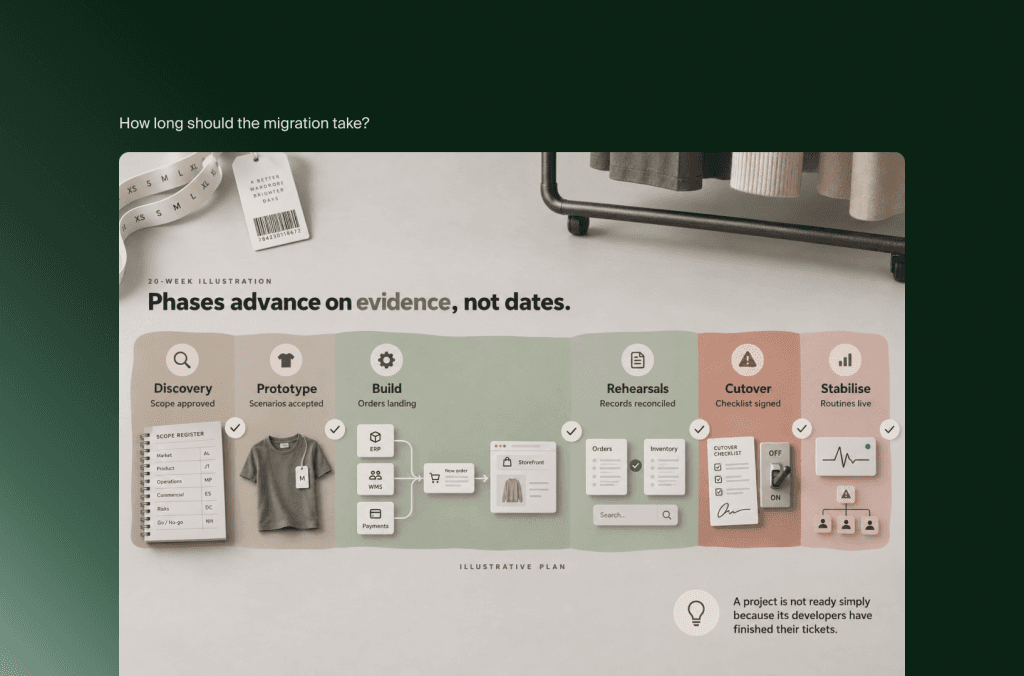
The timeline should follow dependency resolution, not just the number of products being moved. Product mapping, integration access and wholesale acceptance tests belong early in the schedule. The 20-week sequence below is an illustrative plan for the bounded scope in the cost example, not a typical duration or a promised delivery date.
Several workstreams run in parallel; these periods are not a staffing prescription. The assumed hours in the cost model represent combined team effort, not one person working for 20 weeks.
The plan depends on timely access, stable requirements and available business reviewers. An ERP interface change, a new legal-entity requirement or an unresolved allocation process can change the schedule materially. A brand with seasonal presales should also account for buying appointments, campaign launches and incoming-stock peaks when choosing its cutover window.
Training belongs before launch. Merchandising should publish products and promotions, customer service should locate old and new orders, and finance should reconcile a sample transaction. A project is not ready simply because its developers have finished their tickets.
How do you protect SEO and trade through cutover?
Protecting the migration means controlling both public URLs and transactions that remain in flight. Inventory every important landing page, test its intended destination and reconcile the final data changes. Launch only when named owners can explain how late orders, stock updates and existing customer obligations will be handled across the switchover.
Map search intent alongside product identity
A change from separate colour pages to one product page can affect organic landing pages even when the underlying assortment is unchanged. Review important URLs using search, analytics, feed and catalog records. Decide whether each page remains distinct, consolidates into a relevant destination or is retired.
Validate redirects, internal links, canonical tags, language references and sitemap contents. Remove staging restrictions where appropriate and monitor indexing and traffic after launch. Google advises preparing URL mappings and redirects and warns that rankings can fluctuate during a move. No responsible migration plan should promise zero SEO impact. See Google’s site-move guidance.
Product feeds need their own migration check. Decide how identifiers, destinations and variant links will change, then test the resulting records with each receiving channel. This is a separate task from making a product page crawlable.
Rehearse the transaction boundary
Document the final extraction time, any ordering restriction, the handling of subsequent changes and the point when Shopify becomes authoritative for new orders. Use a cross-reference between source and destination identifiers so teams can investigate a transaction without guessing which system holds it.
The rehearsal should include:
A consumer order placed near the switch, processed once by the warehouse.
A wholesale order accepted before launch but fulfilled afterwards.
A cancellation that releases stock to the correct channel.
A return against an older order, handled by the agreed system and team.
A delayed integration event that can be detected and replayed safely.
Define critical launch blockers in advance. Wrong buyer-specific prices, duplicated fulfilment instructions and unexplained stock differences should not be treated like cosmetic defects. Assign an owner and an agreed resolution for every remaining issue.
Rollback also needs an operational definition. Once Shopify has accepted orders or payments, pointing the domain back does not reverse those transactions. Decide when rollback remains safe and when controlled forward repair is the better response. Reconcile new transactions before changing the system of record again.
Leaving Centra is one of three options, so if you are still deciding whether to replatform, rebuild or hold, run that comparison before wholesale and DTC requirements are frozen into a Shopify Plus scope. When the case for moving holds up, our Shopify migration service takes the Centra product model, wholesale commitments and cutover through as one plan.
Frequently asked questions
Can we move DTC to Shopify while keeping wholesale on Centra?
Yes, that can be an architecture option, subject to integration and contractual validation. It requires explicit ownership of shared products, prices and inventory, plus rules for reservations and customer support. Treat the arrangement as an operating model with its own cost and responsibilities, not as an automatically simple halfway stage.
Do all historical orders need to move into Shopify?
Not necessarily. Decide which records need operational access for returns, customer service and reporting, and which can remain in a searchable archive or retained system. Separate historical records from open commitments. Validate any required history-import method independently, including how imported records appear to customers and affect downstream reporting.
Will we need a separate PIM after leaving Centra?
Not automatically. The answer depends on where product enrichment will happen, how many channels consume it and who governs attributes and translations. Test whether the proposed Shopify-led workflow is sufficient before buying another system. If a PIM is retained or introduced, define ownership and synchronisation rather than maintaining competing master records.
Will migrating to Shopify Plus increase conversion?
A platform change does not guarantee a conversion uplift. Outcomes depend on the implemented experience, traffic mix, pricing, availability and measurement quality. Establish a baseline before migration and compare relevant periods and customer segments afterwards. Also monitor fulfilment errors, returns and trading workload so a storefront metric does not hide operational deterioration.
Who should approve the migration scope?
Include ecommerce, merchandising, wholesale sales, operations, customer service, finance and the owners of integrations and data. Each team should approve representative scenarios within its responsibility. Name one accountable business decision-maker for scope and launch, while preserving explicit acceptance criteria for processes that another department must operate after handover.
Key takeaways
A Centra migration is ready to proceed when the target design has proved its critical workflows and the business case includes the work that remains after launch. Use the following checks to distinguish a credible plan from a proposal that only covers a new storefront and a successful data import.
Preserve style, colour, size and stock identity before finalising product-page structure.
Prove wholesale delivery commitments and allocation behaviour with real operating scenarios.
Choose Plus, store structure and frontend architecture for explicit requirements.
Budget for integrations, recurring ownership costs and the coexistence period.
Make reconciled data, working fulfilment and accepted buyer journeys conditions of launch.
If you are assessing the move, bring a representative catalog sample, an integration map and your hardest wholesale scenarios to a conversation with Flatline’s Shopify Plus team. Those inputs make it easier to assess fit and scope before committing to a full implementation.
Related articles


