



Shopify or Shopify Plus?
Shopify Plus is not automatically the right choice because a brand is large. Investigate Plus when you need B2B beyond the standard plans, such as unlimited catalogues or company-specific pricing, run multiple stores or complex market structures, have advanced checkout or automation requirements, or need stricter roles and governance. Weigh the platform cost against the cost of apps, custom work, manual effort and risk on the alternative.
WHITE-GLOVE SERVICE

PROVEN
RESULTS
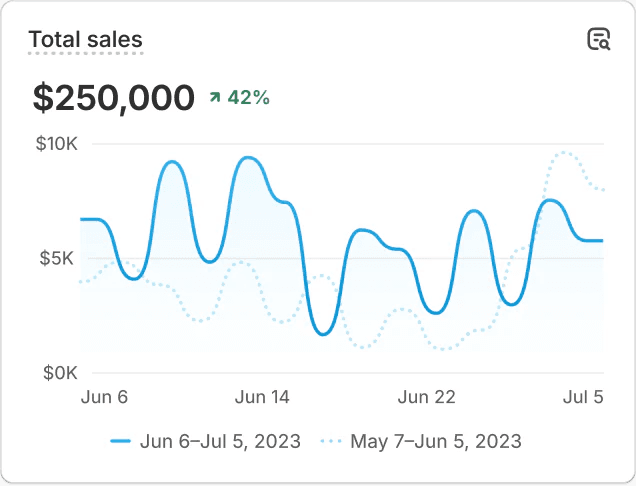
TOTAL SALES VS. PREVIOUS PERIOD


Our Shopify services
A Shopify agency should deliver more than a storefront. The store has to work with product data, fulfilment, marketing, finance and retail, and your team has to be able to run it after launch. That is why we scope design, development and integrations together. Each service below belongs to that one approach and is not a separate product.
New Shopify and Shopify Plus stores, from discovery and UX/UI to theme development, analytics and launch.
Migration and replatforming from Magento, WooCommerce, Shopware, Lightspeed or a custom platform.
B2B on Shopify with company accounts, catalogues, price agreements and payment terms.
PIM and ERP integrations with clear data ownership, sync rules and error handling.
Shopify POS for brands that sell in their own stores as well as online.
Headless Shopify when content, channel or performance requirements justify the extra architecture.
Conversion optimisation and ongoing development after launch, driven by data and a prioritised backlog.
Custom work is not a goal in itself. We use Shopify’s standard features where they cover the need, choose an app when the business case holds, and build our own only when the standard options clearly fall short. For most brands a custom Liquid theme is the most manageable route. Headless only pays off when the requirements are worth the extra architecture and maintenance.
International growth with Shopify Markets
Selling in more countries takes more than translation. Every market raises its own questions about assortment, pricing, currency, taxes, duties, local payment methods, stock, returns, domain structure and content. Shopify Markets handles much of this from a single store. Which setup fits depends on how your organisation actually works in those markets.
Which markets share one store and which need their own, for example for a separate brand or B2B.
How catalogues, prices and currencies differ per market, and who is allowed to change them.
Which duties, taxes and payment methods apply, and how returns run from each country.
How domains, languages and hreflang are set up, so each market appears in its own search results.
Which content and campaigns are managed centrally, and where local teams get room to adjust.
We design this market model before we duplicate storefronts or catalogues. It keeps clear what headquarters owns and where local teams decide for themselves. And it prevents a setup that works at launch but becomes hard to manage as soon as the third or fourth market goes live.
Why brands choose Flatline
Flatline is a Shopify Platinum Partner, which places us in the top 0.5% of Shopify partners worldwide. What matters more than the badge is what sits behind it: commerce strategy, UX/UI, development and integrations in one team, working from Amsterdam for brands across the Netherlands and Europe. The people who design your store are also at the table when data and systems are decided.
We make integrations explicit. For every connection we record which system owns which data, how often it syncs, how errors become visible and get reprocessed, and who manages it after launch. That is the difference between a connection that technically works and one your operations can rely on.
And we say so when we are not the right fit. If you mainly need a standard store on an existing theme with few integrations, a smaller implementation agency is probably the better and cheaper choice. We would rather make that call early than after the scope has started.
How a Shopify project runs
Discovery and scope. We map commercial goals, customer journeys, data, integrations, content, SEO risks and internal processes. Open assumptions become decision points in the scope, not hidden development risk later in the project.
UX/UI and solution design. We design the storefront and decide at the same time how Shopify works with the rest of your systems. Interface and architecture then fit each other, instead of one limiting the other later.
Development and integrations. We build in reviewable parts with fixed review moments. Every integration gets logging, error handling and a clear owner for the data it moves between systems.
Migration and QA. We test data, templates, devices, browsers, tracking, redirects, feeds and permissions. The project team and your future administrators walk through the critical flows together before the store goes live.
Launch and monitoring. Launch follows a runbook with owners, go/no-go criteria and a fallback plan. Afterwards we monitor errors, orders, tracking, feeds, redirects and organic landing pages until everything runs stably.
Optimisation. Once the store is stable, the focus shifts to conversion, merchandising, performance and new commercial opportunities, collected in a backlog you can see and steer.
Shopify work we delivered




Tell us about your Shopify project
Tell us where your store stands and where you want to take it. A Shopify specialist reads every request and replies with a concrete next step, such as a short call or a first look at your setup.


