



CRO is not more pop-ups
Conversion optimisation is not urgency banners and random A/B tests. It starts with a measurable problem, a plausible cause and a change worth the risk. Not every change needs a test: big decisions deserve strong evidence, while small reversible improvements can ship faster. The approach has to match traffic volume, risk and development cost.
PROVEN
RESULTS
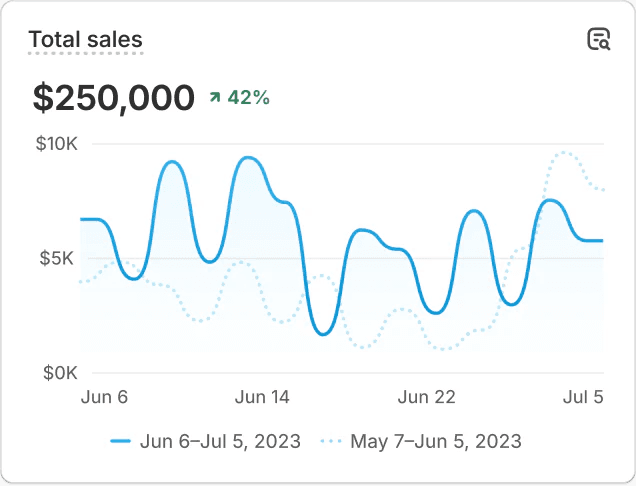
TOTAL SALES VS. PREVIOUS PERIOD


Where we look for friction
We look at the whole route from first visit to completed order, and at the parts of the store your team maintains every day. The improvement can sit in the front end, in the data behind it or in how the store is managed. Areas we typically investigate:
Product discovery: categories, search, filters, sorting, collections and merchandising
Product pages: variants, media, sizing, stock, delivery, returns, reviews and cross-sell
Cart and checkout: costs, payment methods, delivery options, error messages and discount logic
Mobile: navigation, thumb reach, form fields, sticky actions and information per screen
Performance: theme, scripts, apps, media, tracking and external services
International: differences in language, currency, delivery and payment method per market
B2B self-service: account activation, reorders, order history and price context
Speed is part of the experience, but it is not a separate trick. A performance change gets a measurable hypothesis and must not quietly break critical functionality or tracking. Checkout changes stay within what Shopify and your plan currently allow. For business customers, we tie findings to your Shopify B2B set-up and the integrations behind it.
Evidence before opinions
Before we recommend anything, we check whether events, revenue, consent and core funnels are reliable enough to base decisions on. Decisions made on broken analytics create false certainty. We use Shopify Analytics, GA4 and qualitative sources according to one measurement model, with definitions, filters, periods and ownership written down.
We choose metrics per problem, not one generic conversion rate. A search problem needs different evidence than a checkout problem, and a B2B reorder flow is judged differently again. Depending on the question, we combine commercial, behavioural and operational metrics, such as:
Product view to add-to-cart, cart to checkout and checkout completion
Revenue per session and average order value
Search success and the share of searches without results
Filter use and use of size or fit information
Account activation and repeat orders from business customers
Release lead time, error rate and manual order corrections
Every result is reported with segment, period and source. An average can hide opposite effects between mobile and desktop, or between markets and customer types. That is why we compare groups, and why no single headline conversion rate decides whether a change stays live.
Ongoing development as a delivery model
Improvement stalls when loose requests decide the roadmap. We work from one prioritised backlog in which every item has evidence, scope, an owner and acceptance criteria. Work is designed, built, tested and released in reviewable parts, at a rhythm that fits your internal review capacity and your commercial calendar.
As a Shopify agency, we keep research, UX/UI and development in one team. A recommendation is not handed over to developers who have to reconstruct the context. We use native Shopify features, existing components or apps where they are enough, and build custom only where it demonstrably adds value. Larger design changes follow the same principles as our store design work.
Flatline and your team agree who decides on priority, design, code, data, QA, release and results. A retainer without that division of roles quickly becomes a pile of tickets. Capacity goes to the backlog, not to whoever asks loudest, and priorities are reviewed together at fixed moments.
How the CRO cycle works
Measurement and data quality. We check whether events, revenue, consent and funnels are measured reliably, and fix what is broken before anyone draws conclusions from the numbers.
Diagnosis. To find the cause, we combine funnel and segment analysis with search behaviour, service and return reasons, usability research, session analysis where consent allows, technical errors and stock context.
Prioritisation. Each hypothesis gets a problem, evidence, expected outcome, required capacity, risk, measurement method and owner. We rank by expected value, evidence, reach, effort and reversibility.
Design and development. The team that did the research also designs and builds the change. Native Shopify features, existing components or apps come first, custom code only after that.
Test or controlled rollout. An A/B test when traffic allows and the choice matters, a phased rollout for operational risk, before-and-after analysis with stated limits, or a direct fix for clear bugs.
Learn and follow up. We document the outcome, its limitations and differences per segment, then decide to implement, iterate or stop. What we learn goes back into the backlog and the design system.
Optimisation in practice




Want more from your Shopify store?
Share your store URL and what you want to improve. We look at your storefront and data and come back with the first areas where we see room to convert more.


