Seven Signs Your Disconnected Systems Are Quietly Costing You Sales

By Robin Laseur

Some weeks the friction is obvious: an order cancelled because the last unit sold in store an hour earlier, a finance person matching numbers across three screens, a stock figure nobody fully trusts. What is less obvious is whether all of that traces back to one root cause, disconnected systems, or whether you are looking at unrelated problems with cheaper fixes. This is a diagnostic you run against your own operation to tell the difference. Work through the seven signs below, score honestly, and you will know whether your systems are the actual problem or a convenient thing to blame. It is built to give you a clear no as readily as a clear yes.
How to use this checklist
Read each sign and tick it only if it is true in a normal week, not on your single worst trading day. One bad afternoon proves nothing. A pattern that repeats is the signal.
Two of the seven signs carry more weight, because they are the symptoms that are hard to produce unless multiple systems are holding separate versions of the truth. Those two are marked, and each counts double when you score.
Each sign also lists the look-alike: a different cause that produces the same symptom and is not a systems problem. Before you tick a sign, check that the look-alike is not the real story. That is the part most “signs you need to sync” checklists leave out, and it is the part that keeps this one honest.
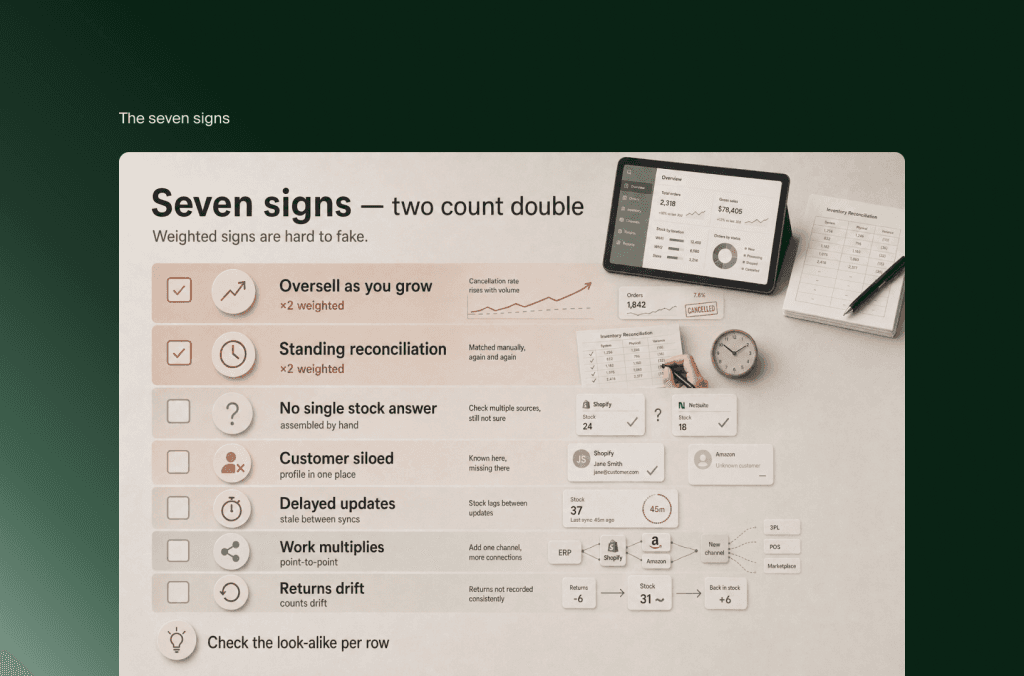
The seven signs
1. You oversell more as you grow, not less (weighted)
What you would notice: cancellations and apologetic “actually, that sold out” emails climbing as volume rises, rather than settling as you get more organised.
What disconnected systems would be doing: each sales channel is reading its own copy of the stock number, so the same unit gets promised twice before either system tells the other it is gone. More volume means more chances for the copies to disagree.
The look-alike: genuine stockouts from thin safety stock or an unreliable supplier. The tell is physical. If the unit was truly gone when you sold it, that is a supply problem. If it was physically present but already committed to another order, that is a systems problem.
2. Reconciliation is a standing job, not an exception (weighted)
What you would notice: someone spends hours most weeks matching stock, orders, or payments across systems, and the job never goes away.
What disconnected systems would be doing: with no single source of truth, reconciliation is the manual labour that fills the gap between systems that each believe something slightly different. It is a recurring tax, not a project.
The look-alike: an inherently complex finance operation, for example multiple legal entities or currencies, that would need reconciliation regardless, or a one-off cleanup after a migration. The tell is whether you reconcile because different systems disagree, or because the business itself is structurally complex.
3. Nobody can answer “how many do we have?” from one place
What you would notice: to get a real stock figure, someone checks two or more systems and still hedges the answer.
What disconnected systems would be doing: there is no authoritative record, so the true number is assembled by hand from partial ones, and the assembly is never quite current.
The look-alike: the number does live in one adequate system, but staff have not been trained to find or trust it. The tell is whether one system actually holds the truth and people do not know where, or whether no system holds it at all.
4. Your best customer is a stranger in one channel
What you would notice: a customer who spends heavily online is invisible to store staff, or an in-store regular has no history when they buy on the site.
What disconnected systems would be doing: customer records are siloed per channel, so the profile exists in one place and cannot be seen from the other.
The look-alike: you simply never set up customer profiles at the point of sale, or a consent setting is limiting what shows. The tell is whether the data is captured somewhere but not shared, or never captured in the first place.
5. A sale in one place shows up everywhere on a delay
What you would notice: stock and orders update after a wait, and you have learned to distrust the numbers until an overnight or hourly sync has run.
What disconnected systems would be doing: separate systems exchange data on a schedule rather than sharing one live record, so between updates they disagree, and any sale made against the stale side is made against a number that is already wrong.
The look-alike: the operational data is live, but a report is cached, so only the dashboard looks stale. The tell is whether the number that decides a sale is delayed, or only the number you read in a report.
6. Every new channel multiplies the manual work
What you would notice: adding a marketplace, a store, or a wholesale line did not just add volume, it added a new source of errors and a new thing to reconcile.
What disconnected systems would be doing: each channel is wired to the others point to point, so every addition multiplies the connections that have to be kept in step rather than plugging into one shared record.
The look-alike: ordinary onboarding friction that settles once the new channel beds in. The tell is whether the extra work went away after setup, or became permanent and grew again with the channel after it.
7. Returns and transfers quietly knock your counts off
What you would notice: after a run of returns or a stock transfer between locations, the numbers drift and need correcting.
What disconnected systems would be doing: a return re-adds stock and a transfer moves it, and if those state changes are handled outside a shared record, or written back to the wrong place, the count stops matching reality.
The look-alike: a receiving or logging process that staff are not following, so the drift is a training gap rather than a systems one. The tell is whether the process is being followed and the number still drifts, or the process is being skipped.

What your answers mean
Score one point for each sign you ticked, and remember that signs 1 and 2 count double.
0 to 2 points.
Disconnected systems are probably not your main problem. The friction you feel is more likely coming from a look-alike, supply, forecasting, configuration, or training, and that is where a fix will pay off fastest. Solving an integration problem you do not have is expensive and will not touch the real cause.
3 to 5 points.
There is real friction, but it is not yet clear whether the cause is architecture or one of the look-alikes stacked together. Work through the look-alikes for each sign you ticked and fix the cheap ones first. If the symptoms survive that, the case for a systems cause gets stronger.
6 or more points, or both weighted signs ticked.
Disconnected systems are the likely root cause. The pattern is structural rather than incidental, and it is the kind of problem that gets worse with growth rather than better. At that point the useful question changes.
Before you blame the systems
The reason this checklist weights two signs and lists a look-alike for every one is that “our systems are disconnected” is an easy and expensive conclusion to jump to. Plenty of lost sales come from problems that a new platform or integration would not fix: a supplier who runs late, a forecast that misses a spike, a team working from an adequate system nobody trained them on, a report that lags while the live data is fine.
A real diagnosis rules those out before it rules integration in. If most of your ticks turn out to be look-alikes on closer inspection, that is a useful result, not a failed one. It means the money is better spent elsewhere, and you have avoided treating a training or supply problem as an architecture problem.
If the signs point to your systems
If you scored high and the look-alikes did not explain it away, you have named the problem: your systems hold separate versions of the truth, and the gaps between them are leaking sales and time. That is worth knowing clearly.
It is not, by itself, an instruction to act. Whether disconnected systems are worth solving now is a separate decision that depends on the size of the leak and where your business is heading, and it is the right next question to ask rather than jumping straight to a fix. Naming the problem is what this checklist is for. Deciding what it is worth is the step after.
Key takeaways
The checklist is a diagnostic, not a verdict. It is designed to return a clear no as readily as a yes, so you do not treat every operational problem as a systems one.
Tick a sign only if it is true in a normal week, and check the look-alike first. Signs 1 and 2, rising oversells and standing reconciliation, carry the most diagnostic weight.
A high score points to disconnected systems as the root cause. A low score points you toward cheaper fixes: supply, forecasting, configuration, or training.
Naming the cause and deciding whether it is worth solving are two different steps. This checklist does the first. The second depends on the size of the problem and your direction.
FAQ
How do I know if overselling is a systems problem or a supplier problem?
Check whether the unit was physically present when you sold it. If it had genuinely run out, the cause is supply or forecasting. If it was on the shelf but already committed to another order that a second channel could not see, the cause is disconnected systems reading separate stock counts.
Can disconnected systems cost me sales even if I never oversell?
Yes. Overselling is only the most visible symptom. Showing an item as out of stock when it is actually available in another location loses the sale silently, and siloed customer data costs you the repeat purchase you could not personalise. Lost sales from disconnected systems are often the ones you never see.
What is the difference between systems that are synced and systems that are unified?
Synced systems are separate and exchange data on a schedule, so they disagree between updates. Unified systems share one record, so there is nothing to reconcile. Most of the seven signs are symptoms of syncing rather than sharing, which is why the delay and the drift keep coming back.
Related articles


