Unified Commerce for Scaling D2C Brands: When It’s Worth It (and When It Isn’t)

By Robin Laseur

For most scaling D2C brands, unified commerce is not a yes-or-no question. It is a timing question. The honest answer is that it becomes worth it when a specific set of operational conditions turns up in your business, and it is an expensive distraction before those conditions exist. This guide names those conditions so you can place yourself: whether unified commerce is a now-problem, a soon-problem, or a not-yet-problem, and why. It is written for operators weighing the decision, not for anyone who has already decided and wants an implementation plan.
What “unified commerce” means here, and what it doesn’t
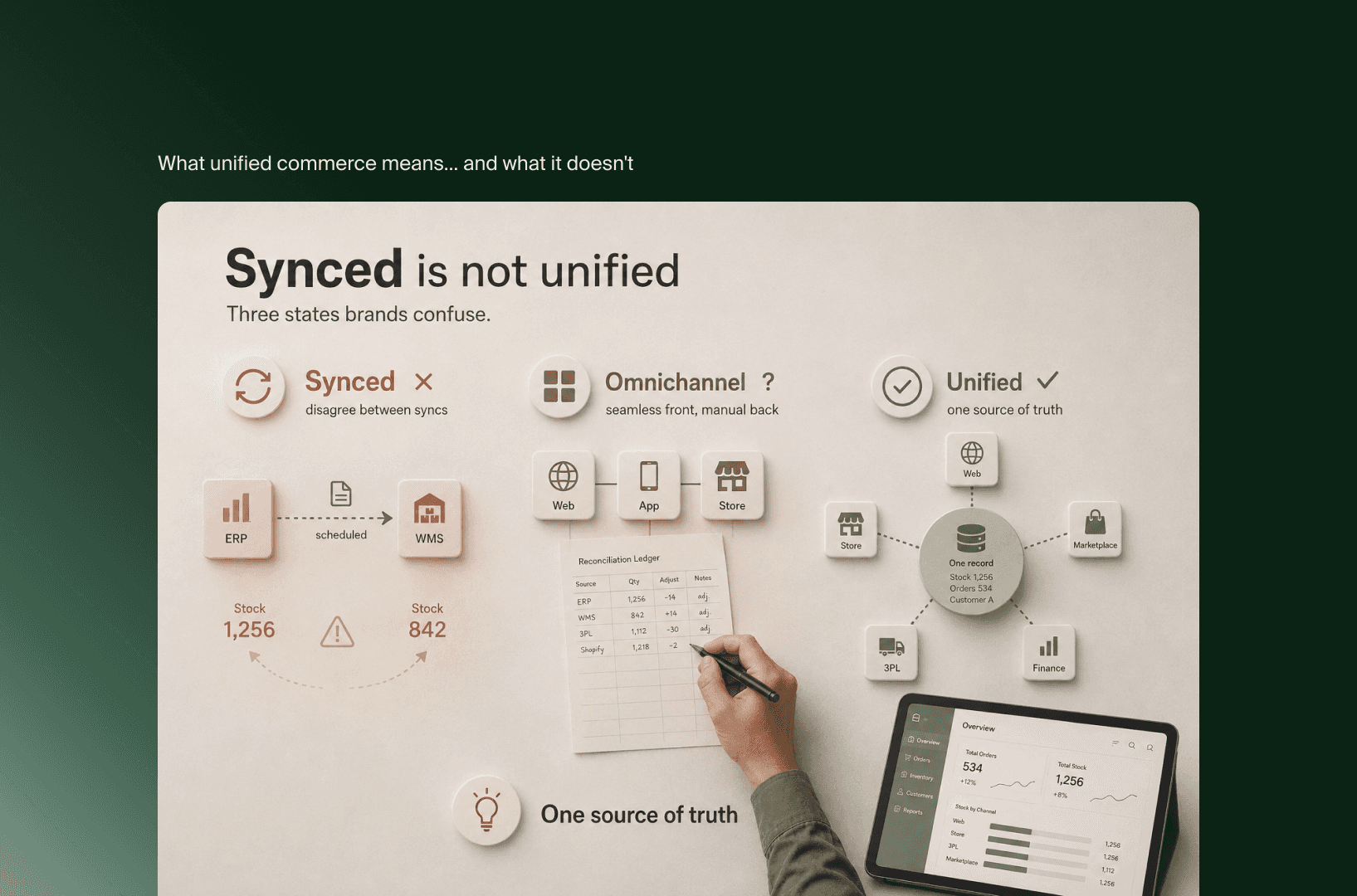
Unified commerce means running every sales channel and the back-office systems behind them on one source of truth, so a single stock number, order record, and customer profile is shared everywhere instead of copied between systems. The distinction that matters for this decision is the one against omnichannel. Omnichannel makes the customer experience feel connected across web, app, and store. Unified commerce connects the systems underneath, so the numbers the customer sees are the same numbers your finance team, warehouse, and store staff are working from.
There is a third state that gets mistaken for unified commerce and quietly causes most of the trouble: synced. Two systems that exchange data on a schedule are synced, not unified. Between syncs they disagree, and the gap is where oversells and reconciliation work live. If your stack is a set of point-to-point connectors passing files back and forth, you have sync, and the question in this article is whether the jump to unified is worth making. For the full definition and the omnichannel comparison, our unified commerce explainer covers the ground; the rest of this guide assumes you know what it is and are trying to decide whether you need it yet.
The case vendors make, and the part of it that holds up
The pitch for unified commerce is consistent across every platform selling it: fewer oversells, faster reconciliation, one customer view, and higher growth. Some of that is measurable and worth taking seriously.
The most credible external read comes from the 2026 Global Unified Commerce Benchmark, run by Manhattan Associates with the research firm Incisiv, which assessed more than 400 specialty retailers on 330 capabilities based on real purchases and returns. It found that only 7% of retailers reached the “Leading” tier while a third were still “Basic,” and that leaders were growing at close to twice the rate of the basic group. It also found that 38% of the capabilities that set leaders apart in 2024, including real-time inventory visibility, had become table stakes by 2026.
Read carefully, that data supports a more useful conclusion than the headline. The growth gap is a correlation, not a proven return: Manhattan did not disclose actual growth rates, and the retailers in the leading tier tend to be larger, better-resourced operations that were already positioned to both grow and invest. So the benchmark does not show that adopting unified commerce doubles your growth. It shows that the operators who benefit most are already operating at meaningful scale, and that the baseline of what counts as competent is rising over time. Both of those are directly relevant to whether the investment fits you now.
The payments side tells the same story from a different angle. Adyen reports that 31% of businesses still run separate payment platforms for online and in-store, and 42% do not let customers shop easily across channels, which is a fair proxy for how common fragmentation still is. Its widely cited customer example, the retail group True Alliance, reported saving over a million dollars a year after unifying, having consolidated reconciliation from manual per-method files into one file that feeds its ERP. That is a real number, but it belongs to an operation running roughly 100 stores across many brands. The size of the prize scaled with the size of the mess.
The variables that decide whether it’s worth it now
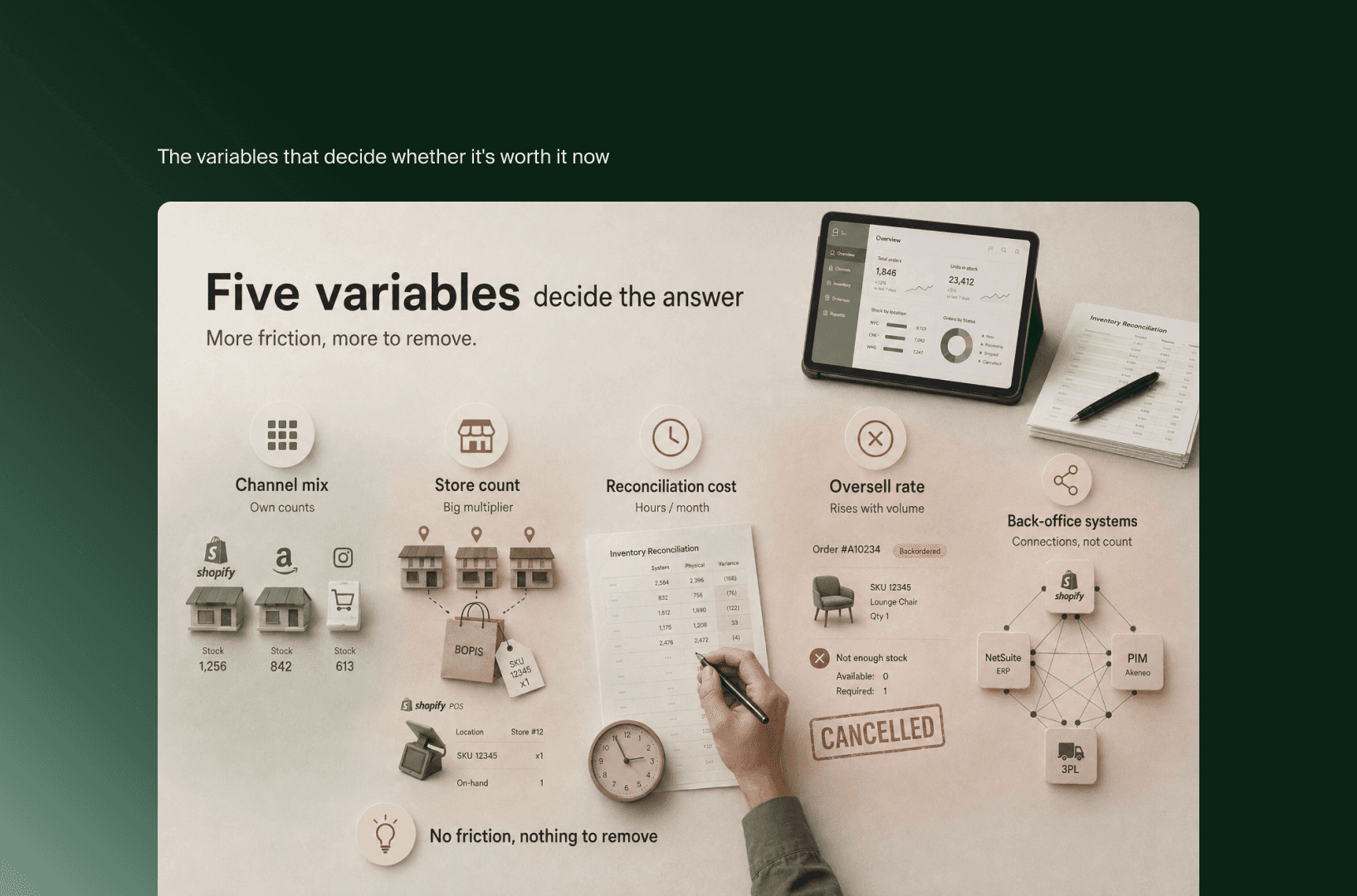
The reason “is unified commerce worth it” has no universal answer is that the value comes from removing specific, quantifiable friction. If that friction is small in your business, the investment has little to remove. Five variables account for most of the difference.
Channel mix
A brand selling through one storefront and one fulfilment path has almost nothing to unify. Value climbs with each channel that holds its own version of stock or customer data: a second web store, a marketplace, wholesale, retail, social checkout. Every added channel that reads a separate count is a source of disagreement.
Store count and physical footprint
Physical retail is the single biggest multiplier. The moment you have stores, the same unit can be promised online and sold in person, and the reconciliation between the two stops being trivial. One store makes this a manageable annoyance. Three or more, especially with buy-online-pickup-in-store or ship-from-store, makes it a standing cost.
Reconciliation cost
This is the most honest signal because you can measure it. Count the finance and operations hours spent every month matching orders, payments, and stock across systems, plus the manual corrections. If that number is small, unified commerce is solving a problem you do not have. If it is a recurring drain that grows every time you add a channel, it is the strongest single argument for acting.
Oversell rate
Track how often you sell something you cannot fulfil and have to cancel or delay. A low, tolerable rate is a cost of doing business. A rate that is rising with volume, damaging customer trust and eating margin in refunds and goodwill, is the friction unified commerce exists to remove.
Back-office system count
Count the systems that need to agree: commerce platform, POS, ERP or accounting, PIM, warehouse or 3PL, marketplace connectors. Point-to-point integration cost does not grow with that number, it grows with the connections between them, which multiply. Two or three systems are cheap to connect directly. Past four or five, the connector web becomes its own maintenance burden, and consolidating onto one source of truth starts to look like the cheaper path over time.
Where the line sits: the point it starts paying for itself
The threshold is not a revenue figure, and any article that gives you one is guessing. It is the point where the recurring cost of staying fragmented overtakes the one-time cost of unifying, and where your trajectory means that gap widens rather than closes.
In practice, unified commerce crosses into worth-it-now when three things are true at once. First, your reconciliation and oversell costs are no longer trivial and are trending up with volume, so the pain compounds rather than holds steady. Second, you are adding channels or locations faster than point-to-point integrations can keep pace, so each new connection makes the last set more fragile. Third, the number of back-office systems that must agree has passed the point where connecting them directly is cheaper than consolidating them.
When all three hold, waiting has a cost that grows on its own. The reconciliation hours do not plateau, the oversells do not self-correct, and the connector web gets more expensive to maintain with every addition. That is the case for acting, and it is specific to your numbers rather than borrowed from a benchmark.
When it’s a later-problem, or not your problem at all
The opposite case is just as important, because adopting unified commerce early is a real and common mistake. It carries the cost of an integration or replatforming programme, the disruption of a cutover, and ongoing platform commitments, in exchange for removing friction that is not yet material at your scale.
If you are a single-channel D2C brand with one fulfilment partner, no physical stores, and reconciliation that a person handles comfortably in a few hours a month, unified commerce is a later-problem. The money is better spent on demand, product, and conversion until the operational friction actually shows up. Buying the enterprise-shaped solution before the enterprise-shaped problem exists is how brands end up paying for capability that sits idle.
There is also a boundary worth naming for Shopify merchants specifically. A store-plus-online brand running on native Shopify with POS may already have a good deal of unified behaviour without a separate platform or a heavy custom build. Where the native setup stops being enough is a genuine question, and it turns on location count, fulfilment complexity, and how deeply an ERP or OMS is involved. That boundary deserves its own answer rather than a line here, so treat “do I need a dedicated platform, or is my current stack already enough” as the next question to resolve before assuming you need to buy anything.
The cost of getting the timing wrong, in either direction
The reason to reason this through rather than follow the market is that both errors are expensive, and they are opposite errors.
Move too early and you carry the full weight of a unification programme, integration or replatforming work, cutover risk, and platform lock-in, to solve friction that is small at your size. The savings that justify the spend, the reconciliation hours and oversell losses, are not large enough yet to earn it back. You have bought a solution ahead of the problem, and the capital and attention are gone.
Move too late and the opposite bill arrives. Reconciliation labour compounds quietly, month over month, as a tax nobody chose. Oversells climb with volume and erode the customer trust that is hardest to rebuild. And the baseline keeps rising: the Manhattan benchmark’s finding that a large share of yesterday’s differentiating capabilities are now table stakes means the operational floor your buyers expect moves up whether or not you do. Waiting past your own threshold does not hold costs steady, it lets them grow while the standard you are judged against climbs.
The point of the threshold is to spend the money once, at the moment the recurring cost of fragmentation clearly exceeds the one-time cost of fixing it, and not before.
Placing yourself: now, soon, or not yet
You can reach a defensible verdict without a spreadsheet by reading your own numbers against the variables above.
You are probably a now: multiple channels including physical retail, three or more locations or active cross-channel fulfilment, reconciliation that costs real recurring hours and is rising, an oversell rate that is climbing with volume, and four or more back-office systems that have to agree. The friction is material and compounding, and unifying removes a cost you can already measure.
You are probably a soon: a growing channel mix, a first store open or planned, reconciliation that is becoming a noticeable chore, and a system count approaching the point where connectors are getting fragile. Nothing is on fire, but the trajectory points at the threshold. This is the moment to plan the move deliberately rather than under pressure, and to understand what a unified build actually requires before you commit to one.
You are probably a not-yet: one or two channels, no physical stores, reconciliation handled comfortably, oversells rare, and a small back-office footprint. Unified commerce is solving a problem you do not have. Revisit the question when two or more of those conditions change, not before.
If you land near a boundary, the decision is worth pressure-testing against your real reconciliation cost and channel roadmap rather than a benchmark. As a Shopify Platinum Partner with a long integration and unified-commerce track record, Flatline can talk through the now-versus-later call for your specific stack, with no obligation to build anything.
Key takeaways
Unified commerce is a timing decision, not a universal upgrade. It becomes worth it when specific operational friction turns up, and it is an expensive distraction before then.
The external evidence points to scale as the condition. Leaders in the 2026 Manhattan and Incisiv benchmark grow faster, but they are already large, and the headline savings in vendor cases belong to operators with many stores and brands.
Five variables decide the answer: channel mix, store count, reconciliation cost, oversell rate, and the number of back-office systems that must agree.
The threshold is the point where the recurring cost of staying fragmented, and its upward trajectory, exceeds the one-time cost of unifying.
Both timing errors are costly and opposite. Too early buys capability you cannot use yet; too late lets reconciliation and oversell costs compound while the standard you are judged against rises.
FAQ
Is unified commerce worth it for a small business?
Usually not yet. If you sell through one or two channels, have no physical stores, and handle reconciliation comfortably, unified commerce removes friction you do not have. The investment fits once channel mix, store count, or reconciliation cost grows enough that fragmentation becomes a recurring, rising cost.
What is the difference between unified commerce and omnichannel?
Omnichannel connects the customer experience across channels so it feels consistent. Unified commerce connects the systems behind those channels onto one source of truth, so stock, orders, and customer data are the same everywhere. Omnichannel can look seamless to the shopper while the back office still reconciles by hand.
How do I know when I have outgrown my current setup?
Watch three signals: reconciliation hours that rise every time you add a channel, an oversell rate climbing with volume, and a set of point-to-point integrations that get more fragile with each new system. When those are trending up together, you have reached the threshold where unifying costs less than continuing to patch.
Related articles


F.A.Q.

Is unified commerce worth it for a small business?
Usually not yet. If you sell through one or two channels, have no physical stores, and handle reconciliation comfortably, unified commerce removes friction you do not have. The investment fits once channel mix, store count, or reconciliation cost grows enough that fragmentation becomes a recurring, rising cost.
What is the difference between unified commerce and omnichannel?
Omnichannel connects the customer experience across channels so it feels consistent. Unified commerce connects the systems behind those channels onto one source of truth, so stock, orders, and customer data are the same everywhere. Omnichannel can look seamless to the shopper while the back office still reconciles by hand.
How do I know when I have outgrown my current setup?
Watch three signals: reconciliation hours that rise every time you add a channel, an oversell rate climbing with volume, and a set of point-to-point integrations that get more fragile with each new system. When those are trending up together, you have reached the threshold where unifying costs less than continuing to patch.