Unified commerce: The strategic imperative for eCommerce in 2026

By Robin Laseur

In 2026, unified commerce will no longer be just industry jargon or a lofty goal, it will be the backbone of any scalable eCommerce operation. Unified commerce means integrating all sales channels, inventory, orders, and customer data into one cohesive system. Unlike traditional omnichannel or multichannel setups, a unified platform provides a single source of truth for all business data. This 360-degree “business brain” ensures that inventory levels, pricing, and customer profiles are synchronized in real time. In practice, this eliminates frustrating problems like a customer seeing a product “in stock” online only to find it’s unavailable at pickup, which leads to angry support queues and lost lifetime value. As we’ll see, tackling these fragmentation issues is essential: leading brands that adopt unified commerce report significantly higher growth and lower costs.
In this article you’ll learn:
What unified commerce really is (and why omnichannel falls short)
The hidden cost of fragmented commerce stacks
Why 2026 is the tipping point
How enterprise brands should approach unified commerce strategically
What is unified commerce (and how it differs from omnichannel)
Unified commerce is often confused with omnichannel, but the two are fundamentally different. Omnichannel strategies focus on giving customers a consistent experience across multiple channels (online, mobile, social, in-store). However, omnichannel storefronts often still run on disconnected back-end systems, requiring complex middleware and manual reconciliations. By contrast, unified commerce unites the back end as well. In a unified model, all sales channels eCommerce site, physical POS, marketplaces, social media, run on a single native platform.
Aspect | Omnichannel | Unified Commerce |
Platform & Integration | Multiple disconnected systems (POS, eCom, CRM, Inventory) with custom connectors | All channels operate on a single native platform |
Customer Data | Scattered and unsynced across tools and touchpoints | One unified customer profile across all interactions |
Inventory & Pricing | Inconsistent stock levels and pricing across channels, risk of overselling | Real-time inventory and pricing synced across all sales channels |
Fulfillment & Orders | Order workflows vary per channel | All orders managed from one dashboard with smart fulfillment routing |
Customer Experience | Appears consistent, but backend may be misaligned | Fully consistent from storefront to backend |
Decision-Making | Fragmented reporting, limited customer journey visibility | Unified analytics enabling full-funnel, real-time insights |
Scalability & Cost | Complexity grows with scale, leading to high overhead | Centralized system delivers faster time-to-market and operational efficiency |
This difference is critical. As Shopify explains, omnichannel data “lives in separate systems requiring complex, custom-built integrations,” whereas unified commerce means “all channels are built on a single native platform, providing one source of truth for all data in real time”. For the customer, omnichannel may feel seamless, but for the operations team, data silos remain. Unified commerce breaks down those silos:
Centralized inventory and pricing: Stock levels update instantly everywhere. For example, if someone buys a pair of shoes online, the inventory is removed from all systems before another customer can purchase it. Discounts and promotions also apply uniformly across channels.
Single customer profile: Every interaction, in-store purchases, online browsing, email clicks, feeds into one unified customer record. Staff can recognize a VIP shopper instantly, no matter which channel they use.
Unified order and fulfillment: Orders from any channel are managed in one dashboard, so logistics can optimize across warehouses and stores. Smart routing automates shipping decisions (closest location, cost-effective node, etc.) to save time and money.
Built-in analytics and AI: With all data in one place, predictive analytics can forecast demand and personalize experiences in real time.
In short, unified commerce means one cohesive technology stack instead of a patchwork of point solutions. It’s why Shopify now themes its releases around #Unified, signaling a push toward integrated platforms.
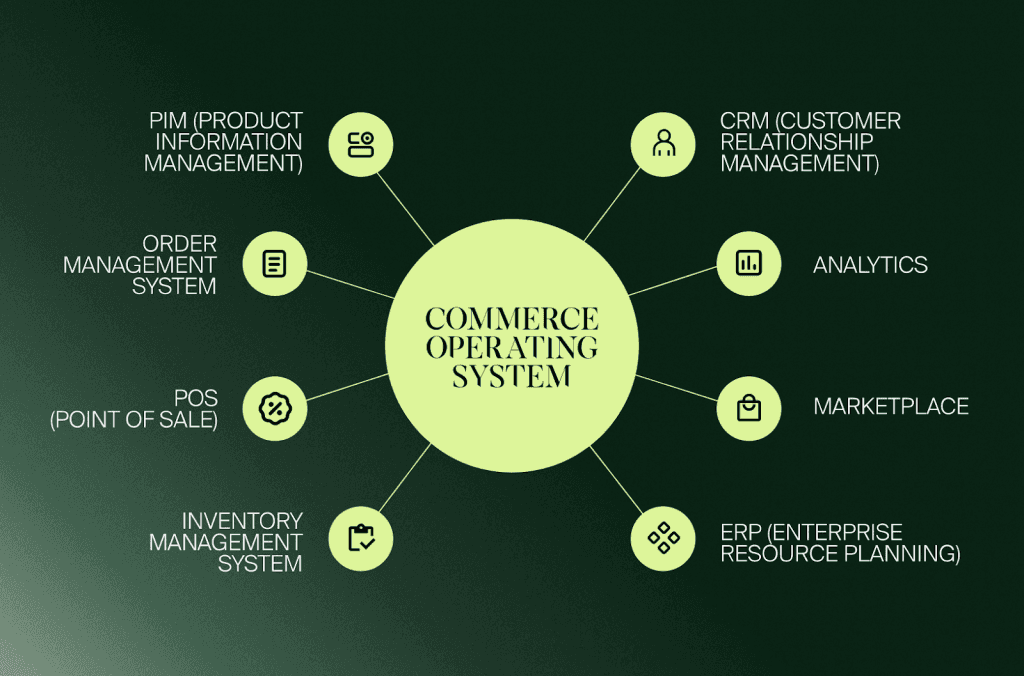
For enterprise brands, the difference is stark: after moving to a unified platform, one retailer saw a 40% year-over-year sales jump in markets with physical stores while only one employee managed both online and offline channels. Training time halved and teams could easily offer services like “buy in store, ship to home” thanks to real-time inventory and customer insights.
The hidden costs of fragmented systems
Brands with fragmented, siloed architectures pay a steep price:
Disjointed customer data: In a fragmented system, data from eCommerce, POS, CRM, and marketing live in silos. This means your teams never see the full customer journey. A Shopify retail study describes a common scenario: a customer who spent $2,000 online walks into a store and is treated like a stranger, because their online history isn’t connected to the in-store system. That’s not a training issue; it’s a technology one. Without unified commerce, every channel can feel like a separate business, missing upsell and loyalty opportunities.
Inventory confusion and oversells: Separate inventory systems often “flag” stock in one place that isn’t actual. The Shopify blog gives an all-too-familiar example: a shopper sees sneakers on sale online and pays, then finds out at pickup they don’t exist. This triggers refunds, angry customer outreach, wasted marketing spend, all because the systems couldn’t “agree” on stock. In other words, disconnected systems drive customer frustration and lost revenue.
Operational inefficiency: Managing multiple platforms creates a constant maintenance burden. Industry analysts call this the “fragmentation tax.” Every extra integration adds complexity. Shopify reports that juggling 7–10 different marketing and sales tools is common, but it fragments insights and slows decisions. The result: developers and IT teams spend days just fixing integration bugs or updating deprecated connectors, rather than building new features. Store managers waste hours on duplicate data entry and training across systems. New product launches stall while teams manually patch workflows.
Costly inertia: A complex stack drags businesses down. Shopify’s research shows unified-architecture retailers implement solutions ~20% faster and have about 22% lower total cost of ownership. Without unification, every change or new channel requires custom work. In the Modern Retail report, Shopify executives note large retailers abandoned legacy systems because “it takes months just to deploy a new payment method” whereas on Shopify it’s “a click of a button”. That means agile competitors can outperform slower incumbents.
In bullet form, the fragmentation tax takes many forms:
Technical overhead: Endless patching, broken APIs, vendor management. Teams end up “trapped in maintenance” instead of innovation.
Operational friction: Duplicate data entry across tools, confusion over promotions, and steep training curves for staff on disjointed software.
Market drag: Longer time to launch new products, inability to quickly adapt pricing or collections, and customer frustration with inconsistent experiences.
Innovation deficit: Budget and attention flow into fixing glue code instead of strategic growth. Every dollar on middleware is one not invested in new capabilities.
These costs compound as brands grow. In one case, a retailer had to literally close stores during online sales because its separate systems couldn’t sync fast enough, risking oversells. Once unified, that retailer said Shopify’s “holistic experience” made it possible to operate without “clunky workarounds”. The lesson: scattered architectures not only waste resources today, they impede every growth step.
Why 2026 is the tipping point
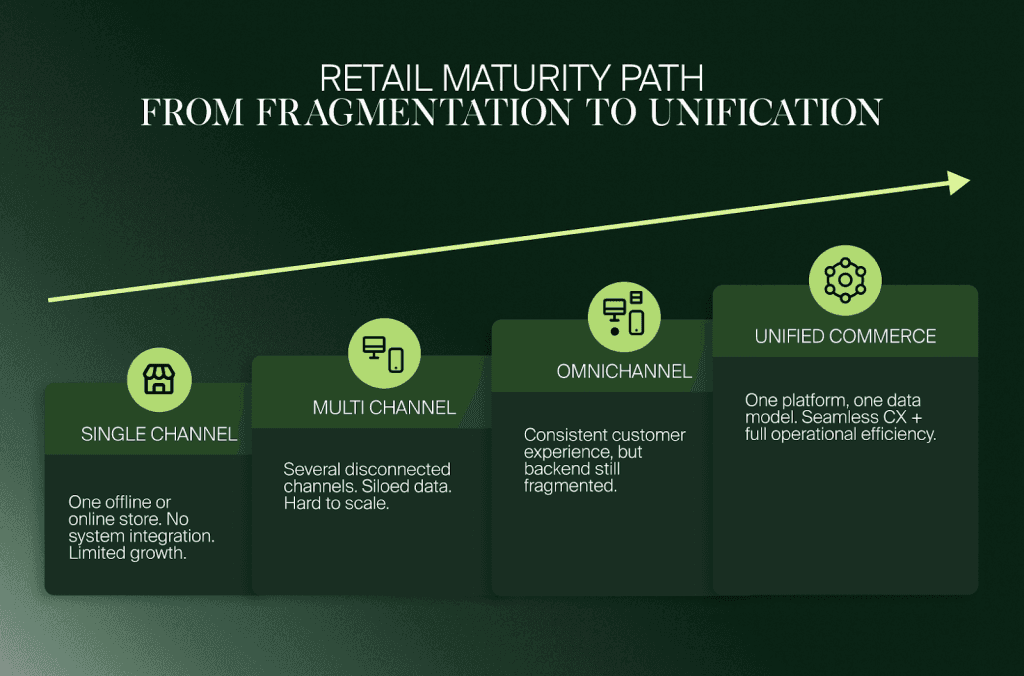
Several powerful trends converge around 2026 to make unified commerce urgent:
AI and data maturity: By late 2025, over 90% of retailers will be investing in AI to some extent. AI and machine learning are reshaping consumer expectations, personalization, chatbots, dynamic recommendations are table stakes. But AI only works well on clean, connected data. As Crystallize put it: “Success now relies on a unified data foundation that supports AI-driven personalization and conversational commerce”. Leading companies already see that the gap between AI “pilot projects” and truly transformative AI comes down to having a unified architecture and executive focus. By 2026, brands without integrated data will struggle to leverage AI effectively (and risk falling further behind competitors who can instantly tailor experiences).
Personalization expectations: Consumer demand for tailored experiences is skyrocketing. Adobe’s research finds 71% of customers expect brands to anticipate their needs with personalized offers, and 78% demand seamless movement between channels. Fragmented systems simply cannot deliver. With unified data, brands can create a true 360° customer view: merge every click, purchase, and interaction into one profile and respond in real time. Retailers that did this saw an average 8.9% lift in annual sales. In the next few years, that difference could be the margin between winning and losing a customer to the competition.
Omnichannel consumer habits: Shoppers today fluently switch between Instagram, web, chat, and the physical store without noticing seams. Industry analysts at NRF 2025 noted customers now expect brands to be one continuous experience. Any friction (out-of-sync inventory, delayed offers, siloed loyalty rewards) leads to immediate abandonment. Paradoxically, even minor glitches in service are no longer tolerated. For scaling brands, meeting this expectation requires unified operations.
Rising complexity costs: As products, markets, and regulations become more complex, the “cost of complexity” skyrockets. Gartner and EY have shown retailers save about 22% in total costs of ownership by unifying commerce systems. And those savings grow as scale grows. Meanwhile, those clinging to disjointed legacy stacks face ever-higher technical debt with quantified risks like security vulnerabilities and compliance issues piling up. In other words, continuing on a fragmented path only becomes more expensive and risky each year.
Economic pressures: The mid-2020s are marked by recessionary fears and tight budgets. Organizations must “do more with less.” Shopify’s partners note that AI assistants and unified automation can significantly ease these pressures. For example, AI chatbots and sidekick tools are rapidly evolving to handle routine inquiries and data tasks. But without unified platforms, even these efficiencies are limited: AI agents need reliable, singular data feeds to automate processes end-to-end. In short, unified commerce is what allows advanced automation to truly pay off.
In summary, by 2026 the competitive and technological environment demands unified commerce. When industry research shows 99% of retail executives agree that unified commerce improves profitability and sales growth, yet most have not achieved it at scale, it’s clear this is both a gap and an opportunity.
Unified Commerce: A business necessity, not a buzzword
It’s tempting to dismiss any industry catchphrase as a passing trend. But unified commerce is fundamentally different: it’s a strategic business model, not a marketing buzzword. A unified commerce platform provides the consistent foundation that makes all other strategies work faster and cheaper.
As one analysis puts it, the retail world has “crossed a tipping point where fragmented architecture is unprofitable”. In practice, unified commerce replaces a “Frankenstein stack” of point solutions with one cohesive system. The benefits compound as scale increases. For example, Shopify data shows that mid-size retailers on a unified platform report 8.9% higher sales growth and 16% lower tech spend, on average. Every day of delay means continuing to pour money into duplicate systems and missed revenue.
Strategic roadmap to unified commerce
For enterprise leadership teams, the question is no longer if to pursue unified commerce, but how. The solutions are strategic and high-level, focusing on direction rather than tactics:
Recenter your technology stack: Begin by evaluating whether your core commerce platform supports true unification. Leading platforms like Shopify Plus, by design, integrate eCommerce, POS, inventory, and customer data natively. If a full replatform isn’t immediately feasible, prioritize investments that close the biggest gaps: a shared inventory system or a unified customer data platform (CDP) to unify records from all channels.
Unify your data model: Establish a single customer profile and inventory ledger. This means breaking down departmental data barriers so that marketing, sales, and support all see the same view of the customer. It also means connecting warehousing, eCommerce, and store systems to a shared inventory database. Real-time synchronization is key, even a few-minute lag in stock data can cost sales.
Embrace automation and AI: With unified data as the foundation, leverage automation to reduce manual work. Advanced commerce tools (like Shopify Flow and external AI services) can automate everything from inventory replenishment to personalized campaigns. Strategically, this means redirecting talent to innovation rather than routine tasks.
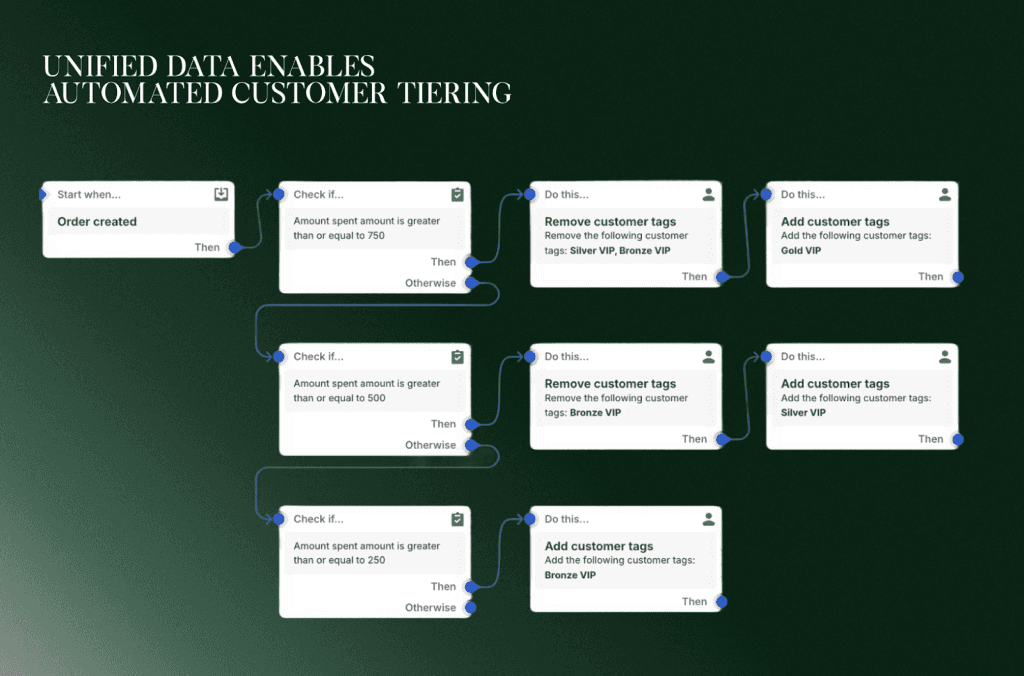
This automation uses Shopify Flow to dynamically tag customers into Bronze, Silver, or Gold VIP tiers based on their spending history, fully powered by unified data across channels.
Build an agile architecture: While unified commerce centralizes core operations, it doesn’t preclude flexibility. Consider composable or headless patterns where appropriate: a unified commerce platform can expose APIs that let marketing teams innovate on the frontend or connect new channels without breaking the data model.
Governance and Change Management: True unification is as much an organizational shift as a technical one. Leadership should designate cross-functional governance, ensuring product, marketing, and operations align on data definitions, customer segmentation, and fulfillment rules. Consider appointing a Chief Commerce Officer or similar role to bridge these silos.
Each of these strategies is a roadmap milestone, not a discrete how-to. They demand executive sponsorship. But the payoff is immense: organizations with unified commerce gain speed and coherence. They can launch new market expansions or product lines quickly (since markets can be managed from a single dashboard), personalize promotions globally, and adapt inventory across channels in hours, not weeks. In contrast, leaders tied to fragmented systems often find strategic initiatives constantly stalled by integration firefights and data clean-up.
Flatline’s perspective and expertise
As a Shopify Platinum Partner, Flatline Agency has a front-row seat to the challenges and breakthroughs of unified commerce. We don’t just build stores, we build infrastructure. From POS to fulfillment, we ensure enterprise brands run on a connected, resilient architecture. Our approach is end-to-end, stitching together platforms, tools, and data flows to create one cohesive system.
We’re also a Master Platinum Partner with Klaviyo, enabling personalized communication at scale. Klaviyo’s integration with unified customer profiles lets brands trigger timely, automated messaging across email and SMS, without relying on fragmented lists.
Flatline’s strategy and consulting practice is grounded in diagnostics: we evaluate where legacy systems create friction, where teams are duplicating effort, and where automation can unlock time. For marketing and CRM, we also implement HubSpot for brands needing advanced customer workflows, especially in omnichannel B2B environments. As an official Gold Partner, we help unify sales, marketing, and service under one roof.
In CX, we help brands centralize support across channels with full customer context from unified profiles. For fulfillment and returns, Returnista lets retailers streamline shipping, automate notifications, and manage exchanges seamlessly, completing the post-purchase loop.
Our automation team also leverages Shopify Flow and custom integrations to eliminate repetitive tasks. For example, we’ve helped brands auto-tag VIP customers, trigger reorder alerts based on inventory, and build end-to-end return workflows that connect CX and logistics.
Client work reflects this philosophy. One global retail client reduced fulfillment complexity by consolidating warehouse logic and smart routing inside Shopify. Another cut 40% of tech spend by removing middleware and standardizing on one stack. Whether it’s launching new channels or scaling to new markets, we ensure unified commerce is not a buzzword, but a foundation for growth.
Conclusion
For enterprise and scaling eCommerce brands, unified commerce is no longer a nice-to-have. It’s a strategic imperative for 2026. By breaking down silos between channels, data, and operations, unified commerce enables seamless customer experiences and huge efficiencies. Bringing that unification to life is squarely the work of an experienced ecommerce agency, one that can connect POS, storefront, and data layers into a single operating model. Brand leaders must recognize this shift: delayed unification means paying an ever-higher fragmentation tax.
Flatline Agency stands ready to help make unified commerce a reality. As Shopify Platinum Partners and commerce experts, we guide brands through planning, integration, and automation. We ensure that by 2026 you’re not chasing one-off fixes, but operating on a cohesive platform that scales gracefully. The future of retail is unified and the time to act is now.
Related articles


