A replatform that pays for itself: sequencing migration around revenue, not features

By Robin Laseur

A revenue-sequenced replatform migrates the highest-earning paths of the store first, so each phase returns money that helps fund the next, instead of moving the whole platform at once and waiting for revenue to follow at the end. The alternative, feature-led migration, ships the entire platform as a single project and treats revenue as the thing that happens after launch. It is the version most likely to run long, cost more than the quote, and stake the whole store’s revenue on one cutover date. Sequencing by revenue turns a migration from one large bet into a series of smaller, self-funding moves. The method is to rank the store’s revenue paths, migrate the biggest first behind a measurable baseline, and let each phase’s result pay toward the next.
This piece assumes the decision to move has already been made, and it is the honest one: the platform is the constraint, not the process or the build, and holding costs more than moving. What remains is the question most migration advice skips past on its way to redirect maps and data validation, which is what to migrate in what order. That order is not a technical detail. It decides whether the project returns money while it runs or only after it ends, and that single difference is what separates a migration that reads as an investment from one that reads as a cost the business absorbs and hopes to recover.
Feature-led and revenue-led are different projects
The default way to sequence a migration is by feature, because that is how quotes and project plans are built. The scope lists everything the current platform does, the new build works toward parity with that list, the whole thing cuts over on one date, and revenue is measured after launch. It feels orderly, and it is how most migrations are structured, but it has a specific shape of risk: nothing returns until everything is done, the entire store’s revenue rides on a single cutover, and the cost is fully spent before the first euro of return arrives. If the project runs long, which migrations tend to, the overrun lands entirely on the cost side of the ledger, because the return side has not opened yet.
Revenue-led migration inverts the order. It identifies what actually earns, moves that first, measures the result immediately, and expands from there. The store is not migrated in one act but in phases ranked by how much each contributes to revenue, so the highest-earning paths are on the new platform earliest and the long tail follows. The two approaches produce the same end state, a fully migrated store, but they are different projects in every way that matters to a CFO: one returns nothing until the end and everything rides on one date, the other starts returning on the first phase and never puts more than a fraction of revenue on any single cutover. The feature-led version optimizes for completeness. The revenue-led version optimizes for the project paying its own way as it goes.
Start by ranking what earns
The revenue-led approach begins with a ranking the feature-led one never produces: the store’s revenue by path, not by feature. In most stores revenue concentrates heavily in a few places, a handful of top categories, the highest-earning customer segment, the one or two markets that carry the volume, the flows that convert the most. Map revenue to those paths and rank them, largest first. That ranking, not a feature checklist, is the migration backlog.
The reason this ranking is the right backlog is that it orders the work by return. The highest-earning path migrated first puts the largest block of revenue onto the new platform soonest, which does two things at once: it starts the return early, and it proves the new platform on the revenue that matters most before anything low-stakes is touched. You are validating the migration where the money is, at the point in the project where you still have the most room to respond if something needs adjusting. A discovery that has already mapped the data model, the integration surface, and the commercial rules gives you exactly the inputs this ranking needs, because you cannot sequence by revenue path until you know which systems and rules each path depends on. The ranking is where discovery output becomes a migration plan.
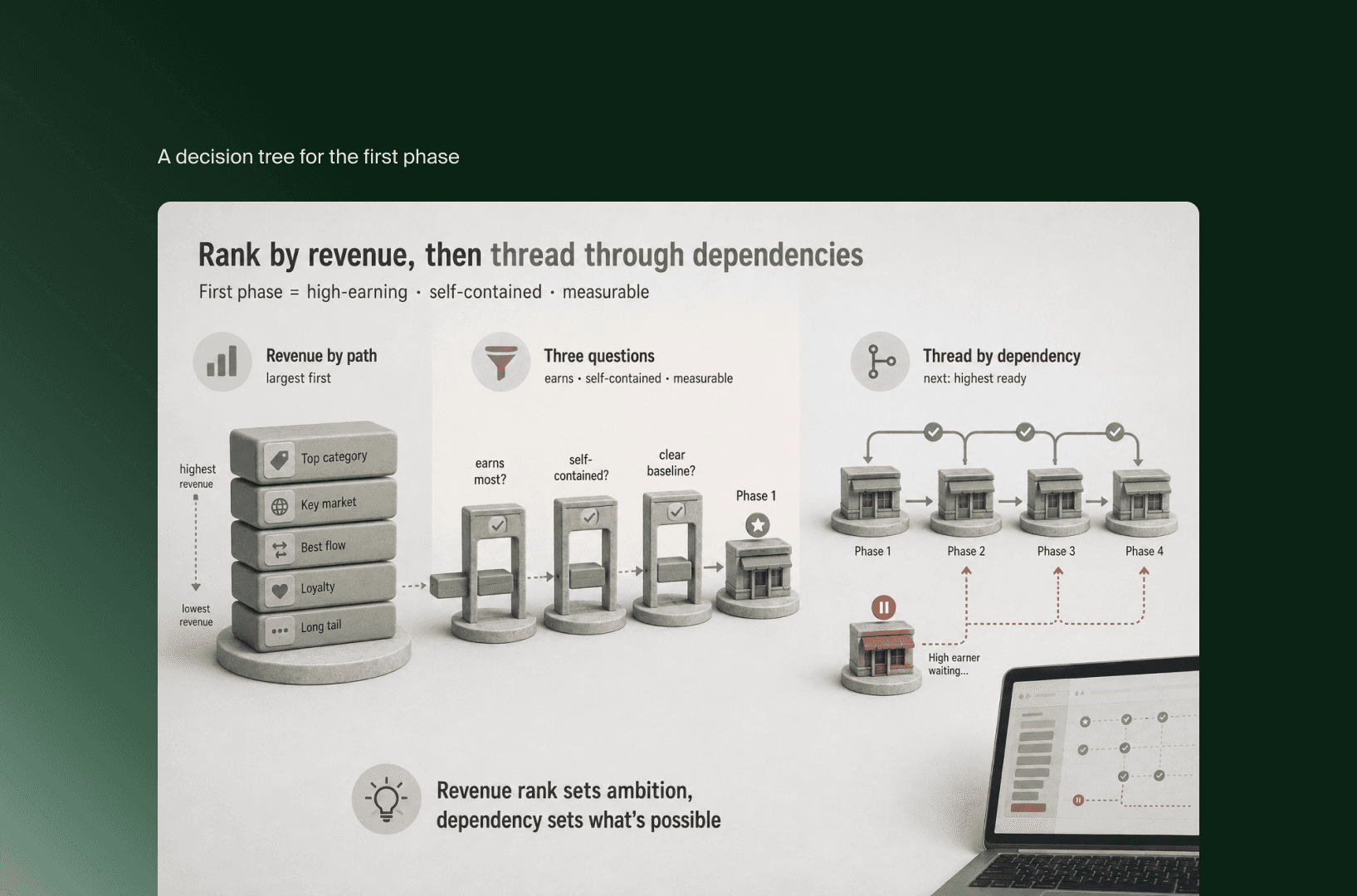
A decision tree for the first phase
Ranking by revenue gives you the priority, but priority alone does not set the sequence, because paths have dependencies. The first phase is chosen by running three questions in order against the ranked list.
First, which path earns the most. That is the default front of the queue, because it returns the most soonest. Second, of the top-earning paths, which is the most self-contained, meaning it depends least on systems, data, or integrations that have not been migrated yet. A high-earning path that requires three unmigrated systems to function cannot go first; the most self-contained high earner can. Third, which path has the clearest baseline to measure against, because a phase you cannot measure cannot make the case for the next one. The first phase is the path that best satisfies all three: high earning, self-contained, measurable.
Then the tree repeats. Each subsequent phase is the next-highest-earning path whose dependencies are now in place, because earlier phases have migrated the systems it needs. Revenue rank sets the ambition; dependency order sets what is actually possible next; the sequence is the interaction of the two. This is why the order is not obvious from the revenue ranking alone, and why sequencing is a genuine planning exercise rather than a sort: you are threading the highest-return path through the constraint of what each phase makes possible for the next. Shopify’s own enterprise guidance treats phased migration as the risk-reducing default for exactly this reason, that moving in dependency-aware stages contains the blast radius of anything that goes wrong.
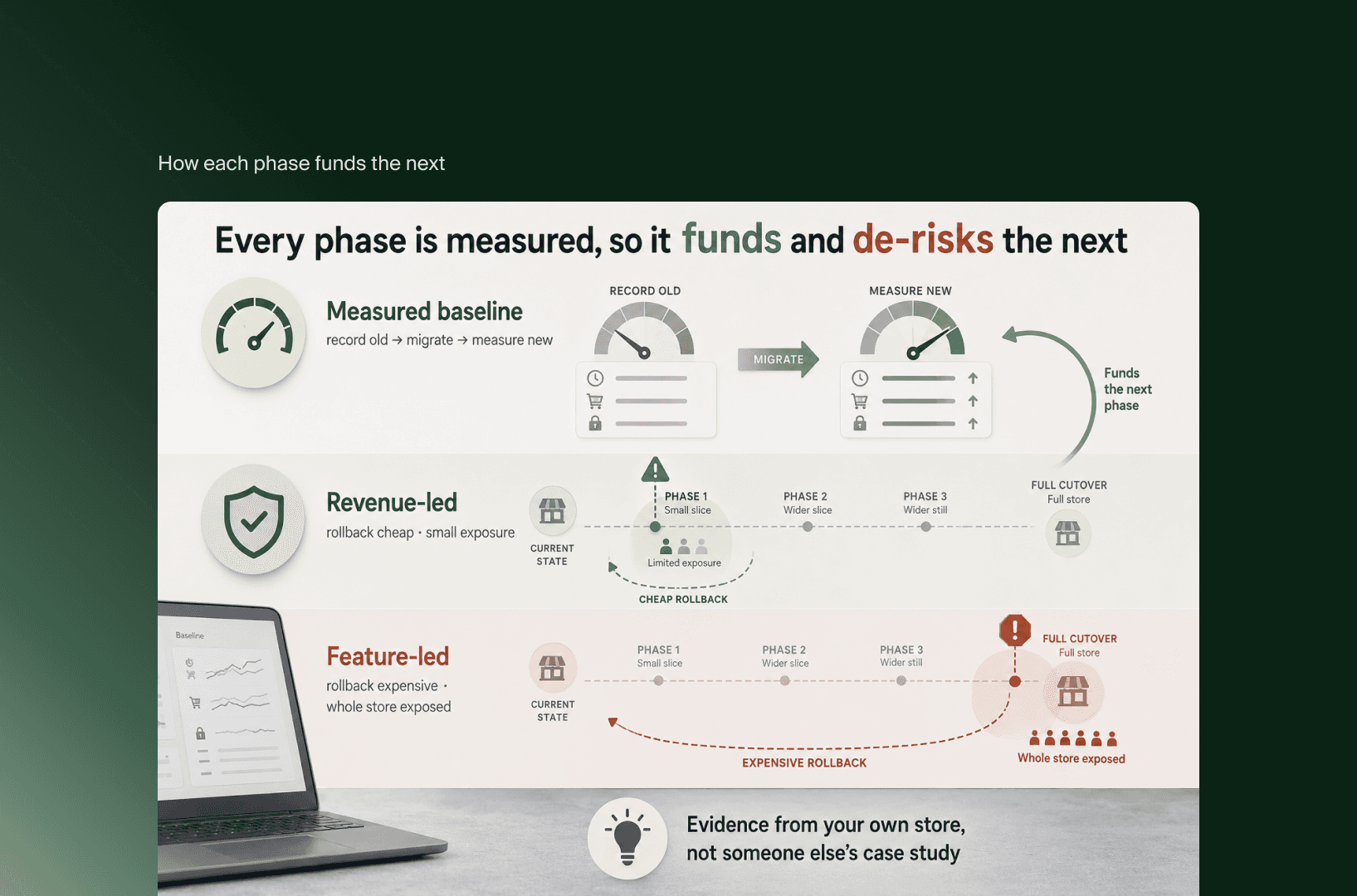
How each phase funds the next
The phrase pays for itself is not a figure of speech here, and the mechanism is the measured baseline. Before a path is migrated, record what it does on the old platform: its revenue, its conversion rate through the relevant steps, its page performance. Migrate the path, cut it over, and measure the same figures on the new platform. A well-executed migration of a high-earning path usually returns something real, faster pages, a cleaner checkout, a capability the old platform blocked, and that measured lift is the funding argument for the next phase, made with evidence from your own store rather than a projection from someone else’s case study. Even a phase that comes back revenue-neutral has earned its place, because it has de-risked the paths that depend on it and shortened the time until the whole store is on the new platform.
Set against the feature-led approach, the advantage is not only financial, it is diagnostic. Feature-led migration produces no measurement until the end, so if the new platform has a problem it surfaces after everything has already moved, on the date the entire store is live, when rollback is most expensive and the cause is hardest to isolate among a thousand simultaneous changes. Revenue-led migration surfaces the same problem on phase one, on the path you understand best, when only a fraction of revenue is exposed and rolling back is cheap. You find out whether the new platform delivers on the revenue that matters most, first, and everything after that is expansion on proven ground rather than a bet still waiting to be settled.
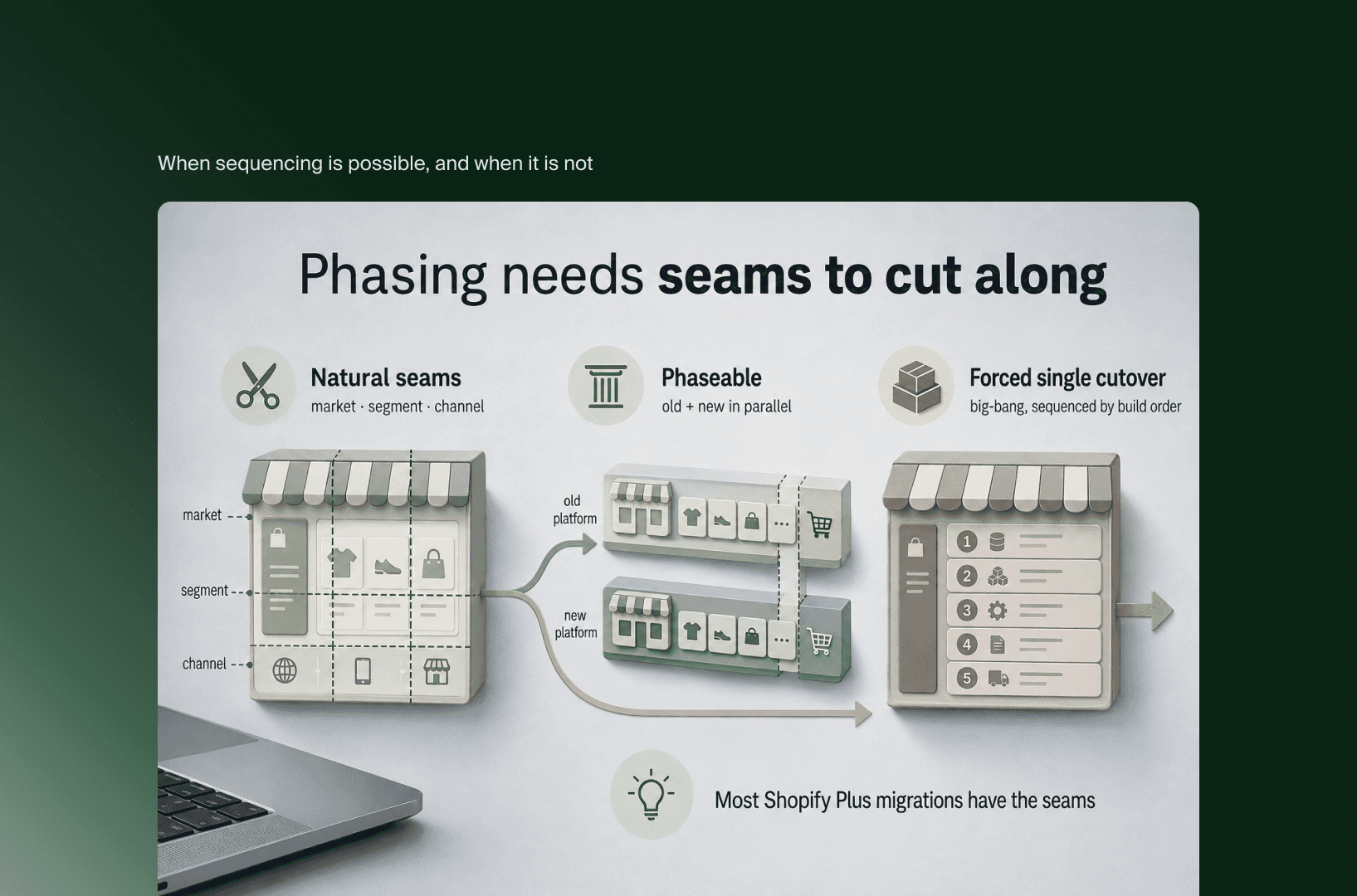
When sequencing is possible, and when it is not
Revenue-sequencing requires a migration that can be cleanly phased, and not every one can. It works when paths can be cut over independently, by market, by catalog segment, by channel, or by customer group, with the old and new platforms running in parallel for a path during its transition. Most Shopify Plus migrations can be phased this way, because markets, catalog structure, and channels give natural seams to cut along. Some migrations genuinely cannot be split, where the data model or the cutover mechanics force an all-at-once move, and in those the honest answer is a single cutover sequenced internally by build order, with the measurement discipline applied to the whole rather than to phases. The point is not that phasing is always available; it is that when it is available, sequencing by revenue rather than by feature is what makes the move an investment instead of a cost, and that most migrations have more room to phase than a feature-led plan assumes.
The decision of whether to move belonged to the earlier question in this cluster; this is the question of how to move once the answer is yes. Sequencing a migration around revenue is the delivery model Flatline uses on Shopify Plus migrations, and as a Shopify Platinum Partner it is how we structure the move so a brand sees return from the highest-earning paths before the long tail is finished rather than after. If you have decided the platform is the constraint and want the migration sequenced so it funds itself as it runs, a migration-sequencing conversation mapped to your own revenue paths and dependencies is the practical next step, and it is one we are glad to have with you.
Sequencing assumes the move is justified, so if that is still open, start with deciding whether to replatform, rebuild or hold.
Frequently asked questions
What is a revenue-sequenced replatform?
It is a migration ordered by how much each part of the store earns, rather than by feature completeness. The highest-earning paths, top categories, key markets, the best-converting flows, move to the new platform first, each behind a measured baseline, so the largest blocks of revenue are migrated soonest and each phase’s result helps fund the next. The end state is the same fully migrated store; the difference is that it returns money while the project runs instead of only after it ends.
How do you decide what to migrate first?
Rank the store’s paths by revenue, then choose the first phase with three questions: which earns the most, which of the top earners is most self-contained (depends least on systems not yet migrated), and which has the clearest baseline to measure. The first phase is the path that is high-earning, self-contained, and measurable. Each later phase is the next-highest earner whose dependencies earlier phases have already put in place.
Can a replatform really pay for itself before it finishes?
In a phased migration, yes, at least partly. Migrating a high-earning path behind a measured baseline usually returns something real, faster pages, a cleaner checkout, a previously blocked capability, and that return begins while the rest of the migration is still underway. It rarely funds the entire project on its own, but it offsets cost as the work proceeds, which is the opposite of a feature-led migration where all cost is spent before any return arrives.
Is phased migration always better than big-bang?
Not always, because not every migration can be cleanly phased. Phasing needs paths that can cut over independently, by market, catalog segment, or channel, with old and new running in parallel during transition. Where the data model or cutover mechanics force an all-at-once move, big-bang is the honest choice, sequenced internally by build order. Where phasing is possible, which is most Shopify Plus migrations, it lowers risk and starts the return earlier.
How do you measure whether a migration phase worked?
Record the path’s figures on the old platform before you move it, revenue, conversion through the relevant steps, and page performance, then measure the same figures on the new platform after cutover. The comparison tells you whether the phase returned a gain, held neutral, or needs attention, on a path small enough to roll back cheaply. That measurement is also what makes the evidence-based case for funding and scoping the next phase.
Key takeaways
A revenue-sequenced replatform migrates the highest-earning paths first, so return begins while the project runs. Feature-led migration ships everything at once and spends all cost before any return arrives.
The migration backlog is the store’s revenue ranked by path, not a feature checklist. Mapping revenue to categories, segments, markets, and flows tells you what to move first.
The first phase is the highest-earning path that is also most self-contained and most measurable. Later phases follow the next-highest earner whose dependencies are already migrated, so sequence is revenue rank threaded through dependency order.
Each phase migrates behind a measured baseline, so its result is evidence, not projection. A high-earning path’s lift funds the next phase; even a neutral phase de-risks what follows and shortens time-to-value.
Phasing needs seams to cut along, by market, segment, or channel, and most Shopify Plus migrations have them. Where a migration cannot be split, big-bang is honest, but sequencing by revenue is what makes a phased move an investment rather than a cost.
Every migration is going to cost what it costs. What sequencing decides is when the return starts and how much of the store’s revenue is exposed on any single day. Order the work by revenue rather than by feature, migrate the biggest earners first behind baselines you can measure, and let each phase make the evidenced case for the next, and the project stops being a large sum spent against a future promise. It becomes a move that starts paying back on the path that matters most, first, and finishes on ground you have already proven.
Related articles


F.A.Q.

What is a revenue-sequenced replatform?
It is a migration ordered by how much each part of the store earns, rather than by feature completeness. The highest-earning paths, top categories, key markets, the best-converting flows, move to the new platform first, each behind a measured baseline, so the largest blocks of revenue are migrated soonest and each phase’s result helps fund the next. The end state is the same fully migrated store; the difference is that it returns money while the project runs instead of only after it ends.
How do you decide what to migrate first?
Rank the store’s paths by revenue, then choose the first phase with three questions: which earns the most, which of the top earners is most self-contained (depends least on systems not yet migrated), and which has the clearest baseline to measure. The first phase is the path that is high-earning, self-contained, and measurable. Each later phase is the next-highest earner whose dependencies earlier phases have already put in place.
Can a replatform really pay for itself before it finishes?
In a phased migration, yes, at least partly. Migrating a high-earning path behind a measured baseline usually returns something real, faster pages, a cleaner checkout, a previously blocked capability, and that return begins while the rest of the migration is still underway. It rarely funds the entire project on its own, but it offsets cost as the work proceeds, which is the opposite of a feature-led migration where all cost is spent before any return arrives.
Is phased migration always better than big-bang?
Not always, because not every migration can be cleanly phased. Phasing needs paths that can cut over independently, by market, catalog segment, or channel, with old and new running in parallel during transition. Where the data model or cutover mechanics force an all-at-once move, big-bang is the honest choice, sequenced internally by build order. Where phasing is possible, which is most Shopify Plus migrations, it lowers risk and starts the return earlier.
How do you measure whether a migration phase worked?
Record the path’s figures on the old platform before you move it, revenue, conversion through the relevant steps, and page performance, then measure the same figures on the new platform after cutover. The comparison tells you whether the phase returned a gain, held neutral, or needs attention, on a path small enough to roll back cheaply. That measurement is also what makes the evidence-based case for funding and scoping the next phase.