The platform isn’t the problem, until it is: signs you have outgrown your ecommerce stack

By Robin Laseur

The signs you have outgrown your ecommerce platform are real, and they are also among the most misread signals in ecommerce, because two very different problems produce the same symptoms. A platform rarely fails loudly. It slows you: releases take longer, workarounds accumulate, and the cost of keeping the stack running creeps upward until it quietly passes the cost of replacing it. Outgrowing a platform is a trend line, not an event. But a rising trend line is not proof the platform is the ceiling, because a large share of what feels like outgrowing is a process, ownership, or customization problem that would follow you to any new platform. The useful question is not “what are the signs,” which every guide already lists, but “is this drift structural, or is it portable.”
This piece is the reframe that question needs. The standard article hands you five or ten signs and points you toward a migration, which is fine when the platform truly is the constraint and expensive when it is not. What follows is how outgrowing actually shows up, as a slope rather than a moment, why the same slope is so often blamed on the platform when the real cause would travel with you, and how to tell the two apart before you commit a year and a budget to moving a problem instead of solving it.
What outgrowing looks like, and the easy conclusion
The symptoms are consistent across every store that has genuinely outgrown its stack, and they are worth naming because they are real. Shipping a change that used to take a day now takes a week. The store runs on a growing stack of apps and custom code layered on to patch things the platform does not do natively. Features the business now needs are either impossible or quoted as major projects. Peak traffic strains the system. The monthly cost of licenses, apps, and developer time to keep everything stable rises year over year. Each of these is a legitimate signal that something is wrong.
The easy conclusion, and the one most content on this topic reaches for, is that the platform has become the ceiling and the answer is to replatform. Sometimes that is exactly right. But the conclusion runs ahead of the evidence, because every one of those symptoms has more than one possible cause, and only some of the causes are the platform. A store can show all of them and be running on a platform that is entirely capable of what the business needs, held back instead by how it is set up, who owns it, or what was built on top of it. Treating the symptom as proof of the cause is how a team spends a year and a large budget migrating to a new platform and arrives to find the same slowness waiting for it, because the thing that was actually slowing them down came along for the move.
Outgrowing is a trend line, not an event
The first correction is to stop waiting for a moment and start watching a slope. Nobody wakes up one morning outgrown. The platform that fit the business two years ago fits it a little less each quarter, as the catalog grows, the channels multiply, the team expands, and the requirements outrun what the original setup anticipated. The drift is gradual, which is exactly why it is easy to miss until it is severe: no single day is dramatically worse than the one before it, so the decline hides in the absence of a crisis.
That means the signal worth tracking is a rate of change, not a threshold. Are releases getting slower quarter over quarter, or is this quarter just busy. Is the workaround pile growing, or did you always have a few. Is the total cost of keeping the stack running, licenses plus apps plus the developer hours spent maintaining rather than building, rising toward the cost of replacing it, or holding steady. The true cost of a maturing stack rarely appears on the platform invoice; it shows up in the engineering backlog, in time-to-launch, and in the revenue the business cannot capture because the store cannot yet do what the moment needs. Measured as a trend, outgrowing becomes visible while there is still time to act deliberately rather than in a panic. But measuring the slope only tells you that something is getting worse. It does not tell you what.

The platform isn’t the problem, until it is
Here is the reframe the title promises, and the reason this diagnosis is harder than a checklist. A slow, drifting, workaround-heavy store feels unmistakably like a platform limit, and yet three other causes produce a symptom set almost identical to a genuine platform ceiling, and none of them is fixed by replatforming.
The first is a process and ownership problem. When no one clearly owns the store, approvals crawl, and the marketing team is locked out of changes they should be able to make, releases slow and frustration builds, and the platform takes the blame for what is actually a workflow. A new platform does not hand your organization a decision-making process; that is a choice you make, not software you install, and the slowness moves with you if the process does not change. The second is self-inflicted customization debt. A store heavily customized against the platform’s natural way of working becomes expensive to change, because every update has to be reconciled with the bespoke code around it, and that expense reads as a platform limitation when it is really the cost of having fought the platform earlier. Rebuild the same bespoke layer on a new platform and you rebuild the same debt. The third is an integration and data problem that lives in the systems around the storefront, an ERP that will not reconcile, product data with no single source of truth, and that dysfunction is often mistaken for a storefront limit even though it would persist behind any storefront. Replatforming to escape a portable problem is one of the most costly errors in ecommerce, precisely because it feels like progress the entire time you are making it.
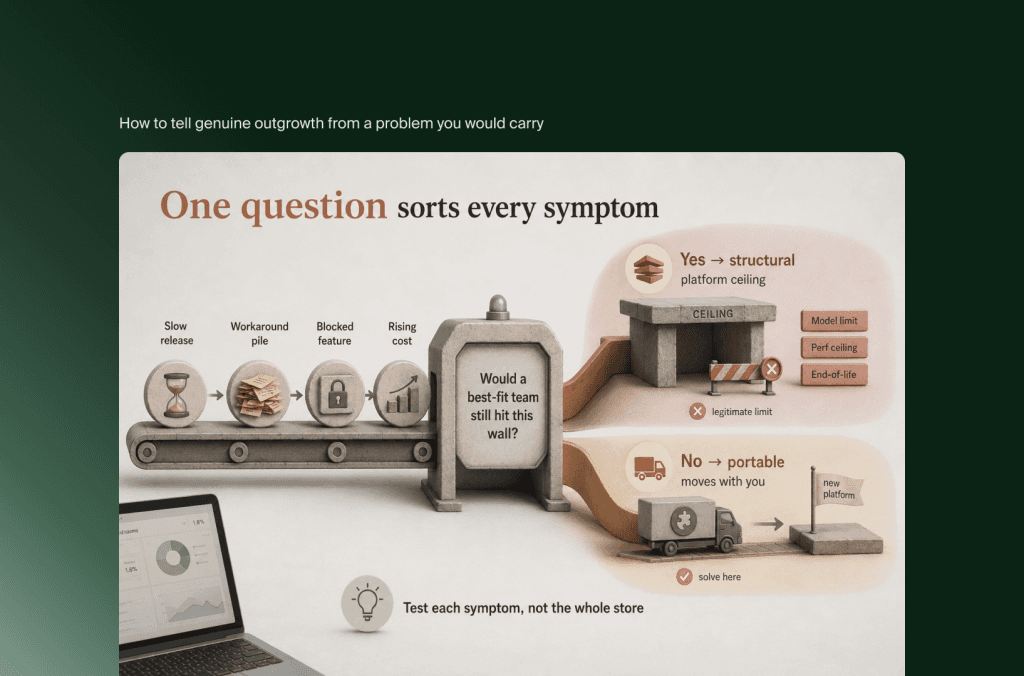
How to tell genuine outgrowth from a problem you would carry with you
The test that separates the two is a single question asked honestly: would a competent team, running on the best-fit platform for your business, still hit this same wall. If the answer is yes, the constraint is structural and the platform genuinely is the ceiling. If the answer is no, the constraint is portable, and moving platforms relocates it rather than removing it.
Applied to each symptom, the question resolves quickly. A feature you cannot ship: is it blocked by the platform’s architecture, or by the custom code you layered on top of it. Slowness: is it architectural, built into how the platform serves pages, or is it accumulated app-bloat and unoptimized customization you could shed. A workaround: does it exist because the platform genuinely cannot do the thing, or because no one has owned building the proper version. Rising cost: is it the platform’s pricing at your scale, or the developer hours your own customization now demands. The structural causes, a platform that truly cannot support the business model you are moving toward, an architecture that caps performance regardless of tuning, a platform at end-of-life or losing security support, are real and they are the legitimate reasons to move. The genuinely Plus-shaped triggers for a growing brand, a wholesale channel that needs real B2B infrastructure, compliant multi-country expansion, subscription mechanics the base plan caps, are structural in exactly this sense: no amount of process fixing makes the current setup do them. The portable causes, process, ownership, self-made customization debt, and system-integration dysfunction, are the ones to solve where they are, because a migration inherits them intact.

When the drift is real: reading the crossover
Put the trend line and the structural test together and the decision resolves into a crossover with two conditions, both of which have to hold. The first is economic: the fully-loaded cost of keeping the current stack, the workarounds, the backlog it creates, and the revenue the business cannot capture because of it, has risen past the cost of replacing it. The second is causal: the constraint driving that cost is structural, the platform itself, and not one of the portable problems a move would carry along. When only the first condition holds, you have an expensive problem that a replatform might not fix. When both hold, the platform has genuinely become the ceiling, and continuing to work around it costs more every quarter than moving would.
That is the moment the title turns on: the platform was not the problem, until the drift crossed from portable into structural and the economics crossed with it. Reaching that point is not a planning error; it is what growth does to a stack that once fit. A business whose complexity has genuinely outrun its platform, a brand running retail and wholesale and multiple markets through a setup that was built for one channel and one country, is not being held back by a process it could fix or a customization it could shed, and for a business at that point a replatform is a substantial, deliberate project worth reserving for exactly this case. It is the pattern behind considered replatforming work with brands whose operational complexity outgrew the original build, names like Mason Garments among them, where the move was made because the platform had become the true constraint, not because a slow quarter made it a tempting one. Read the slope, rule out the portable causes, size the crossover, and the replatform decision stops being a reaction to symptoms and becomes a diagnosis you can defend.
Once the diagnosis is in, the next step is deciding whether to replatform, rebuild or hold, because an outgrown build and an outgrown platform call for different answers.
Frequently asked questions
What are the signs you’ve outgrown your ecommerce platform?
The common signals are slow releases, a growing pile of apps and custom workarounds, features the business needs but cannot ship, strain at peak traffic, and a maintenance cost that rises year over year. These are real, but they are symptoms with more than one cause. The same set can come from a genuine platform limit or from a process, customization, or integration problem, so the signs alone do not tell you whether replatforming is the answer.
Is outgrowing a platform a sudden problem or a gradual one?
Almost always gradual. A platform rarely fails in a single dramatic moment; it fits the business a little less each quarter as the catalog, channels, team, and requirements grow past what the original setup anticipated. Because no single day is much worse than the last, the decline is easy to miss until it is severe. The reliable signal is the trend, whether releases, workarounds, and cost are worsening over time, not any one threshold.
How do you know if it’s the platform or your setup?
Ask whether a competent team on the best-fit platform would still hit the same wall. If yes, the constraint is structural and the platform is genuinely the ceiling. If no, the problem is portable, meaning it comes from your process, your ownership model, your custom code, or your system integrations, and a new platform would inherit it. Test each symptom this way: is the feature blocked by the platform or by your customization, is the slowness architectural or accumulated bloat.
When is replatforming worth it?
When two conditions hold together. First, the fully-loaded cost of staying, workarounds, engineering backlog, and revenue you cannot capture, has risen past the cost of replacing the platform. Second, the constraint causing that cost is structural, the platform itself, rather than a portable process or customization problem. If only the cost condition holds, a replatform may not fix the cause. When both hold, staying costs more each quarter than moving.
Does replatforming fix slow releases and workarounds?
Only if the platform is what caused them. If slow releases come from a workflow with no clear owner, or workarounds exist because bespoke customization made the platform expensive to change, a migration carries those causes with it and reproduces the same symptoms on new software. Replatforming fixes constraints that are built into the platform’s architecture; it does not fix problems that live in your process, your customization choices, or your surrounding systems.
Key takeaways
The signs of outgrowing a platform are real but easy to misread, because a genuine platform limit and a process, customization, or integration problem produce almost identical symptoms.
Outgrowing is a trend line, not an event. Watch whether releases, workarounds, and cost-to-keep are worsening over time, rather than waiting for a crash or a single blocked feature.
The same drift is routinely blamed on the platform when the real cause is portable: a process and ownership problem, self-inflicted customization debt, or an integration and data problem in the surrounding systems.
The test is one honest question: would a competent team on the best-fit platform still hit this wall. Yes means structural and the platform is the ceiling; no means the problem moves with you.
Replatform when both conditions hold: the cost of staying has passed the cost of moving, and the constraint is structural rather than portable. Moving to escape a portable problem relocates it rather than removing it.
The reason “the platform isn’t the problem, until it is” is worth holding onto is that both halves are true and most advice keeps only one. Skeptics who treat every replatform as an overreaction miss the point where drift becomes genuinely structural and staying turns expensive. Enthusiasts who read every slow quarter as proof the platform has hit its limit miss how often the real constraint is one a migration would carry along. Track the slope, separate the structural from the portable, and size the crossover, and you will know which half you are in, which is the one thing a list of signs can never tell you.
Related articles


