Choosing an eCommerce Platform When You Outgrow the First: A Stage-Based Comparison

By Robin Laseur

Feature comparisons are the wrong instrument for this decision, and everyone who has run one knows it. Every enterprise platform can do almost everything on the list, which is why the matrix comes back nearly full and settles nothing. The right platform is not the most capable one. It is the one that fits your catalog, your team, and your next two years, and the comparison changes shape depending on which of those three is actually constraining you.
This piece is about identifying that constraint first. Once you know whether you are catalog-bound, team-bound, or roadmap-bound, the head-to-head comparisons become useful rather than exhausting, because you know which rows in the matrix matter.
Why the feature matrix keeps failing
Three reasons, and they compound.
Capability has converged at the top of the market. Multi-currency, B2B pricing, headless delivery, and composable integration are available in some form nearly everywhere, so a checklist comparison produces a near-tie and the decision falls back to whoever presented most recently.
The costs that decide the outcome are not features. They are the shape of the total cost: licence against infrastructure, agency retainer against internal hires, upgrade cycles against automatic updates, and the speed at which your team can ship a change without a developer. None of that appears in a capability row.
And a platform decision is a decision about your operating model wearing technical clothing. The platform that suits a merchandising team of two shipping weekly changes is not the one that suits an in-house engineering team of eight running a release process. Both are legitimate. They are not interchangeable.
Find your binding constraint first
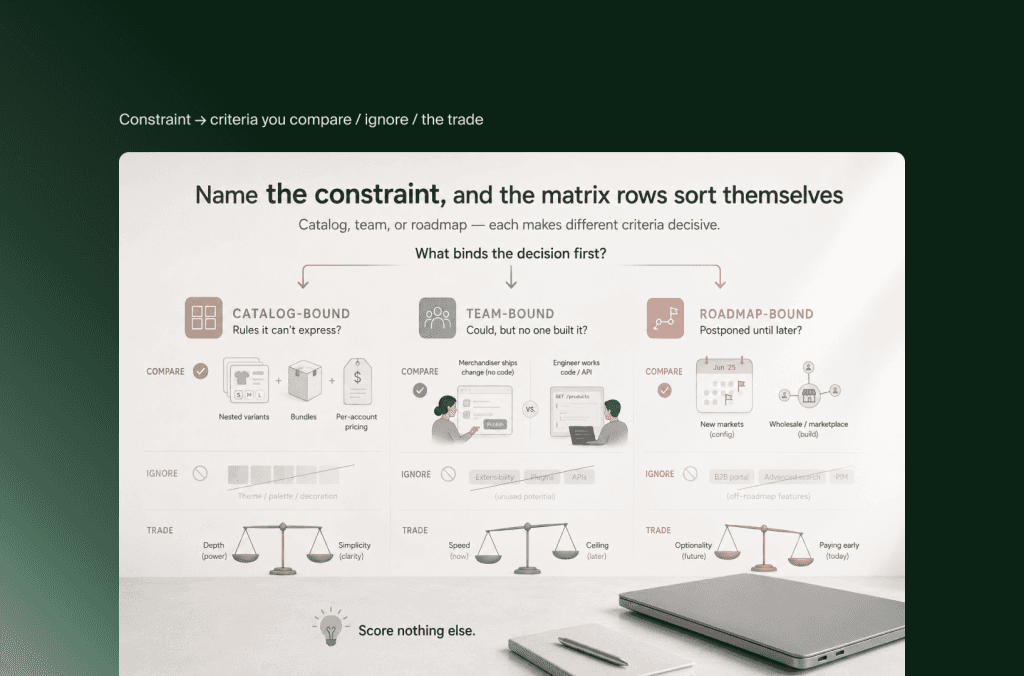
Three constraints, each with a recognisable signature. Most brands have one dominant; some have two.
Catalog-bound. Your commercial model is the complication. Configurable products, kits and bundles, contract pricing per customer, multi-entity structures with different tax and currency treatment, or a wholesale model with entitled catalogs per account. The question is whether a platform can express your commercial reality without a workaround only one person understands.
Team-bound. Your people are the constraint, in either direction. A small commercial team with no engineering capacity needs a platform where merchandisers ship changes themselves. A brand with a real engineering team and a specific product vision needs a platform that gets out of the way. Choosing as though you have the other team is the most expensive version of this decision.
Roadmap-bound. Something specific and dated is coming: three new markets, a wholesale channel, a marketplace, an acquisition to integrate, a subscription model. The question is whether the platform makes those things a configuration or a project.
A quick way to locate yourself: describe the last three things your team wanted to do and could not. If they were commercial rules the system could not express, you are catalog-bound. If they were things the system could do but nobody had time or skill to build, you are team-bound. If they were things postponed until after some larger change, you are roadmap-bound.
What each constraint means for the comparison
The instruction that saves the most time is in the third column. A comparison scored against every criterion equally is a comparison that cannot produce a decision.
The categories, honestly
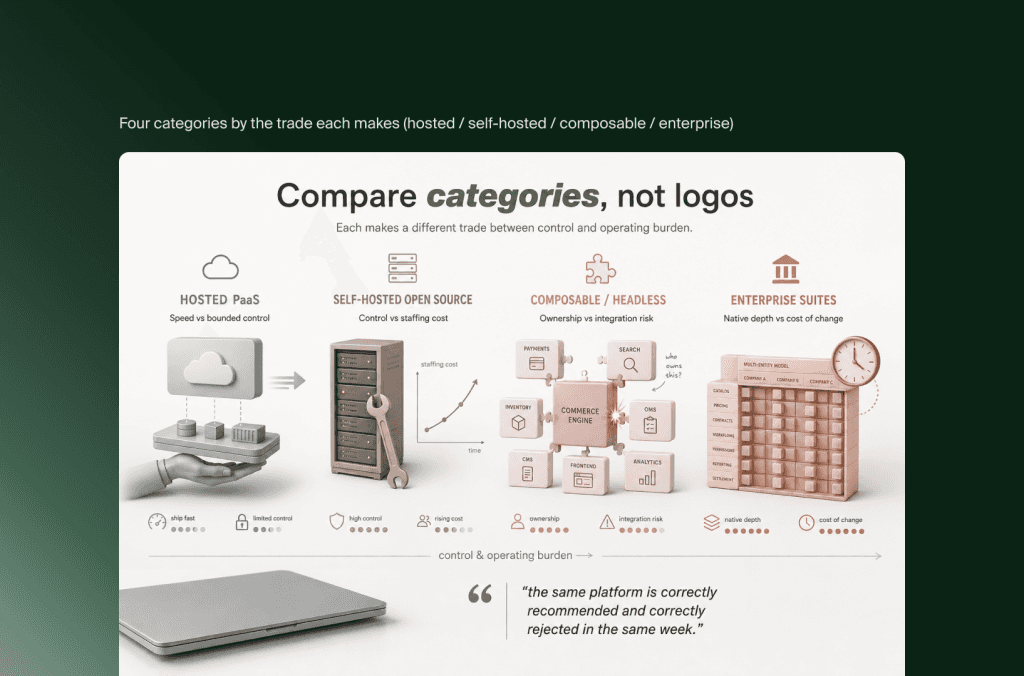
Four categories, described by the trade each one makes rather than by vendor name. Individual products move between these positions over time, which is why the shape matters more than the logo.
Hosted platform-as-a-service. The vendor runs infrastructure, security, and upgrades. Strong for predictable operations, fast time to live, and small teams shipping without engineering. The trade is bounded control: checkout, backend workflows, and data model are extensible within limits that are generous for most brands and real for some.
Self-hosted open source. You control everything and you carry everything: hosting, security patching, upgrades, and the developer capacity to run them. Strong where the commercial model is genuinely unusual or where regulatory and data-residency requirements dictate architecture. The trade is that the total cost moves from a licence line into staffing, and it keeps moving.
Composable and headless architecture. Best-of-breed components assembled around a commerce engine, with the frontend fully owned. Strong for brands with engineering capacity and a distinct product vision, and for complex multi-brand or multi-region structures. The trade is integration ownership: nobody else is accountable when two components disagree.
Enterprise suites. Deep native capability for complex B2B, configuration, and multi-entity operations, with implementation and licence costs to match. Strong where the commercial model is the product. The trade is speed and cost of change.
Where a category fits a given brand depends entirely on the constraint identified above, which is why the same platform is correctly recommended and correctly rejected in the same week.
Where the comparison is currently sharpest
Once you know your constraint, the head-to-head comparisons do the detail work, and the ones worth reading depend on where you are coming from.
Coming off Magento or Adobe Commerce, the substance is in total cost of ownership rather than features. Our analysis of the hidden costs in the Magento versus Shopify comparison covers what actually accumulates: upgrade risk, infrastructure, and the experiments a slow ecosystem prevents you from running.
If pricing structure is your open question, the BigCommerce versus Shopify comparison works through transaction fees and how the arithmetic changed.
If you are in a European market with a Shopware installation, the Shopware versus Shopify comparison frames it as an operating model question rather than a feature one, which matches the argument here.
And for a bespoke build on a developer framework, our Sylius versus Shopify piece covers why migrating off deep custom logic is a different exercise from migrating off a packaged platform.
Read those against the row of the matrix that applies to you, and skip the rest.
When the obvious answer is the wrong one
An honest comparison has to include the cases where the recommendation goes the other way, and there are four worth naming.
Your commercial model is genuinely unusual. Not complicated, unusual. Configured products with dependency rules, industry-specific pricing structures, regulated categories with unusual compliance requirements. Where the model is the business, a platform with deep native modelling of that model can be worth its cost and its slower pace of change.
Data residency or regulatory constraints dictate architecture. Where these are hard requirements rather than preferences, they narrow the field before any commercial comparison starts.
You have a real engineering team and a genuine product thesis. A brand whose competitive advantage is an experience it builds itself, with the people to build and maintain it, is choosing differently from a brand that wants commerce infrastructure to be someone else’s problem. Both are correct.
The platform is not actually your constraint. This is the most common of the four. If the last three blocked initiatives were blocked by unclear ownership or missing data rather than by system limitations, replatforming will reproduce the problem in a new system. Our companion piece on the eCommerce scaling decisions brands reach too late covers how to tell the difference before committing a quarter to the wrong project.
Decision rules
Name the constraint before comparing anything. Catalog, team, or roadmap. If three people in your business name different constraints, that disagreement is the first thing to resolve.
Compare on the four to six criteria your constraint dictates, and score nothing else. A full matrix produces a tie by construction.
Model total cost across three years, not licence cost. Include infrastructure, agency and internal engineering time, upgrade cycles, and the cost of the experiments a slower platform prevents.
Test the roadmap items, not the feature list. Take the three specific things you know are coming and ask each vendor how they would be done, then ask what breaks when the fourth one arrives unplanned.
Choose for the team you have plus one planned hire. Not for the team you might build, and not for the one you had two years ago.
Verify that the platform is the constraint before committing to a migration. Remediation on your current platform is smaller, cheaper, and reversible, and it is sometimes the whole answer.
If platform fit is the open question, a short advisory call narrows it against your constraints. Flatline evaluates platform fit against catalog, team, and roadmap before recommending anything, including the cases where staying put is the right call.
Frequently Asked Questions
How do I know whether we have genuinely outgrown our platform?
List the last three things your team wanted to do and could not, then classify each one. Commercial rules the system cannot express point to a platform limitation. Things the system supports but nobody had time to build point to a team or budget constraint. Things postponed pending a larger change point to sequencing. Only the first category is a platform problem.
Should we go headless when we replatform?
Only if you have engineering capacity to own the frontend and the integrations permanently, and a product reason that justifies it. Headless moves accountability for the experience to your team, which is an advantage when you have a specific vision and a cost when you do not. It is a separate decision from which commerce platform to run, and combining the two decisions is how projects double in scope.
Is total cost of ownership actually different between platforms, or is that a sales argument?
It is different, and the difference sits in categories that are easy to leave out of a comparison: hosting and infrastructure, security patching, upgrade projects, developer time for changes a merchandiser could otherwise make, and the opportunity cost of slow delivery. Model it over three years with your own numbers rather than accepting any vendor’s published comparison, including ours.
Can we delay this decision another year?
Sometimes, and the test is specific. If the platform is preventing dated commercial commitments, delay has a price you can calculate. If it is merely making work awkward, remediation on the current platform usually buys more than a year and costs far less than a migration.
Key Takeaways
Identify your binding constraint before comparing anything. Catalog, team, or roadmap each make a different set of criteria decisive, and a full feature matrix produces a tie by construction.
Compare categories rather than logos. Hosted, self-hosted, composable, and enterprise suites each make a different trade, and individual products move between those positions over time.
Model three-year total cost including infrastructure, engineering time, upgrade cycles, and the experiments a slow platform prevents. Licence comparison is the least informative part.
Verify the platform is genuinely the constraint. If blocked work traces to unclear ownership or missing data rather than system limits, a migration reproduces the problem in a new system at considerable expense.
Platform selection is one of the few decisions in eCommerce that is expensive to make and expensive to unmake, which is an argument for spending longer on the diagnosis than on the demos. A brand that can state its constraint in one sentence will run a shorter, better selection process than one that arrives with a scoring spreadsheet and no thesis.
Related articles


