Sylius vs Shopify: the platform comparison for CTOs who need more than a feature table

By Robin Laseur

When PrestaShop’s new ownership recommended Sylius as the natural migration path for merchants moving off the platform, it put Sylius back in the spotlight. For developers, that recommendation made sense, Sylius is technically serious, Symfony-based, and genuinely API-first. For business stakeholders, it deserves a harder look.
Organisations that built on Sylius three to five years ago are migrating away from it at an increasing rate. Not because Sylius failed them technically, but because the economics of owning a Sylius store at scale reveal a fundamental misalignment: it is a platform built for developers, running inside a business that needs to grow.
The debate surrounding Sylius vs Shopify is crucial for merchants considering their long-term eCommerce strategy. In the Sylius vs Shopify discussion, it’s important to weigh the benefits and limitations of each platform carefully.
Shopify Plus is built for the opposite priority. The engineering complexity is abstracted away. The eCommerce team moves independently. This post covers the Sylius vs Shopify debate honestly; architecture, total cost of ownership, scalability, and the migration path, for CTOs evaluating both platforms and eCommerce directors who suspect the current Sylius investment is delivering diminishing returns.
This article explains:
Why Sylius’ total cost of ownership is significantly higher than it appears on paper
How Shopify’s managed infrastructure eliminates the operational overhead that makes Sylius expensive to run
What the migration path from Sylius to Shopify actually looks like; timeline, SEO risks, and what gets rebuilt
From cost breakdown to migration timeline, this guide covers everything needed to make an informed platform decision.
What Sylius gets right
Understanding the key differences between Sylius vs Shopify can greatly impact the success of your eCommerce operations. When considering Sylius vs Shopify, many factors come into play, including flexibility, cost, and ease of use.
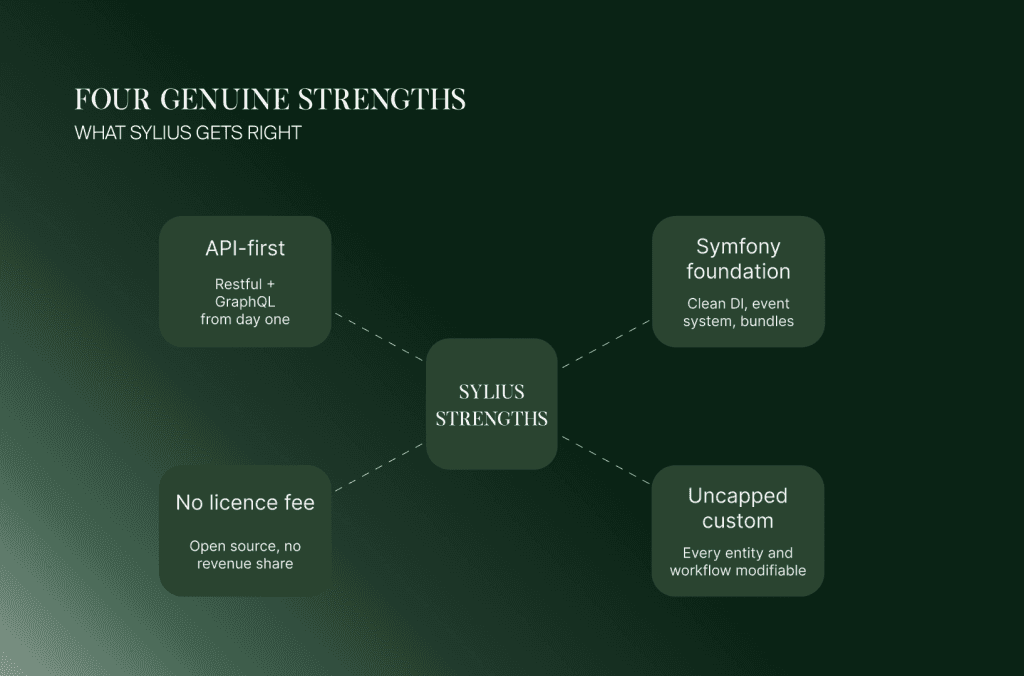
To make a credible case for migrating off Sylius, you need to start by acknowledging what it does well, because the organisations that chose it had good reasons.
Genuinely API-first. Sylius was designed around a clean separation between the application layer and the presentation layer, with a RESTful API and GraphQL layer available from early versions. For teams pursuing a headless or composable architecture, this is well-documented in Sylius’ official architecture and was a genuine differentiator at the time.
Symfony foundation. Sylius inherits Symfony’s dependency injection, event system, and the entire ecosystem of Symfony components and bundles. For organisations already running Symfony applications, Sylius integrates naturally.
Uncapped customisability. Sylius has no meaningful ceiling on what can be modified; every entity, workflow, and business rule can be changed at the framework level. For platforms with genuinely specific requirements, complex B2B pricing, non-standard product configurators, bespoke order flows, Sylius can model almost anything.
Open source, no licence fee. No platform lock-in at the code level, no revenue share on transactions. For organisations with strong engineering teams, this felt like full control.
These are real advantages. The question is not whether they exist; it’s what they cost, and what they preclude.
The Sylius total cost of ownership problem
The Sylius sales narrative, like PrestaShop’s leads with the licence cost of zero. The operational reality is considerably more expensive. Here is where the money actually goes:
Cost category | Sylius (mid-market) | Shopify Plus |
Platform licence | €0 | |
Cloud infrastructure | €800–€3,000/month | Included |
DevOps / server management | In-house or agency retainer | Included, managed by Shopify |
Engineering team (platform maintenance) | 2–4 FTE PHP developers (€160K–€400K/year) | No dedicated platform engineers needed |
Security & PCI DSS compliance | Your team’s responsibility | Level 1, handled by Shopify |
Major version upgrades | Significant sprint cycles per major release | Deployed by Shopify, zero merchant effort |
Estimated annual total | €200,000–€500,000 | ~€28,000 base + apps + dev work |
The more significant cost is not infrastructure, it is engineering hours. Because Sylius is a framework-level platform, every meaningful eCommerce capability is either built in-house or assembled from community bundles of varying quality. Payment integrations, shipping rule engines, promotion logic, customer loyalty systems, B2B account management, none of this comes out of the box the way Shopify’s app ecosystem delivers it.
The practical consequence: a Sylius eCommerce team typically employs 2-4 full-time PHP developers whose primary role is maintaining and extending the platform. At European developer salaries, that is €160,000 – €400,000 annually in engineering cost before a single revenue-generating feature is shipped. The narrative in the Sylius vs Shopify conversation often highlights the upfront costs versus long-term value.
The upgrade problem
Sylius vs Shopify isn’t just a technical comparison; it’s about aligning your platform with business goals. Sylius follows semantic versioning, with major releases introducing breaking changes. Upgrading from Sylius 1.x to 2.x, a migration many organisations are currently navigating is not a point-and-click operation. It requires significant refactoring of custom code, bundle updates, and thorough regression testing. Organisations with years of accumulated custom development often find that major version upgrades are effectively mini-migrations in themselves. Shopify’s platform updates are deployed by Shopify. Merchants never manage a platform upgrade.
Sylius vs Shopify: Architecture and velocity
The Sylius architecture model
Sylius is a Symfony application, well-structured by PHP eCommerce standards, with a clean domain model and sensible use of Symfony’s event dispatcher. Developers who work with it regularly describe the codebase positively. The architectural limitation is not internal quality, it is deployment model.
As we explore the Sylius vs Shopify landscape, consider the implications for your team’s workflow and efficiency. Sylius is synchronous and server-side rendered by default, though it can be run headless. Every customisation compounds the surface area that engineering teams must maintain. The more customized the Sylius installation, the more expensive every future change becomes.
There is also the question of state management. Like all self-hosted platforms, Sylius requires your team to manage the application state across deployments, blue-green deployments, zero-downtime database migrations, rollback strategies. These are engineering problems your team owns entirely.
Where Shopify’s architecture changes the equation
Shopify’s infrastructure runs across multiple global regions with automatic failover, edge caching via Fastly, and a 99.99% uptime SLA for Shopify Plus merchants. None of this is your team’s problem.
For teams that want the architectural flexibility Sylius originally promised, API-first, composable, headless. Shopify now provides the same foundation without the infrastructure overhead:
Shopify Functions: A serverless execution environment for customising checkout logic, discount algorithms, and delivery methods. Replaces the Symfony service override model with something version-controlled, testable, and reversible. See the full documentation here.
Hydrogen + Oxygen: Shopify’s React-based headless framework and globally distributed hosting, for teams that want full frontend control without managing a Node.js deployment.
Storefront API and Admin API: GraphQL-first APIs that make composable commerce; connecting your ERP, CMS, PIM, or loyalty platform, a structured engineering problem rather than custom Symfony service wiring.
Sylius vs Shopify: where it actually matters for eCommerce teams
Beyond architecture, these are the dimensions that affect day-to-day operations for merchants and their teams:
Dimension | Sylius | Shopify Plus |
Team autonomy | Almost every change requires developer involvement, merchandising, promotions, new pages | eCommerce teams operate independently for day-to-day tasks; dev needed only for custom logic |
Checkout customisation | Custom-built from scratch; every requirement requires a Symfony developer | Shopify Functions, customisable without touching core, fully testable and reversible |
International commerce | Custom multi-store implementation; requires significant dev work per market | Shopify Markets: single store, localised pricing, currency, language, checkout from one admin |
App / integration ecosystem | Community bundles of varying quality; every integration is a dev project | 8,000+ reviewed apps; standardised quality; replaces most custom Sylius bundles |
Uptime & infrastructure | Managed by your team; spikes, security patches, and server scaling are your problem | 99.99% SLA for Shopify Plus; global CDN, auto-scaling, zero merchant effort |
Developer availability | Sylius/Symfony PHP specialists are rare and expensive to hire | Largest developer ecosystem in eCommerce; Shopify Partners widely available |
Key-person risk | High,often critically dependent on 1-2 engineers who understand the custom codebase | Low, standardised platform; knowledge transfers easily across teams and agencies |
The migration path: migrate Sylius to Shopify
Migrating off Sylius is more complex than migrating off PrestaShop, the custom logic runs deeper, the data model is more bespoke, and the integration surface is wider. But it is a well-understood process when approached with the right methodology.
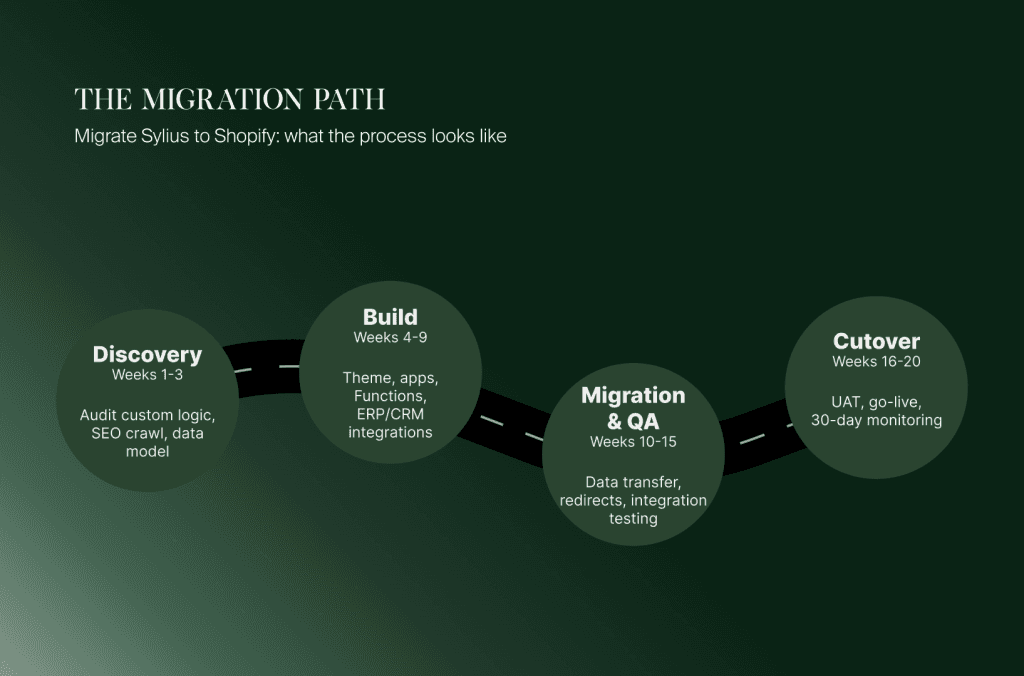
The Sylius vs Shopify debate has implications for merchants, especially regarding feature availability and support. A Sylius to Shopify migration for a mid-market merchant with significant custom functionality typically runs 12-20 weeks:
Discovery (weeks 1-3): Full audit of custom Sylius functionality, integration mapping (ERP, CRM, PIM), SEO crawl of all indexed URLs, data model analysis, and rebuild scope definition.
Build (weeks 4–9): Theme development on Shopify Online Store 2.0, app configuration, Shopify Functions for custom checkout and discount logic, API integrations.
Data migration and QA (weeks 10–15): Test migrations of products, customers, and orders; content review; 301 redirect implementation; full integration testing.
UAT and cutover (weeks 16–20): Stakeholder testing, performance benchmarking, go-live checklist, and 30-day post-launch monitoring.
What gets migrated
Product catalogue, products, variants, images, metafields, collections
Customer accounts, contact data and order history (passwords reset on first login)
Order history, for reference and customer service continuity
SEO assets, all indexed URLs, meta data, structured data, and redirect mapping
Content, CMS pages, blog posts, policy pages
What gets rebuilt
Custom Sylius business logic, price calculators, promotion engines, custom order workflows, Symfony service overrides, does not migrate. It is re-implemented using Shopify Functions, metafields, Flow automations, or app integrations. This is an opportunity, not just a cost: the rebuild process forces an audit of which custom logic delivers genuine business value versus what was built to work around Sylius limitations.
SEO continuity
Sylius URL structures vary significantly between implementations. A clean migration requires a full crawl of the live store to capture every indexed URL and its traffic value, a 1:1 redirect map built before cutover, structured data re-implementation, and Search Console monitoring for 60–90 days post-launch. Organic visibility can be maintained with a rigorous plan. Without one, ranking recovery typically takes 6–12 months.
The business case in summary
For the leadership team building the internal case:
Dramatically lower TCO. Eliminating the engineering overhead of platform maintenance, infrastructure, upgrades, DevOps, security, frees budget for growth initiatives rather than platform survival.
eCommerce team autonomy. On Shopify, merchandising managers, content teams, and eCommerce directors can execute independently without developer involvement in routine operations. On Sylius, almost every change requires developer time.
Faster time to market. New markets, sales channels, and features ship faster on Shopify’s managed platform with its mature app ecosystem than on a Sylius stack requiring custom development for equivalent functionality.
Reduced key-person risk. Sylius’ expertise is rare. Organisations running custom implementations are often critically dependent on one or two engineers who understand the system. Shopify’s developer ecosystem is the largest in eCommerce, knowledge transfers across teams and agencies without friction.
Future-proof architecture. Shopify’s investment in Hydrogen, Shopify Functions, and composable commerce means the platform is moving toward the same architectural goals Sylius was originally chosen for, with Shopify absorbing the infrastructure complexity.
The question is not whether Sylius is technically capable. It is. The question is whether the cost of that capability, in engineering hours, infrastructure overhead, and speed-to-market, is justified by requirements that Shopify cannot meet. For the vast majority of merchants we evaluate, the honest answer is no.
What to do next
If you are running Sylius and evaluating whether a migration makes sense, the first step is an honest audit, not of Shopify’s feature list, but of your current platform’s actual annual cost and the custom logic that genuinely differentiates your business. Most of what was built around Sylius limitations can be replaced. What can’t be replaced is usually achievable through Shopify Functions or the app ecosystem.
If you migrated, or are considering migrating, from PrestaShop, the calculus is similar. Our PrestaShop to Shopify migration guide covers the full scope of that process, including SEO continuity and data migration strategy.
Flatline Agency is a certified Shopify Platinum Partner specialising in migrations from technically complex platforms. We bring experience on both sides of the migration, Sylius and Shopify, and an honest assessment of what the move will require for your specific implementation. Get in touch for a no-obligation migration assessment.
As the Shopify Plus agency handling this migration path end to end, we scope the discovery phase around your actual custom logic rather than a generic platform checklist.
Flatline Agency is a certified Shopify Platinum Partner specialising in eCommerce migrations, international storefront builds, and composable commerce implementations.
Related articles


