Shopify Specialist, Creative Studio or Full-Service Commerce Agency: Which Model Fits Your Team?

By Robin Laseur

The Shopify specialist vs full-service ecommerce agency decision is not a contest between depth and breadth. It is a question of dependencies. Choose a specialist when the assignment is narrow and your team can coordinate the surrounding work. Choose a creative studio for brand-led experience. Choose full-service when several commerce workstreams must move as one.
What are you really choosing between?
You are choosing where specialist expertise sits, who coordinates the workstreams, and who remains accountable when one decision affects another. A Shopify specialist concentrates platform capability. A creative studio concentrates brand and experience. A full-service commerce agency combines more disciplines under one delivery model. None is inherently superior.
The distinction matters because a storefront rarely operates alone. Theme architecture affects merchandising. Product data affects filters and search. ERP logic affects availability and fulfillment promises. Brand decisions affect component behavior. Analytics and lifecycle marketing depend on the final data layer.
The more tightly those decisions interact, the more valuable coordination becomes. The more independent the assignment, the more attractive a focused specialist can be.
Use three practical definitions:
Shopify specialist: A platform-focused team hired for Shopify strategy, design, development, migration, optimization, or a specific technical assignment.
Creative studio: A brand and experience-led team hired for identity, campaigns, visual systems, UX direction, content, or high-concept digital design.
Full-service commerce agency: A multidisciplinary team that can coordinate strategy, design, development, integrations, data, growth, and post-launch work within one operating model.
Which criteria should you use to compare agency models?
Compare agency models on assignment depth, workstream dependency, coordination capacity, accountability, delivery speed, and post-launch ownership. Headcount is a weak shortcut. The decisive factor is whether your project needs one exceptional capability, several loosely connected suppliers, or one team responsible for decisions that cross technical and commercial boundaries.
Start with six questions:
How bounded is the assignment? A theme performance sprint is narrower than a multi-market replatform.
How many disciplines must make joint decisions? Count design, development, data, integrations, SEO, analytics, content, CRM, and operations.
How much coordination can your team own? Name the internal person who will resolve cross-supplier questions.
Where does technical authority sit? Establish who can make architecture decisions and challenge assumptions.
What must continue after launch? Separate maintenance, experimentation, campaigns, merchandising, and platform evolution.
How will accountability work? One contract can simplify escalation, but only when responsibility is genuinely integrated.
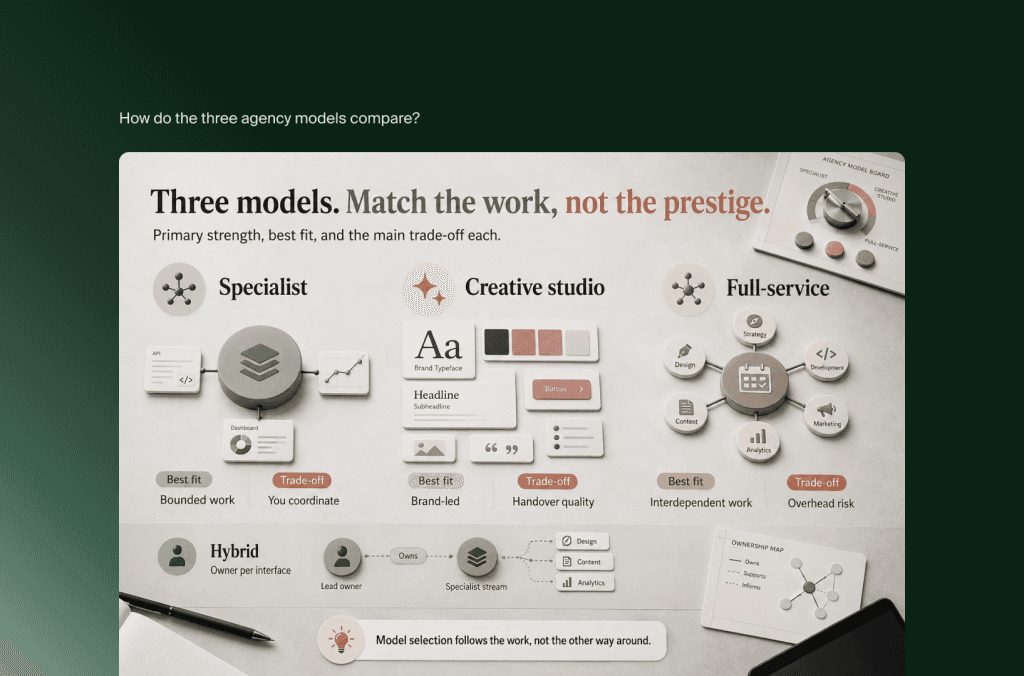
How do the three agency models compare?
A Shopify specialist usually offers the greatest concentration of platform expertise. A creative studio prioritizes brand expression and customer experience. A full-service commerce agency offers broader coordination and ownership. The best fit depends on the assignment, internal team, and number of dependencies, not the perceived prestige of the agency model.
Shopify’s own guide to hiring an ecommerce agency similarly separates development, marketing, and full-service needs, then asks buyers to assess goals and in-house capability. That is the right starting principle. Model selection follows the work, not the other way around.
When does a Shopify specialist fit best?
A Shopify specialist fits best when the problem is clearly defined, platform depth matters, and the client can own adjacent decisions. Strong examples include theme development, checkout extensibility, performance, a contained migration, app architecture, or technical optimization. Focus creates value when interfaces and acceptance criteria are already clear.
Choose a specialist when:
Your brand system and UX direction already exist.
An internal product owner can coordinate content, data, analytics, and operations.
The assignment has measurable technical boundaries.
Your integration scope is limited or separately owned.
You want direct access to senior Shopify practitioners.
Test focus as carefully as breadth. Ask which Shopify assignments make up the team’s recent work, who will execute yours, and how the specialist handles issues that cross into ERP, analytics, UX, or lifecycle marketing. A disciplined specialist should be comfortable defining where its responsibility ends.
When does a creative studio fit best?
A creative studio fits best when differentiation, brand expression, and customer experience lead the business case. It can be the right choice for a new identity, flagship campaign, premium art direction, or experience concept, provided the technical implementation partner and handover model are established before detailed design begins.
Choose a creative studio when:
The central question is how the brand should feel and behave digitally.
A technical team already owns Shopify architecture and delivery.
The work needs distinctive visual thinking or content production.
Your organization can translate creative intent into platform decisions.
Design governance matters beyond the initial storefront release.
Ask how the studio documents states, components, responsive behavior, merchandising rules, and content requirements. Then confirm who makes the final call when brand expression, conversion behavior, and technical constraints point in different directions.
When does a full-service commerce agency fit best?
A full-service commerce agency fits best when strategy, experience, platform engineering, integrations, data, and growth are materially interdependent. The model is most valuable when one roadmap and governance structure reduce handoffs that your internal team would otherwise manage. Breadth alone is not the benefit. Coordinated decisions are.
Choose a full-service model when:
You are migrating a complex store while redesigning the experience.
ERP, PIM, OMS, POS, CRM, or fulfillment systems influence storefront behavior.
Several markets, business models, or sales channels share one platform.
Your internal team is lean relative to the program.
Post-launch optimization needs access to design, development, data, and marketing.
The commercial test is simple: list the cross-workstream decisions the agency will own. If the answer is mostly scheduling meetings between separate internal departments, the integrated premium has not been justified. If the team can resolve dependencies within one accountable delivery structure, the model may reduce coordination cost and decision latency.
What an integrated commerce model looks like in practice: Flatline
Flatline is one example of the integrated model described here. Its eCommerce capability spans Shopify Plus, strategy, design, development, replatforming, PIM, WMS and ERP work, connectors, headless architecture, and POS. The Gisou case shows that mix in a live context, combining Shopify Plus support, performance and UX work, and Klaviyo activity for an international brand.
That range makes Flatline relevant when the assignment crosses storefront, architecture, experience, and growth. It does not make the model universally suitable. A merchant seeking a contained theme change may get more direct value from a focused specialist. A brand whose primary need is a new identity may begin with a creative studio. Flatline belongs on the shortlist when multidisciplinary coordination is part of the problem being purchased, not merely because more services are available.
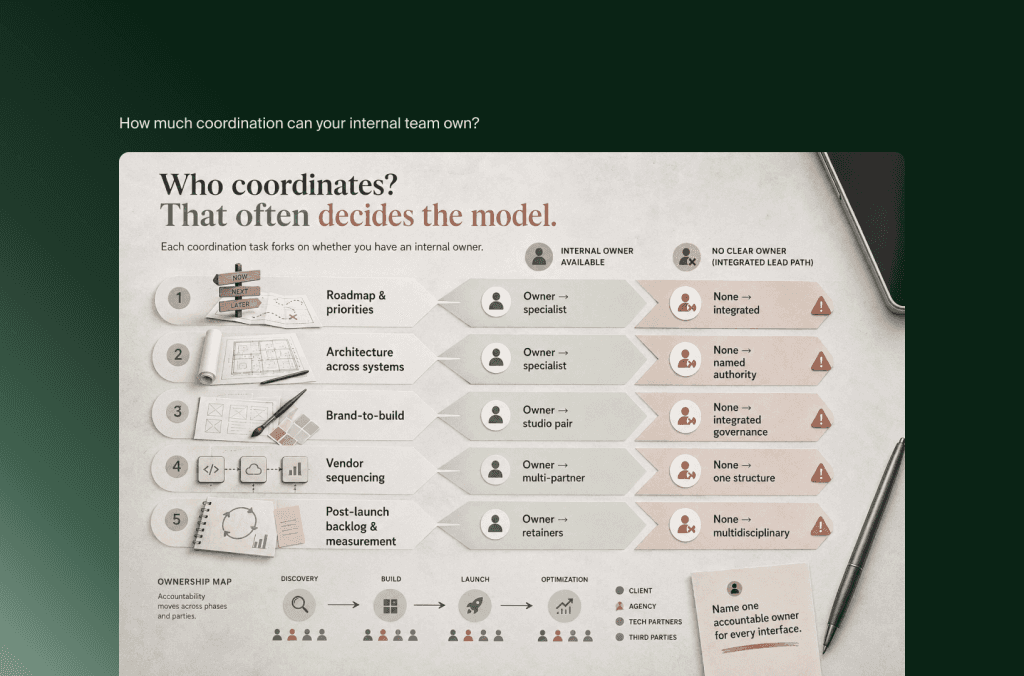
How much coordination can your internal team own?
Internal coordination capacity often decides the agency model. Multiple specialists can produce excellent work, but someone must connect their decisions, schedules, dependencies, and acceptance criteria. If your team has a capable commerce lead, architect, and delivery manager, distributed expertise can work. If not, coordination needs explicit external ownership.
Map ownership before requesting proposals:
Dylan Laseur’s position in this comparison is straightforward: agency breadth only earns its cost when it removes real coordination work or improves decisions across dependent workstreams. His wider view of modular commerce follows the same principle. Flexibility has value only when the organization can govern the connections between platforms, teams, and customer touchpoints. Flatline’s article on composable commerce provides the architectural context for that position.
During selection, ask each agency to draw the ownership map. It should name client, agency, technology partners, and third-party vendors across discovery, build, launch, and optimization. Ambiguity in that map is more informative than the service list in the pitch deck.
When does a hybrid agency model work better?
A hybrid model works when the project needs specialist depth and integrated governance at the same time. One lead partner can own the roadmap and architecture while a creative studio or technical specialist owns a defined stream. The model succeeds when decision rights, interfaces, and escalation paths are explicit from the start.
Common hybrid structures include:
A commerce agency leads the program while a brand studio owns identity and art direction.
An internal product team leads while a Shopify specialist delivers the platform work.
A systems integrator owns ERP transformation while a commerce agency owns the customer experience and Shopify layer.
A creative studio sets the experience system while an internal engineering team implements it.
Name one accountable owner for every interface, especially design-to-development, ERP-to-Shopify, content-to-merchandising, and launch-to-optimization.
For a wider geographic and evidence-based shortlist, use the decision framework for choosing a Shopify agency in the Netherlands. This comparison answers which operating model fits. The parent framework covers how to verify individual agencies within that model.
Frequently asked questions
Is a Shopify specialist better than a full-service ecommerce agency?
Neither model is always better. A Shopify specialist often provides deeper platform focus for a bounded assignment. A full-service ecommerce agency becomes more useful when design, development, integrations, data, and growth must be coordinated. The better choice is the model that matches your dependencies and internal ownership capacity.
Is a creative studio enough for a Shopify build?
A creative studio can lead a Shopify project when a capable technical team already owns architecture and implementation. If no technical counterpart is defined, confirm how designs will translate into components, performance, accessibility, merchandising rules, integrations, and content operations before the scope is approved.
Does full-service mean every capability is in-house?
No. Full-service can include employees, embedded specialists, or established partners. Ask who will work on the project, which responsibilities are subcontracted, and who remains accountable for quality and delivery. The operating model matters more than whether every discipline appears on the agency payroll.
Can several specialist agencies work together successfully?
Yes, when the client or a lead partner owns the roadmap, decision rights, dependencies, and acceptance criteria. Several specialists can provide exceptional depth. The structure becomes harder to manage when no one has authority to resolve cross-workstream questions or sequence releases across shared systems.
Key takeaways
Choose the agency model from the dependencies in the brief, not from agency size.
Use a Shopify specialist for focused platform work with clear interfaces.
Use a creative studio when brand and experience lead, with technical delivery already covered.
Use a full-service commerce agency when coordinated decisions across several disciplines create measurable value.
Treat internal orchestration capacity as a selection criterion.
Consider a hybrid model when specialist depth and integrated governance are both required.
Evaluate Flatline as an integrated option only when its multidisciplinary coverage matches the problem.
The strongest shortlist may contain one agency from each model. That is useful. It forces the selection team to compare different ways of owning the work, rather than three similar presentations. Once the dependencies, decision rights, and internal capacity are visible, the appropriate model usually becomes much easier to defend.
Related articles


