Project Handover or Long-Term Partner? Choosing a Shopify Post-Launch Model Before You Sign

By Robin Laseur

Choose a Shopify agency post-launch support model by assigning each operational workstream to the team with the right capability, capacity, and accountability. A complete handover works for capable internal teams. A retained partner suits continuing specialist demand. A hybrid model divides ownership. Define that model before signing, not in the final week before launch.
The choice is often framed as keeping the agency or taking the store in-house. In practice, merchandising, engineering, integrations, incidents, and optimization may need different owners. Start with responsibilities, not a retainer package.
What does Shopify post-launch support actually include?
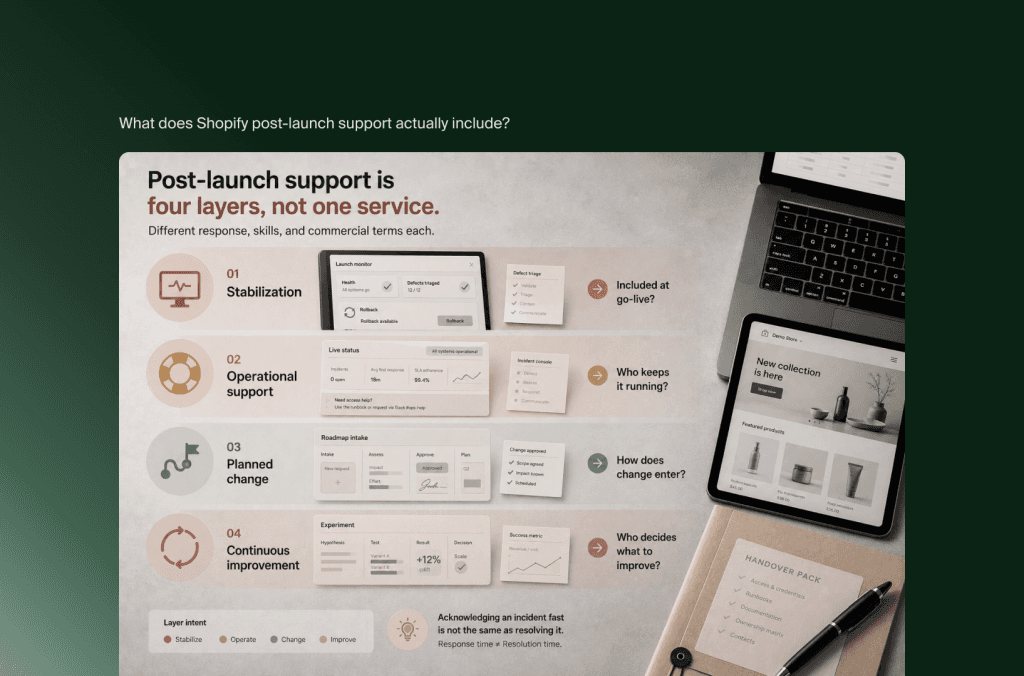
Shopify post-launch support includes four distinct layers: launch stabilization, operational support, planned change, and continuous improvement. They involve different response expectations, skills, and commercial arrangements. Treating them as one vague support service makes it difficult to know what the agency has promised or what the internal team must provide.
Do not bundle these layers. Stabilization may be part of implementation, operational support may use service levels, and planned change may consume a retainer or separate scope. Improvement needs evidence and an outcome owner.
Shopify maintains a developer changelog covering updates, action-required items, breaking changes, and deprecations. This does not make a retainer mandatory, but someone must own monitoring relevant platform changes, assessing their effect, and acting when required.
Why should you choose the model before signing?
Choose the post-launch model before signing because it affects architecture, documentation, training, staffing, access, commercial terms, and the definition of project completion. An agency building for internal ownership should make different delivery choices from one expected to remain accountable for the technical roadmap after launch.
Late decisions create predictable gaps. The internal team may lack deployment access, integration knowledge, or release capacity while the agency assumes its responsibility ended at launch. A generic promise to “support the store” does not resolve this mismatch.
The desired operating model should influence the project from discovery onward:
Architecture, documentation, and training should reflect the future owner’s capabilities.
Accounts, repositories, environments, and vendor relationships need named owners.
Acceptance should distinguish defects from new requests.
Launch plans need stabilization coverage and exit conditions.
Commercial terms should match demand, urgency, and uncertainty.
Shopify’s guidance for agency processes identifies client handover and training, integration test cases, quality assurance, and roadmap planning as activities that benefit from documented processes. The practical lesson is straightforward: handover is not a final meeting. It is a delivery outcome that must be designed and tested.
Include the operating model among the questions to ask a Shopify agency before discovery, while scope and commercial options are still open.
Which Shopify post-launch models can you choose?
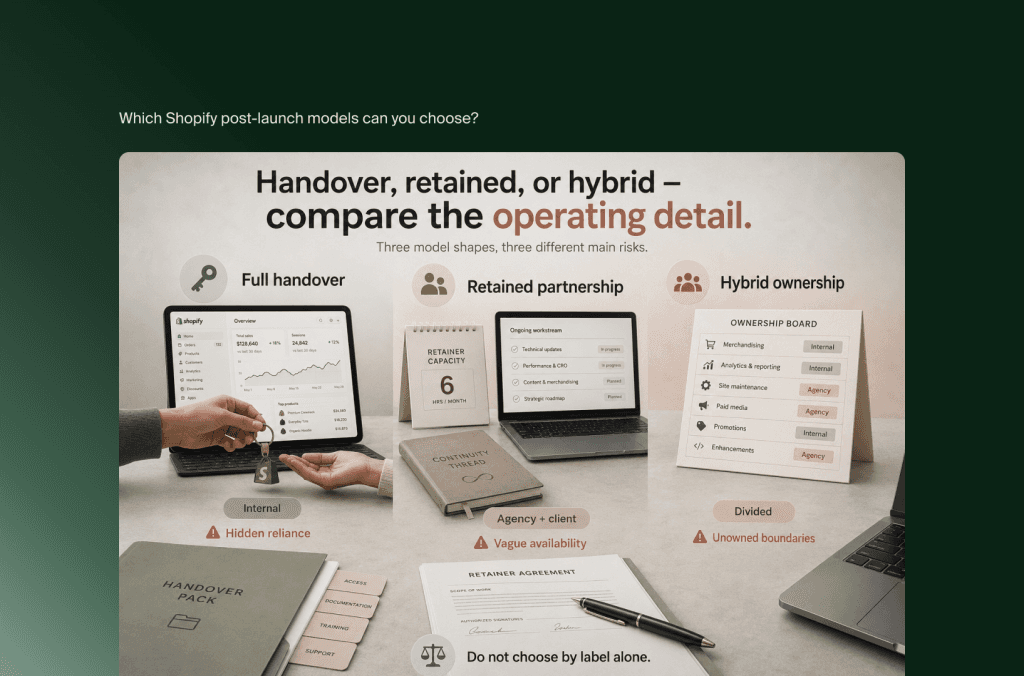
The three practical models are full handover, retained agency partnership, and hybrid ownership. The right choice depends on internal capability, demand patterns, operational risk, and change cadence. Select the model per workstream where necessary; one store can combine internal merchandising, agency-led engineering, and shared roadmap governance.
Do not choose by label alone. Retainers can provide different capacity, skills, response commitments, and roadmap involvement. Handovers can include radically different documentation and training. Compare the operating detail.
When does a full project handover work well?
A full handover works when the internal team can operate the store, diagnose common failures, manage vendors, release changes safely, and own the roadmap without relying on undocumented agency knowledge. It is a deliberate transfer of control and capability, not the simple expiration of an implementation contract.
The internal team does not need every discipline that built the store, but it needs a credible route to specialist help. Before selecting a complete handover, confirm five conditions:
Capability: Named people understand Shopify, the storefront, connected systems, and release practices relevant to their roles.
Capacity: They have time for maintenance, incidents, and roadmap work.
Authority: Product, technical, and commercial decisions have clear owners.
Coverage: The business can respond during absences, critical trading, and severe incidents.
External access: Specialists can work without relying on private agency accounts or undocumented setup.
What should a Shopify handover package contain?
A useful Shopify handover package contains the assets, access, knowledge, and tested procedures needed to operate and change the live service. Its quality should be assessed through practical exercises, such as deploying a release, tracing an order flow, or resolving a simulated integration failure.
At minimum, review:
Ownership and access for Shopify, domains, repositories, apps, analytics, and deployment services.
Architecture and data-flow diagrams for the storefront and material connected systems.
Environment, release, approval, rollback, and emergency-change procedures.
Integration runbooks covering authentication, monitoring, retries, failures, and vendor contacts.
Test evidence, known defects, deferred scope, technical debt, and recovery duties.
Theme, design-system, content-model, analytics, and safe merchandising instructions.
Role-specific training, escalation routes, and a final responsibility map.
Ask future owners to perform representative tasks before acceptance; documentation alone does not prove operational readiness.
When does a retained Shopify agency partnership make sense?
A retained partnership makes sense when the business has recurring specialist demand, meaningful integration or release risk, an active change roadmap, or insufficient internal capacity to cover the required disciplines. Its value comes from defined ownership and continuity, not from keeping the original agency involved by default.
Continuity reduces the time needed to understand architectural decisions and dependencies. Reserved capacity can also help teams that need development, UX, data, integration, or strategic input but cannot support each capability internally.
The case is weaker when work is infrequent or the organization can perform it. A monthly fee is not evidence of readiness.
Separate these categories before evaluating a retainer:
Then examine what the retainer actually commits:
Named roles, seniority, and whether capacity is dedicated, reserved, or best effort.
Included capacity, term, rollover, notice, and unused allocation.
Support hours, severity levels, response targets, and escalation routes.
The distinction between response, workaround, restoration, and resolution.
Prioritization when incidents and roadmap work compete.
Treatment of third-party coordination, reporting, and peak-period coverage.
Documentation duties and the process for transfer to another team.
A retained partner should keep the client capable of leaving through current documentation, client-controlled access, and an explicit exit process.
When is a hybrid ownership model better?
A hybrid model suits an internal team that can own frequent commercial operations but needs external capability for engineering, integrations, major releases, or structured improvement. It concentrates agency spend on scarce skills while keeping business knowledge and everyday commercial judgment inside the organization.
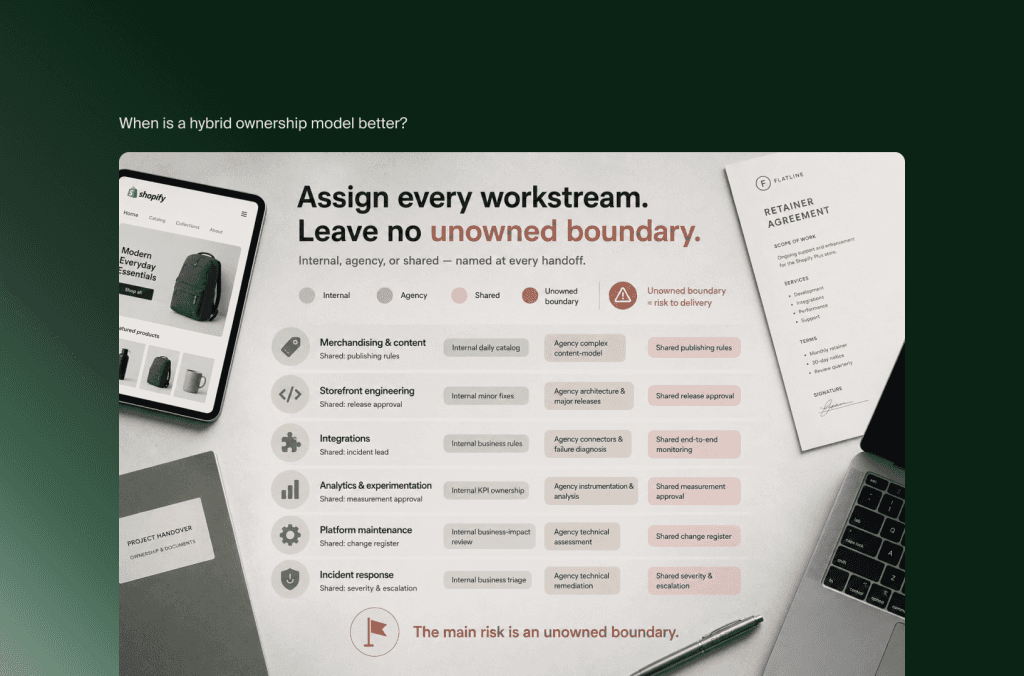
Hybrid does not automatically mean internal content plus agency development. Divide ownership according to your team and risk profile. One organization may own front-end engineering; another may ask an agency to coordinate Shopify, ERP, PIM, and POS releases.
An ownership matrix makes the arrangement testable:
The main risk is an unowned boundary. “Shared” should never mean that both parties wait for the other. For every cross-team process, name the accountable lead, required contributors, decision authority, expected handoff, and escalation point.
How should you decide between handover, retainer, and hybrid?
Map recurring work, required capabilities, demand variability, criticality, and internal capacity. Assign an owner to each workstream, then choose terms that support those assignments. Different layers of one commerce operation may therefore have different owners and commercial arrangements in practice.
Use seven questions as a decision gate:
What work will exist after launch? Separate operations, incidents, maintenance, releases, and improvements.
Which capabilities does it require? Include only the disciplines each workstream needs.
What exists internally? Assess named people and available time, not hiring assumptions.
What is the cost of delay? Critical order or inventory issues need different coverage from design enhancements.
How variable is demand? Recurring work, incidents, and occasional projects need different terms.
How often will the platform change? An active multi-market roadmap increases coordination needs.
Can ownership transfer cleanly? Check documentation, access, dependencies, and switching cost.
Score each workstream separately. Internal ownership for four areas, retained support for two, and projects for one can be a coherent model.
What should the contract define about post-launch support?
Define stabilization, warranty, ongoing support, ownership, service measurement, commercial limits, and exit as observable duties. “Ongoing support” and “priority access” remain ambiguous without coverage, triggers, responsibilities, and capacity rules. The contract should also state how responsibility changes when implementation ends.
Clarify the following before signature:
Stabilization staffing, coverage, end date, and exit criteria.
Warranty period, defect definition, exclusions, and correction process.
Service hours, severity, response targets, and escalation channels.
Whether targets cover acknowledgement, workaround, restoration, or resolution.
Capacity, rates, rollover, overage approval, and reprioritization.
Boundaries between incidents, defects, maintenance, requests, and projects.
Responsibilities for critical client, agency, platform, and vendor dependencies.
Ownership of assets, accounts, data, credentials, and documentation.
Reporting, notice, offboarding, knowledge transfer, and access revocation.
Response time is not resolution time. An agency may acknowledge an incident quickly while depending on a platform, app vendor, or client system. Define what it controls, how others are coordinated, and how progress is communicated.
Review these terms while comparing Shopify agency proposals. The implementation fee only becomes comparable when future operating responsibility and cost are visible.
When may Flatline be a suitable post-launch partner?
Flatline may suit a Shopify operation needing coordinated ownership across strategy, design, development, connectors, PIM, ERP or WMS, headless architecture, or POS. That breadth matters when post-launch work crosses those boundaries. It is unnecessary for occasional configuration or work covered internally.
Flatline’s published eCommerce capabilities are a starting point. Verify the people, capacity, coverage, system ownership, governance, and exit process proposed for your account.
The agency model should also fit your team. The comparison of a Shopify specialist, creative studio, and full-service commerce agency can help determine whether broad retained capability is useful or whether a narrower partner is more efficient.
If your team is deciding which responsibilities to retain after launch, Flatline can review the proposed operating model with you and map the handover, retained, and shared ownership options. The useful outcome is a model your internal team can operate, whether Flatline remains involved or not.
Frequently asked questions
How long should Shopify post-launch support last?
There is no universal duration. Stabilization should continue until agreed risks, priority defects, data checks, and operating procedures meet exit criteria. Keep ongoing support while specialist demand justifies it, with review points as internal capability and roadmap needs change.
What is the difference between a warranty and ongoing support?
A warranty corrects delivered work that fails agreed requirements, subject to its terms. Ongoing support covers live needs such as incident triage, maintenance, or planned changes. Define which service, response expectation, and commercial treatment applies.
Does every Shopify store need an agency maintenance retainer?
No. A store needs named ownership for platform changes, maintenance, incidents, integrations, releases, and improvement. An internal team can provide it. A retainer is useful when external capability, continuity, or reserved capacity offers better coverage.
Can we switch Shopify agencies after launch?
Yes, if the business controls essential accounts and assets and receives usable documentation, access records, known issues, architecture information, and offboarding support. Review notice and intellectual-property terms early. A new agency should still conduct technical and operational discovery.
Key takeaways
Treat post-launch support as stabilization, operational support, planned change, and continuous improvement.
Choose an ownership model before signing because it affects delivery, training, access, documentation, and cost.
Use full handover when internal teams have the required capability, capacity, authority, and coverage.
Use a retained partner when recurring specialist demand, continuity, or reserved capacity creates clear value.
Use hybrid ownership to divide work by capability, but assign one accountable lead at every boundary.
Separate warranty defects, incidents, maintenance, change requests, and roadmap improvements.
Define capacity, service levels, escalation, third-party dependencies, and exit in observable terms.
Keep access and knowledge transferable even when a long-term agency relationship works well.
The strongest model gives every material workstream a capable owner, enough capacity, clear decision rights, and a practical transfer route. Decide that before launch pressure turns assumptions into operating risk.
Related articles


