12 Questions to Ask a Shopify Agency Before You Approve Discovery

By Robin Laseur

The most useful questions to ask a Shopify agency test whether discovery will produce a decision, not merely start a relationship. Before approval, confirm the business outcome, unknowns, participants, deliverables, ownership, price, and exit options. A credible discovery proposal should show how each unresolved question becomes evidence your team can act on.
Discovery is often presented as the sensible first phase of a Shopify build, redesign, or migration, but the label alone proves little. Its substance depends on the questions, evidence, and outputs behind it.
Your job is not to demand certainty before the work begins. It is to establish whether the process will reduce the right uncertainty, and whether your organization will own enough of the output to make a sound build decision afterward.
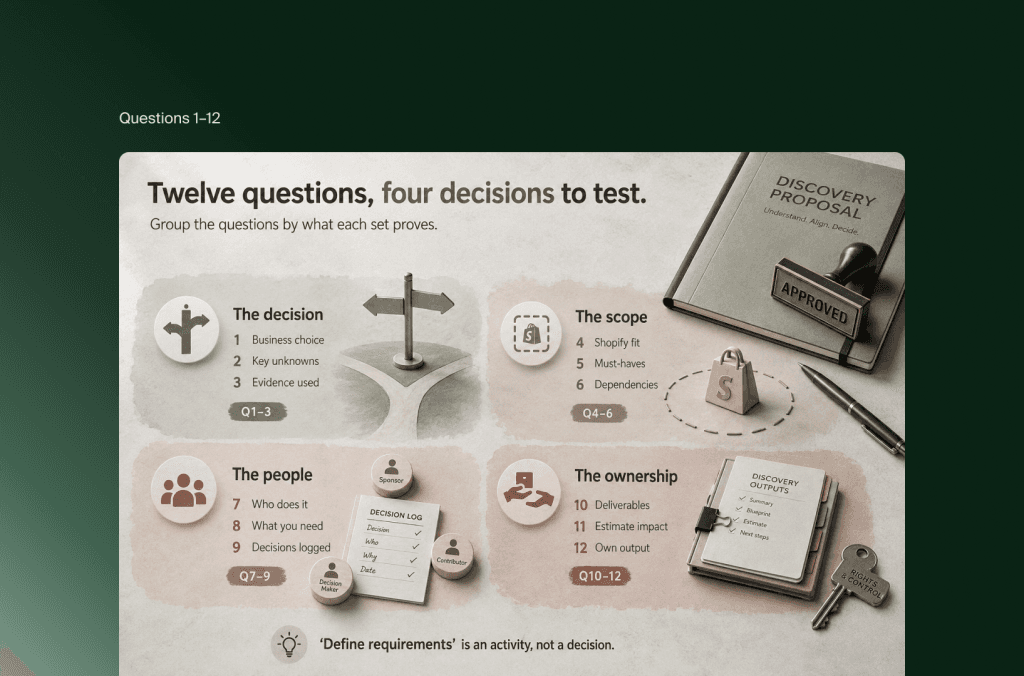
What should you know before approving Shopify discovery?
Before approving discovery, you should know which decisions it must support, who needs to participate, what evidence the agency will examine, which artifacts it will deliver, and what happens next. You do not need a final solution or fixed build estimate. You do need a defined route from open questions to an informed decision.
Shopify’s own guidance on choosing an ecommerce agency recommends checking who will do the work, how success will be measured, what comparable evidence exists, and how offboarding works. Those are useful selection questions. Discovery approval needs another layer: what exactly are you buying before the main engagement exists?
Use the 12 questions below in the proposal review, not only on a sales call. Ask the agency to put material answers in writing. A persuasive conversation can establish fit, but the approved scope, deliverables, assumptions, and ownership terms govern what the team will actually receive.
Questions 1–3: What decision is discovery meant to support?
The first three questions test whether discovery begins with a business decision or a predetermined build. Strong answers connect the proposed work to an operating problem, identify the important unknowns, and define evidence that will inform approval. Weak answers move directly to pages, features, or technology before explaining what those choices need to accomplish.
1. What business decision will discovery help us make?
Ask the agency to complete this sentence: “At the end of discovery, the client will be able to decide whether and how to…” The answer might concern replatforming, consolidating markets, replacing a storefront, introducing B2B, connecting retail operations, or sequencing a broader commerce program.
A decision-grade answer names the decision, its owner, and the alternatives under consideration. “Define requirements” is an activity, not a decision. The phase must clarify what management can approve or reject afterward.
2. Which unknowns must discovery resolve?
Every serious Shopify project begins with uncertainty. The useful question is whether the agency has identified the uncertainties that can materially alter scope, architecture, cost, or timing. Ask for an initial list and expect it to change as evidence appears.
Typical unknowns include data quality, ERP or PIM behavior, checkout requirements, B2B pricing, SEO exposure, app dependencies, and internal capacity. A credible agency separates facts, assumptions, and open questions rather than quietly converting assumptions into scope.
3. What evidence will you use to answer those questions?
Workshops are a method for gathering perspectives, not evidence by themselves. Ask which systems, analytics, interfaces, contracts, process documents, user research, and stakeholder inputs the team will inspect. Then ask how conflicting information will be resolved.
The evidence should match the decision. Replatforming may require data samples, integration documentation, URL inventories, analytics, and operational interviews. Redesign may depend on behavioral data, customer research, merchandising needs, and content workflows.
Questions 4–6: How will the agency define the problem and scope?
The next three questions examine whether the agency can translate business needs into a bounded Shopify assignment. Look for platform reasoning, explicit inclusion and exclusion rules, and early treatment of dependencies. Discovery should make the work easier to estimate because it clarifies boundaries, not because unresolved complexity has been hidden inside a broad label.
4. How will you test whether Shopify is the right answer?
An agency can specialize in Shopify and still examine platform fit honestly. Ask which requirements could challenge the proposed Shopify or Shopify Plus model, how alternatives will be evaluated, and which constraints might require process change rather than customization.
The useful answer explains how the team will compare native capability, apps, custom development, integrations, and operational change. It also identifies conditions that would justify a narrower implementation, a different sequence, or no replatforming.
5. How will you separate must-haves from inherited preferences?
Legacy platforms accumulate features, workarounds, and local exceptions. Moving every behavior into Shopify can preserve unnecessary complexity and inflate the scope. Ask how the agency will distinguish commercial requirements from historical implementation choices.
Look for prioritization tied to customer journeys, operations, revenue, compliance, and measurable risk. The output should show what must exist at launch, what can follow, and what should be retired.
6. Which dependencies could change the estimate or timeline?
Ask the agency to identify systems and decisions outside its direct control. These may include ERP, PIM, OMS, CRM, tax, payments, fulfillment, identity, content production, translations, legal review, procurement, or another vendor’s API.
A useful answer names the dependency, owner, required information, decision date, and likely impact. It also distinguishes dependencies discovery will validate from assumptions that will remain open.
Questions 7–9: Who will do the work and make the decisions?
These questions test the operating model behind the proposal. Discovery depends on access to the right expertise and timely decisions from both sides. Confirm the named agency team, the client contribution, and the mechanism for resolving disagreements. A senior sales presentation does not guarantee senior participation once workshops and technical analysis begin.
7. Who will work on discovery, and what will each person own?
Request names or clearly defined roles, expected allocation, and responsibility for each deliverable. If architecture, UX, data, SEO, analytics, or commercial strategy matters, establish who covers it and whether that person participates directly or reviews work later.
Also ask who is expected to continue into delivery. The answer should reveal whether practitioners lead discovery and how knowledge transfers if the delivery team changes.
8. What will you need from our team, and when?
Discovery is not work the agency performs around the client. It requires access to systems, decision-makers, operational knowledge, data, and existing vendors. Ask for a client-side participation plan before committing to dates.
The plan should specify roles, preparation, workshop time, access, review windows, and sign-off responsibilities across relevant functions. If essential people cannot participate, the agency should identify which conclusions will remain provisional.
9. How will decisions, disagreements, and scope changes be recorded?
Ask what governance artifacts the agency will maintain during discovery. At minimum, complex work usually needs a decision log, assumption log, risk register, open-issue list, and a named owner for each action.
The important signal is traceability: why a requirement changed, which evidence informed a choice, and who accepted the trade-off. The proposal should identify review points, escalation routes, and change authority.
Questions 10–12: What will you own when discovery ends?
The final questions test the commercial and practical value of the phase. Discovery should leave your organization with usable decisions and artifacts, even if the proposed build changes or does not proceed. Confirm the deliverables, estimate logic, intellectual-property rights, and continuation options before allowing momentum to substitute for a deliberate investment decision.
10. What exact deliverables will we receive?
Ask for named artifacts rather than a promise of “findings” or “recommendations.” Depending on the project, useful outputs may include a requirements map, solution outline, system context diagram, integration responsibilities, data-migration assessment, prioritized backlog, delivery roadmap, risk register, acceptance criteria, and investment range.
Each deliverable should have an audience and decision purpose. Ask to see a sanitized example so your team understands the expected depth, not just the file format.
11. How will discovery change the build estimate and commercial model?
Discovery exists partly because the agency cannot responsibly estimate every aspect of the build yet. Ask what becomes more certain afterward, which variables may remain open, and how the team will convert findings into a proposal or delivery plan.
A credible answer distinguishes a budget range from a fixed commitment and explains assumptions, contingency, third-party costs, client costs, and change control. Discovery improves the estimate by making uncertainty visible.
12. Can we use the output if we choose another route or partner?
This question exposes whether discovery is a decision product or a sales dependency. Confirm your rights to the artifacts, any tool access, confidentiality terms, handover format, and whether another qualified team could understand the work.
Also ask whether discovery commits you to the build, whether its fee is credited later, and what happens if the evidence supports a smaller project or a pause. The client should retain a genuine decision at the end.
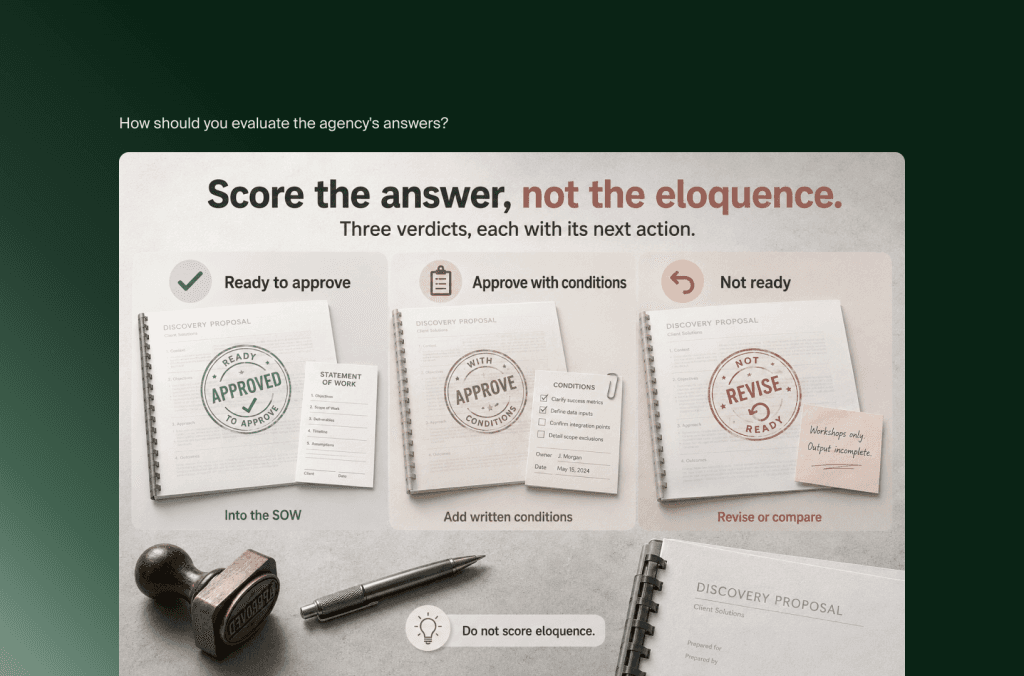
How should you evaluate the agency’s answers?
Evaluate answers by their specificity, traceability, and willingness to preserve uncertainty where evidence is still missing. A strong agency does not need to know the final solution before discovery. It should know how the unknowns will be investigated, who owns each decision, and what your organization will possess when the phase closes.
Do not score eloquence. Score whether the answer can survive transfer from the sales call into a statement of work. If a commitment matters to approval, record it in the proposal, contract, or attached delivery plan.
This is also where adjacent diligence becomes useful. Review the agency’s evidence using a structured guide to evaluating Shopify agency case studies, then apply these questions to the actual discovery scope. Past capability and proposed method are different evidence categories. You need both.
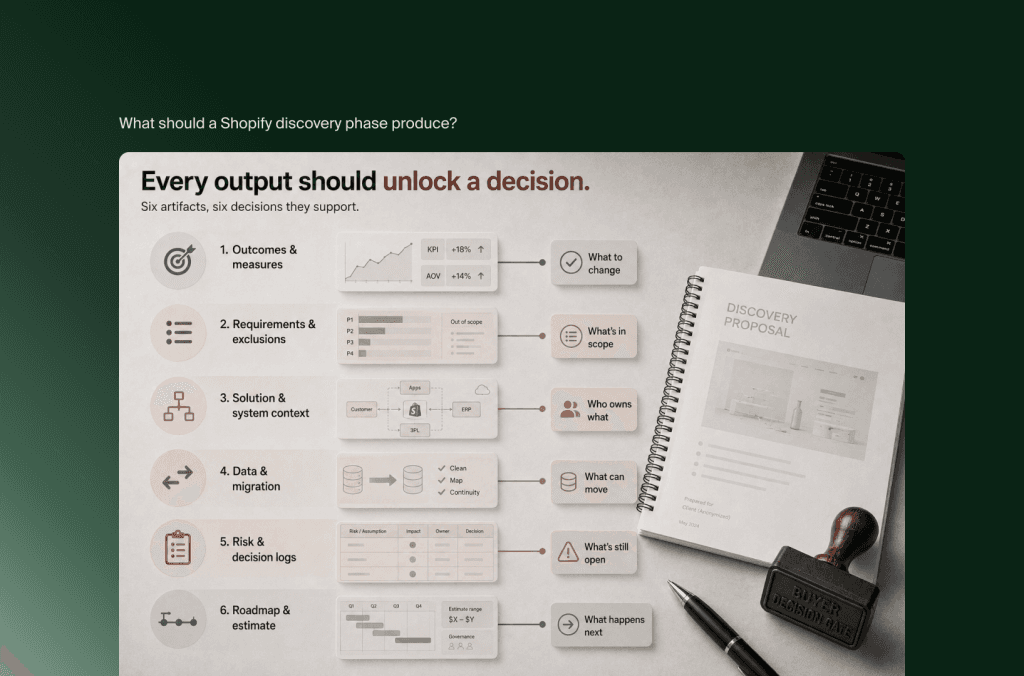
What should a Shopify discovery phase produce?
A Shopify discovery phase should produce a defensible recommendation, a bounded initial scope, a view of architecture and dependencies, an owned risk and decision record, acceptance criteria, and a commercial roadmap. The exact artifacts vary by project. Their shared purpose is to make the next investment easier to approve, revise, sequence, or decline.
For a complex migration, discovery may go deeper into data reconciliation, redirects, acceptance testing, launch criteria, and post-launch stabilization. For a bounded optimization project, the output may be a smaller evidence-backed backlog and measurement plan. More documentation is not automatically better. Every artifact should reduce a named decision risk.
When might Flatline be a useful discovery partner?
Flatline may be a useful discovery partner when a Shopify decision crosses strategy, design, development, migration, data, and connected operations. Its eCommerce work covers Shopify projects alongside replatforming, PIM, ERP, connectors, headless storefronts, and POS, making the fit most relevant when several of those areas must be considered together.
That breadth is not necessary for every assignment. A merchant with a narrow theme change and a capable internal technical owner may be better served by a focused Shopify specialist. Use the broader guide to choosing a Shopify agency in the Netherlands to compare the operating models before deciding who should run discovery.
If your team already has a discovery proposal but is unsure whether it resolves the decisions behind the investment, Flatline can review the brief with you and identify the unanswered scope, evidence, and ownership questions. The aim is a clearer approval decision, whether that leads to a larger program, a smaller first phase, or more work before either begins.
Frequently asked questions
Should Shopify discovery be paid?
Paid discovery is reasonable when the agency performs substantive research, analysis, facilitation, architecture, and planning that produces reusable outputs. The fee should correspond to defined work and deliverables. A sales call or generic proposal workshop should not be relabeled as paid discovery without explaining the additional decision value your organization will receive.
Does discovery guarantee a fixed Shopify project price?
No. Discovery should improve estimate quality by clarifying requirements, dependencies, risks, and assumptions, but some variables may remain open. Ask the agency to state what can be fixed, what remains an allowance or range, and which events trigger change control. Treat unexplained certainty as less useful than a transparent estimate model.
How long should Shopify discovery take?
Duration depends on the decisions, stakeholders, systems, markets, and evidence involved. A bounded storefront assignment may require a short focused phase, while a multi-market migration with ERP, PIM, B2B, and retail dependencies requires deeper investigation. Evaluate the proposed activities and outputs rather than selecting a duration in isolation.
Should we run discovery with more than one Shopify agency?
Usually, compare agencies before awarding substantive discovery, then select one team for the phase. Parallel discoveries can duplicate stakeholder effort and produce incompatible assumptions. If you need competitive validation, use a common brief, request comparable proposal detail, or commission an independent review of the preferred discovery output before approving the build.
Key takeaways
Approve Shopify discovery only when it is tied to a specific business or investment decision.
Ask which unknowns will be resolved and which evidence the agency will inspect.
Confirm the named agency team and the time, access, and decisions required from your organization.
Put deliverables, ownership rights, assumptions, governance, and exit options in writing.
Judge answers by specificity and traceability, not confidence in the sales room.
Preserve a genuine choice at the end of discovery, including the option to change scope, pause, or select another delivery route.
The right discovery phase does not remove every unknown. It makes the important ones visible, assigns a method and owner to each, and gives your organization enough evidence to decide what deserves approval next.
Related articles


