The Shopify Agency Shortlist Scorecard: Compare Technical Fit, Delivery Risk and Growth Support

By Robin Laseur

A polished pitch can make Shopify agencies sound equally capable while concealing different teams, assumptions, and operating models. A Shopify agency shortlist scorecard turns that ambiguity into a 100-point comparison of technical fit, delivery risk, and growth support. It combines weighted criteria with pass/fail gates so presentation quality cannot compensate for a capability gap.
Copy the tool into a spreadsheet, set its weights before proposals arrive, and record evidence beside every score. Apply it to every agency, including Flatline.
How should you use the Shopify agency shortlist scorecard?
Use the Shopify agency shortlist scorecard after defining your requirements but before choosing finalists. Set pass/fail conditions first, adjust the default weights to match the project, collect comparable evidence, and have commercial, operational, and technical stakeholders score independently. Reconcile their reasoning before calculating the final shortlist, rather than averaging unexplained opinions.
Use this sequence:
Define the assignment: outcome, constraints, markets, systems, and post-launch model.
Set gates and weights: separate non-negotiable conditions from preferences.
Collect comparable evidence: request the same artifacts and ownership detail.
Score independently: record a 0–5 score and evidence note.
Resolve uncertainty: clarify weak criteria, check references, and update contract terms.
UK government tender guidance separates participation conditions from weighted criteria and recommends clear, measurable criteria with stated importance. Private buyers can apply that logic proportionately.
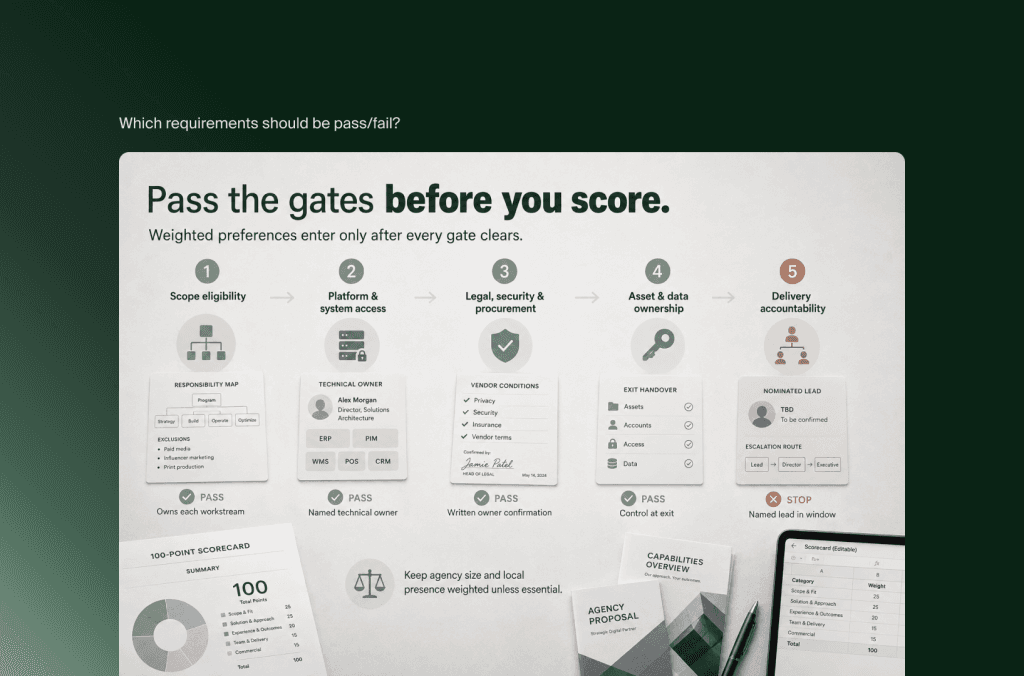
Which requirements should be pass/fail before scoring begins?
Pass/fail gates cover conditions that make an agency unsuitable for the assignment. Keep them short and project-specific so mandatory security, integration, legal, or ownership requirements cannot disappear inside an average. Weighted preferences should enter only after every candidate meets these entry conditions.
Keep agency size and local presence weighted unless essential.
Use Shopify’s Partner Directory to verify ecosystem presence. Directory status is one source, not proof of project-specific capability.
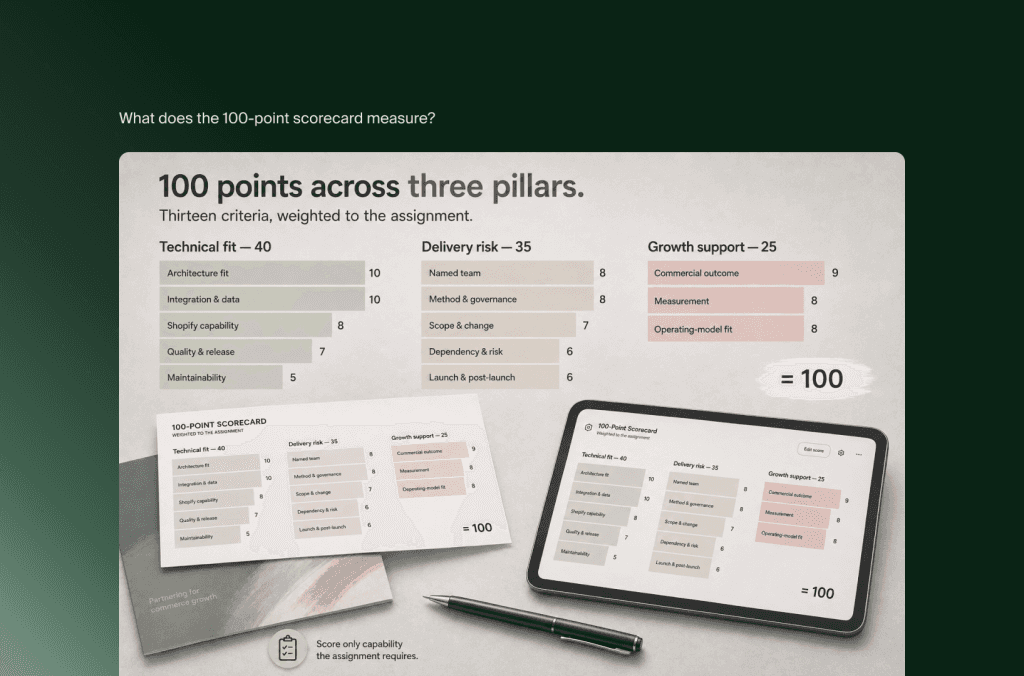
What does the 100-point Shopify agency scorecard measure?
The default scorecard allocates 40 points to technical fit, 35 to delivery risk, and 25 to growth support. Thirteen criteria translate those pillars into observable evidence. These weights suit a complex Shopify build or migration, but they are a starting model rather than a universal benchmark. Adapt them before agencies submit final responses.
Technical fit should follow the brief, not the longest capability list
Score only capability the assignment requires. A Liquid build earns no credit for unrelated Hydrogen capability. Evidence should connect the approach to your stack and constraints.
Delivery risk belongs in the score, not in the contract appendix
Team allocation, decision rights, dependencies, and scope controls show whether delivery can work. The Shopify ecommerce agency guide also recommends checking team, measurement, evidence, and offboarding.
Growth support means commercial judgment, not a promise of results
Score measurable outcome logic, dependencies, and roadmap decisions. Unsupported forecasts earn no additional credit.
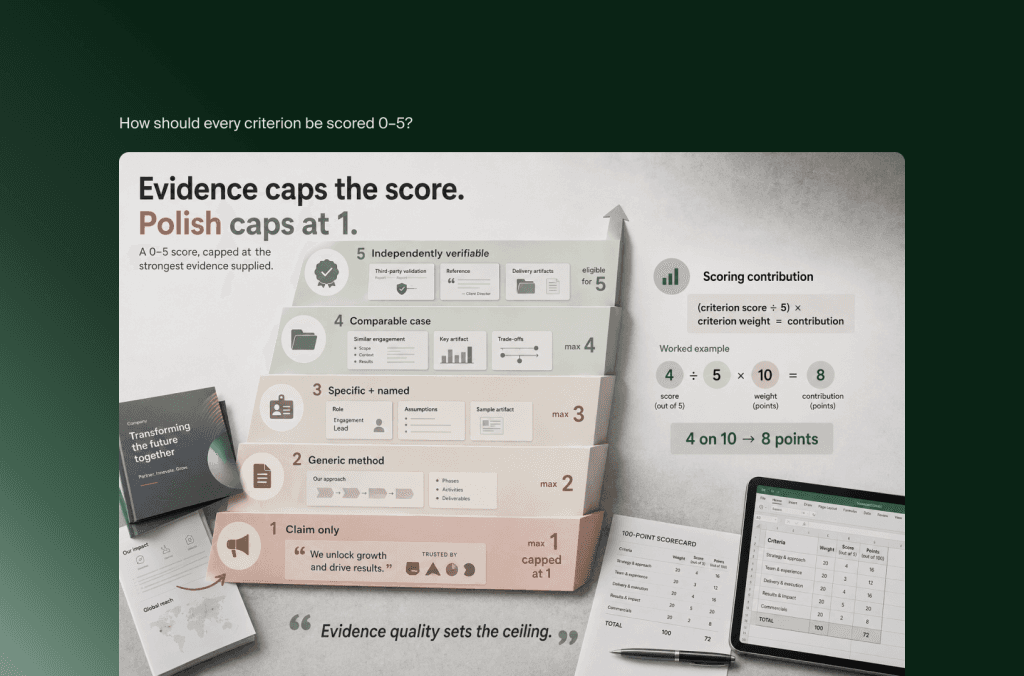
How should every criterion be scored from 0 to 5?
Score each criterion from 0 to 5 by evidence relevance and quality. A maximum score requires project-relevant proof, credible ownership, and enough detail to verify the method. Record the reason beside each number. This rubric prevents presentation polish from receiving the same credit as verified project evidence.
Cap the score according to the strongest evidence supplied:
Claim only: maximum 1.
Generic method or artifact: maximum 2.
Project-specific method with named ownership: maximum 3.
Comparable case or artifact with explained trade-offs: maximum 4.
Independently verifiable evidence that aligns with the proposal: eligible for 5.
Calculate each contribution with this formula:
Weighted contribution = (criterion score ÷ 5) × criterion weight
An agency scoring 4 on a 10-point criterion receives 8 points. Keep its evidence note beside the result.
See choosing a Shopify Plus partner for broader shortlist context.
What does the final score mean for your shortlist?
Treat the total as a confidence signal, not a forecast. A high score reflects stronger evidence against your criteria. It cannot cancel a failed gate, contractual issue, or low score in a critical area. The pattern across criteria matters as much as the arithmetic.
These are working bands, not industry benchmarks. Document changes before scoring.
Have commercial, operational, and technical stakeholders score separately. Review two-point differences before recording a calibrated score.
How should you adapt the weights to your Shopify project?
Adapt the scorecard by moving points toward the capabilities carrying the most consequence while preserving a 100-point total. Set weights before final proposals arrive. The default allocation suits a complex build or migration; design, optimization, and retained-service engagements need different emphasis under the same evidence rules.
Test the weights with contrasting agencies. Correct any result that contradicts the brief before evaluation begins.
If the brief changes, document it and rescore every agency. Never change weights to improve a preferred candidate’s result.
How should you resolve two agencies with similar scores?
Resolve two similar agency scores through criterion-level differences, evidence confidence, internal effort, and unresolved assumptions. Do not add decimal precision to manufacture a winner. Test the issue most capable of changing the decision through an equal clarification, reference conversation, or working session, then rescore that criterion.
Use these tie-breakers in order:
Critical-criterion strength. Prefer stronger evidence where a weak decision has the greatest consequence.
Unresolved assumptions. Identify material unknowns and who carries their cost or schedule exposure.
Client-side demand. Compare the content, data, testing, decisions, and vendor coordination required from your team.
Reference depth. Ask a comparable client about continuity, trade-offs, scope changes, communication, and support.
Working-session evidence. Give both teams the same scenario and assess how they clarify, reason, and assign ownership.
Whole-life exposure. Compare technology, retained support, internal effort, transition costs, and exit conditions.
Record what produced confidence. Specific reasoning is usable; “we liked them” is not.
What should you do after completing the scorecard?
After completing the scorecard, advance agencies that pass every gate and show credible evidence in the criteria that matter most. Convert low scores into equal clarification questions, validate references, normalize proposal scope, and transfer the responsibilities and assumptions behind the selected score into the contract and discovery plan.
The next action depends on the result:
One clear leader: verify references and contract terms against the evidence.
Several credible candidates: run one equal clarification round.
No credible candidate: revisit the brief, agency model, or shortlist source.
High scores with weak notes: repeat the evaluation against evidence.
One critical gap: decide whether discovery can resolve it or whether it remains a gate.
Flatline’s published eCommerce scope includes Shopify, strategy, design and development, replatforming, PIM, ERP and WMS work, connectors, headless, and POS. Score that scope through the same evidence rules used for every agency.
If your team wants a second opinion before issuing an RFP or selecting finalists, send Flatline the brief and draft scorecard through the contact page. We can help calibrate the gates, weights, and evidence requests around the outcome you need to protect. You keep the method whether or not Flatline joins the shortlist.
Frequently asked questions
How many Shopify agencies should be on a shortlist?
Use the smallest shortlist that provides meaningful alternatives. Two or three well-matched agencies often create clearer comparison, but the right number depends on procurement and complexity. Apply eligibility gates before requesting detailed proposals.
Should price be included in the Shopify agency scorecard?
Yes, but compare price after normalizing scope, assumptions, client effort, recurring costs, and post-launch commitments. Add it as a weighted criterion or assess it after a quality threshold, using the same declared method for every agency.
Who should score the agencies?
Include stakeholders accountable for the outcome and able to test evidence. For a complex project, this may include eCommerce leadership, an operational owner, and a technical reviewer. Score independently, then calibrate material differences.
Can we use the scorecard before discovery?
Yes. Use public evidence and early conversations for the initial shortlist, then update criteria where discovery adds evidence. Keep weights stable unless the brief changes. Discovery should reduce uncertainty, not rewrite the method around one agency.
Key takeaways
Set genuine pass/fail conditions before weighted scoring so a critical gap cannot hide inside a strong total.
Allocate the default 100 points across technical fit, delivery risk, and growth support, then adapt the weights to the assignment before proposals arrive.
Cap scores according to evidence quality. A polished claim without project-specific proof remains a low score.
Score independently, calibrate the reasoning, and treat large evaluator differences as unresolved interpretation rather than noise.
Use totals as confidence signals. Review critical criteria, unknowns, internal effort, references, and whole-life exposure before appointment.
A useful scorecard does not identify a universally best Shopify agency. It identifies the agency that has supplied the strongest, most relevant evidence for your brief under a method your team can explain. The result becomes more valuable after selection when the same criteria inform discovery, contracting, governance, and post-launch review.
Related articles


