Why ‘More Ad Spend’ Stopped Being a Growth Strategy for DTC Brands

By Robin Laseur
For most of the last decade, a direct-to-consumer brand could grow by spending more. Put another dollar into acquisition, get more than a dollar back, repeat. That loop has quietly broken, and the reason is arithmetic rather than fashion: acquisition costs have climbed while the margin that has to absorb them has shrunk, so the same spend now buys growth that loses money. Profitable growth is no longer a spend decision. It is a question of which single constraint, acquisition, conversion, or retention, is actually holding your brand back, because pouring budget past that constraint just funds the leak. This guide gives you a way to find yours, so you can name the lever that moves profitable growth and the one you are overspending on.
The spend reflex, and why the math broke
The instinct when growth stalls is to spend more: more ads, more channels, more top-of-funnel pressure. It worked when acquisition was cheap and margins were fat. Two shifts took that option away.
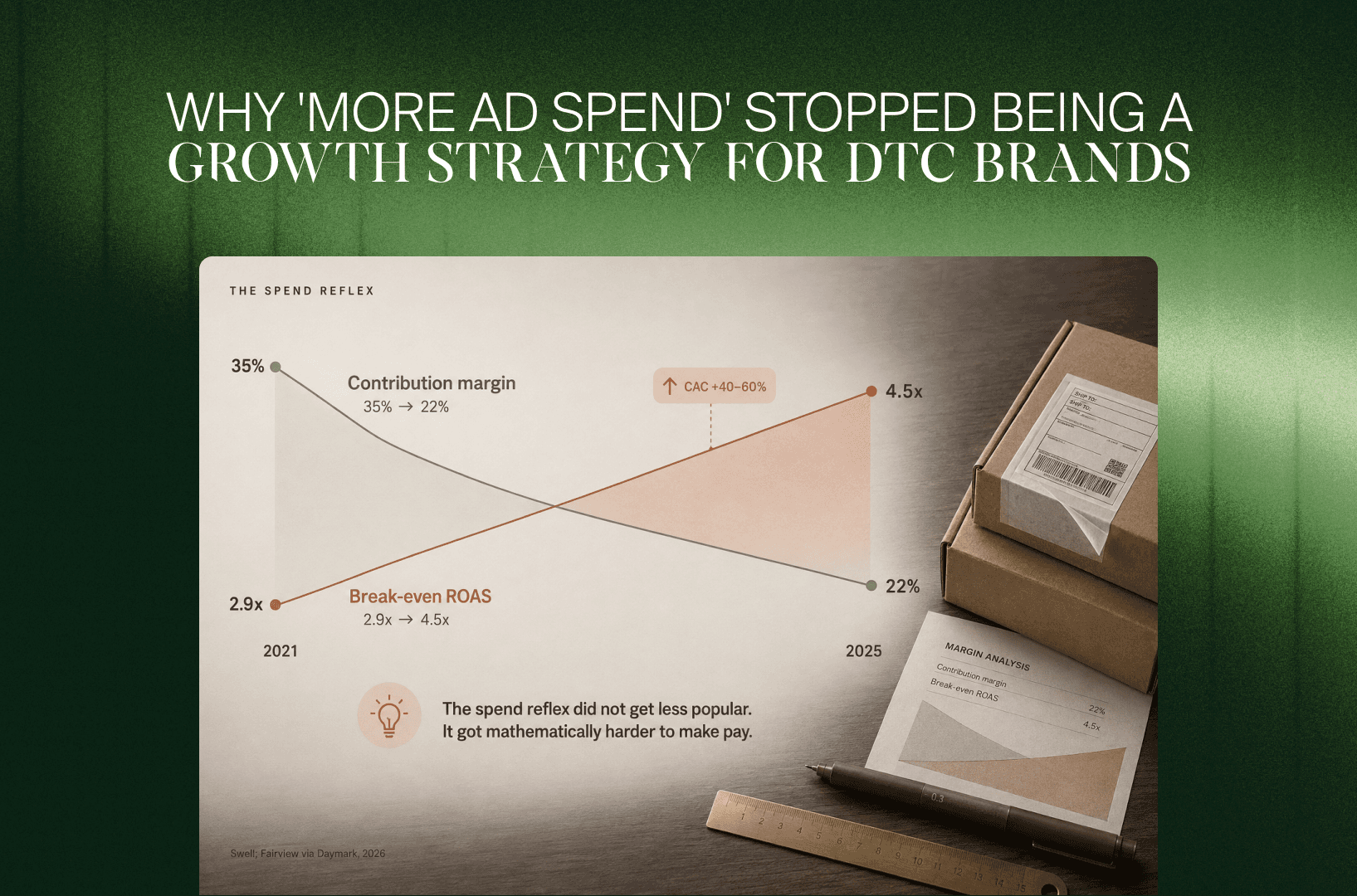
Acquisition got structurally more expensive. Multiple 2026 benchmark syntheses put the rise in ecommerce customer acquisition cost at roughly 40 to 60 percent between 2023 and 2025 alone, with Swell’s DTC data and others converging on that range. The drivers are not a bad quarter you can wait out: the 2021 iOS tracking changes gutted pixel targeting and pushed Meta acquisition costs up sharply, and ad auction inflation from mega-retailers has kept CPMs and CPCs climbing double digits year over year. The same budget simply buys fewer customers than it did.
At the same time, the margin that has to pay for all that acquisition compressed. Median DTC contribution margin fell from roughly 35 percent in 2021 to about 22 percent in 2025, according to Fairview’s analysis cited in Daymark’s 2026 benchmarks, driven mostly by those rising acquisition costs. That number matters more than it looks, because break-even return on ad spend is simply one divided by your contribution margin. A brand at 35 percent margin breaks even at about 2.9x. At 22 percent it needs 4.5x for the same result. Margin compression raised the bar on every acquisition dollar at the exact moment acquisition got more expensive. The spend reflex did not get less popular. It got mathematically harder to make pay.
Treat both figures as directional, and model your own. Contribution margin varies widely by vertical, and your CAC depends on your channel mix, so the point is the direction of travel and the mechanism, not the specific percentages. Run your own numbers through the same logic.
Growth is a constraint, not a budget line
Here is the reframe that the spend reflex misses. Profitable growth is not one number you buy more of. It is a system with three levers, acquisition, conversion, and retention, all bounded by contribution margin. Acquisition brings people in. Conversion turns the traffic you already pay for into customers. Retention decides how much each customer is worth after the first order. Contribution margin is the ceiling that decides whether any of it makes money.
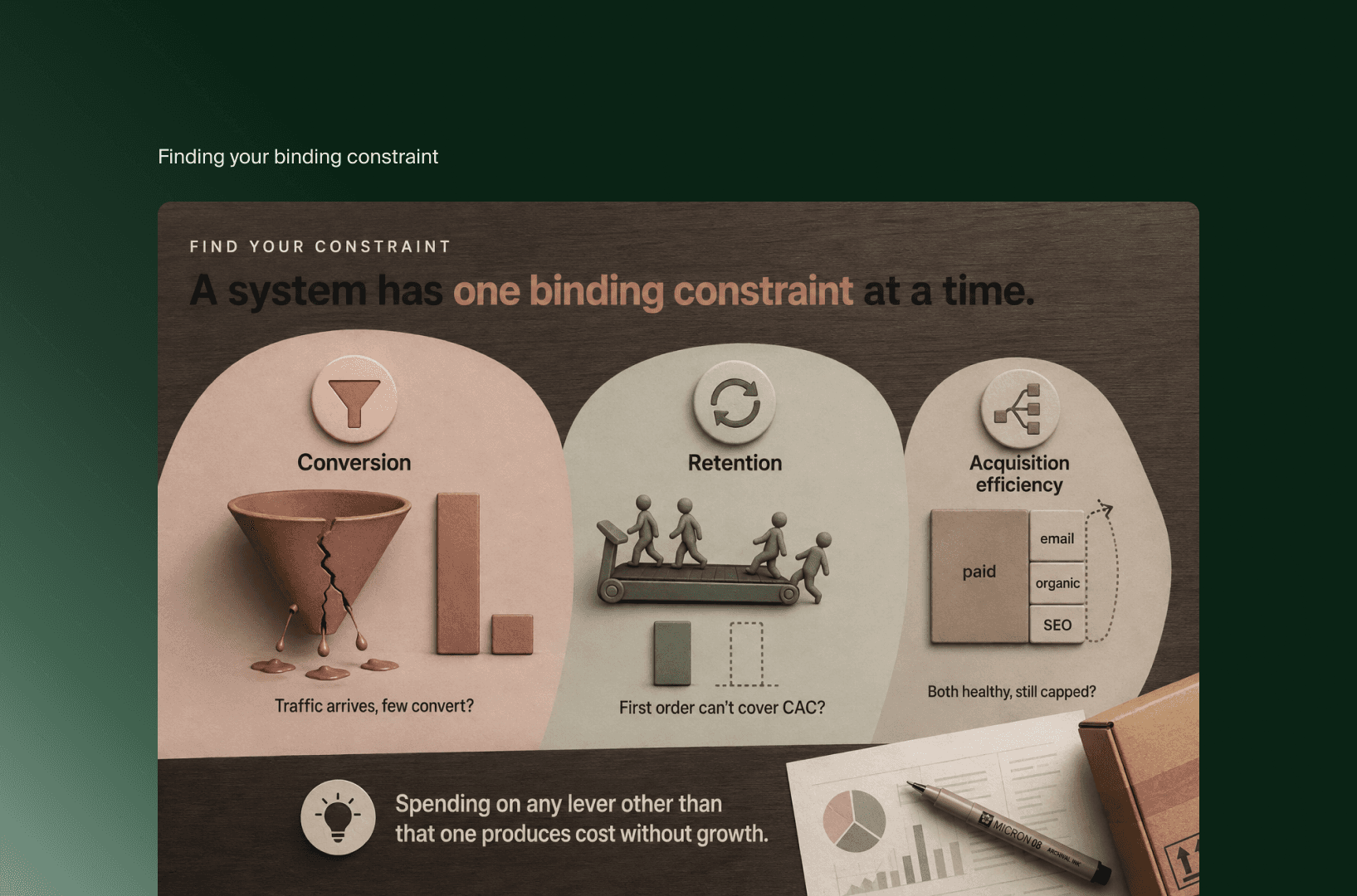
The single most useful consequence of this view is that customer acquisition cost is meaningless on its own. A $200 CAC is a disaster against a $180 first-order contribution and excellent against a $900 lifetime one. CAC only signals danger relative to the margin it has to earn back. So the real question is never “can we spend more,” it is “where is the system actually constrained,” because a system has one binding constraint at a time, and spending on any lever other than that one produces cost without growth.
The constraint funnel: from ambition to the one lever that binds
Work the problem as a funnel, from the top-line ambition down to the constraint that decides it.
Start with the revenue goal. Convert it into the number of profitable customers it requires, not the amount of spend it seems to need. Then bring it down to unit economics: what is your true contribution margin per customer, after all variable costs, and what is your true CAC, counting only net-new customers and all the costs of acquiring them. That comparison, contribution earned per customer against cost to acquire one, is where growth is won or lost, and it is worth measuring by channel and cohort rather than as a blended average, because a blended figure hides which part of the system is actually broken. Splitting metrics before drawing conclusions is a discipline in itself, and it is the same reason blended channel numbers mislead whenever two commercial models share one report.
Once those numbers are honest, the binding constraint usually names itself. It is the one of the three levers that is capping profitable growth right now, while the other two have slack. Find that lever and you have found where the next dollar should go. The rest of this guide is how to identify it.
Finding your binding constraint
Three diagnostic reads separate the three levers. Most brands recognise themselves in one of them more than the others, and that one is the constraint.
If you are leaking the traffic you already pay for, conversion is your constraint
The tell is a healthy top of funnel and a disappointing bottom. You are buying traffic, the visits arrive, and too few of them become customers. When CAC rises, this is the most under-used response, because improving the rate at which paid traffic converts extracts more customers from spend you are already making, without buying a single extra click. If your store-wide conversion looks acceptable but collapses when you segment by device or by traffic source, you are paying full price for traffic and capturing a fraction of it. Spending more on acquisition here is the classic error: it widens the top of a funnel that leaks in the middle.
If customers do not come back, retention is your constraint
The tell is a first-order contribution that cannot cover CAC, and a repeat rate that never rescues it. In a world where a large share of DTC revenue comes from returning customers, a brand that acquires and then loses them is running the acquisition treadmill at full speed to stay in place. Retention is also the lever with the best margin arithmetic, because a dollar earned from an existing customer carries almost none of the acquisition cost that a new one does, so it drops almost entirely to contribution. If your growth depends on constantly replacing customers you failed to keep, no amount of acquisition spend fixes the hole, it just feeds it faster.
If acquisition is structurally expensive and the rest is healthy, acquisition efficiency is your constraint
The tell is the one to be honest about, because it is the rarest of the three even though it feels like the default. If your conversion is genuinely strong and your customers genuinely return, and growth is still capped, then acquisition itself is the constraint, and the answer is efficiency rather than volume: diversifying away from a single expensive channel, because brands dependent on one paid platform carry the highest CAC volatility, and blending in owned channels like email, organic, and SEO measurably lowers blended acquisition cost. Note that this is efficiency work, not “spend more.” Spending more into the same expensive channel is the reflex this whole guide is about.
Why pulling the wrong lever is expensive
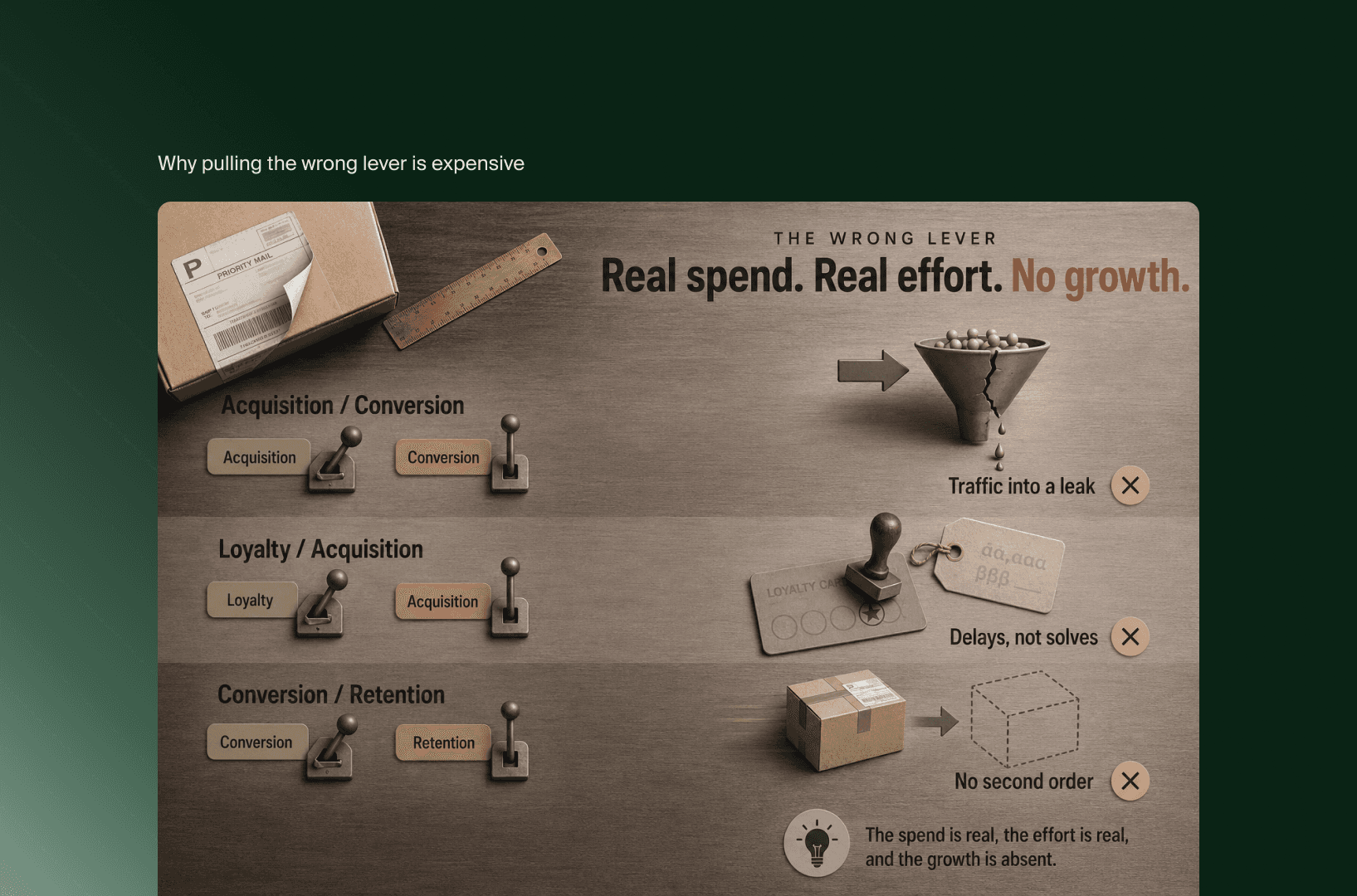
The reason to diagnose before acting is that the levers are not interchangeable, and the cost of pulling the wrong one is invisible until it has already been paid.
Put budget into acquisition when conversion is your constraint, and you pay rising CAC to send more traffic into a funnel that leaks, so your blended economics get worse, not better. Build a loyalty program when acquisition efficiency is your constraint, and you invest in retaining customers you are still overpaying to acquire, which delays rather than solves the problem. Chase conversion-rate tactics when retention is the real gap, and you optimise the first purchase of customers who will never make a second. In every case the spend is real, the effort is real, and the growth is absent, because the effort landed on a lever that was not binding. This is the specific way brands “invest in growth” and watch margin erode anyway: the investment was aimed at the wrong constraint.
What to do once you have named it
Once you know which lever binds, the plan gets simple, and it gets focused on one thing rather than spread across three. Pull the binding lever, measure the effect on contribution per customer relative to CAC, and re-diagnose, because constraints move: fix conversion and retention often becomes the next ceiling; fix retention and you may earn the room to acquire more aggressively again. Each of the three levers has its own depth of tactics, and the honest work sits inside whichever one your diagnosis surfaced, not in all three at once.
If you want a second read on where your growth is actually constrained, working from your real contribution margin and CAC rather than blended dashboards, that diagnostic is the kind of work Flatline does with DTC brands. But the first move is yours and it costs nothing: compute the two numbers honestly, and let the constraint tell you where the next dollar belongs.
If the constraint turns out to be retention or acquisition, the follow-up question is how to divide the next budget between acquisition and retention.
Key takeaways
More ad spend stopped working because acquisition cost rose roughly 40 to 60 percent from 2023 to 2025 while median contribution margin compressed from about 35 percent to 22 percent, and break-even ROAS is one divided by margin, so the target rose as spend got more expensive.
Profitable growth is a system of three levers, acquisition, conversion, and retention, bounded by contribution margin, not a budget you increase.
CAC is meaningless on its own. It only signals danger relative to the contribution margin it has to earn back, so measure both, by channel and cohort, not blended.
A system has one binding constraint at a time. Diagnose which lever is capping profitable growth, and put the next dollar there.
Pulling the wrong lever is the hidden way margin erodes: real spend, real effort, no growth, because the effort missed the constraint. Treat the benchmark figures as directional and model your own.
FAQ
What actually makes DTC growth profitable now that ad costs are high?
Matching your spend to your binding constraint rather than increasing it. Profitable growth comes from contribution margin per customer exceeding the cost to acquire them, so the lever that moves it is whichever of acquisition efficiency, conversion, or retention is currently capping that relationship. Spending on the other two produces cost without growth.
Is customer acquisition cost the right metric to focus on?
Only in relation to contribution margin. A high CAC is fine against a high lifetime contribution and fatal against a thin first-order one. Track CAC and contribution margin together, counting only net-new customers in CAC and all variable costs in margin, and by channel rather than as a blended average that hides which part is broken.
Should I cut ad spend to grow profitably?
Not necessarily. The point is not less spend, it is spend aimed at the binding constraint. If acquisition is efficient and the constraint is conversion or retention, the same or less acquisition spend can drive more profitable growth once the real bottleneck is fixed. If acquisition itself is the constraint, the answer is efficiency and channel diversification, not simply a bigger or smaller number.
Related articles


F.A.Q.

What actually makes DTC growth profitable now that ad costs are high?
Matching your spend to your binding constraint rather than increasing it. Profitable growth comes from contribution margin per customer exceeding the cost to acquire them, so the lever that moves it is whichever of acquisition efficiency, conversion, or retention is currently capping that relationship. Spending on the other two produces cost without growth.
Is customer acquisition cost the right metric to focus on?
Only in relation to contribution margin. A high CAC is fine against a high lifetime contribution and fatal against a thin first-order one. Track CAC and contribution margin together, counting only net-new customers in CAC and all variable costs in margin, and by channel rather than as a blended average that hides which part is broken.
Should I cut ad spend to grow profitably?
Not necessarily. The point is not less spend, it is spend aimed at the binding constraint. If acquisition is efficient and the constraint is conversion or retention, the same or less acquisition spend can drive more profitable growth once the real bottleneck is fixed. If acquisition itself is the constraint, the answer is efficiency and channel diversification, not simply a bigger or smaller number.