Acquisition or retention: deciding where the next euro actually returns

By Robin Laseur

It is budget season, and two line items are competing for the same money. One funds another month of Meta and Google. The other funds the flows, the loyalty logic, and the post-purchase work that turns a first order into a second. Most teams settle it with a percentage split copied from somewhere: 70/30, 60/40, whatever matched a store roughly their size. That split is the wrong instrument for the decision actually in front of you.
Acquisition vs retention spend is not a fixed ratio you set once by store size. It is a marginal question you answer one euro at a time: the next euro belongs wherever its next-euro return is higher, and the variable that flips the answer is your repeat purchase rate read against your contribution margin, not your customer count. Get that one reading right and the split stops being a guess.
What the acquisition-vs-retention decision actually is
The decision is a marginal-return comparison, not a philosophy. For the next unit of budget, you are asking which use returns more contribution: buying incremental new customers, or producing incremental repeat orders from customers you already have. Whichever returns more gets the euro. That is the whole mechanism, and it quietly disagrees with most of the advice written about it.
Two definitions do the load-bearing work. Customer acquisition cost (CAC) is the total spend to win a new customer, divided by the number of new customers it won. Cost to retain is the spend on keeping and re-purchasing existing customers, divided by the customers that spend produced a repeat order from. The famous asymmetry between the two is real, but the asymmetry is not the decision. The decision is what happens to the next euro, and averages do not answer that.
A useful way to hold it: acquisition buys a customer who has not yet returned any margin, so the first purchase usually runs at a loss once CAC is subtracted, and the investment only pays back if that customer comes back. Retention acts on customers who already cleared that hurdle, at full margin, with no acquisition toll attached. The reason the next-euro answer changes from store to store is that these two returns move at different speeds depending on one number.
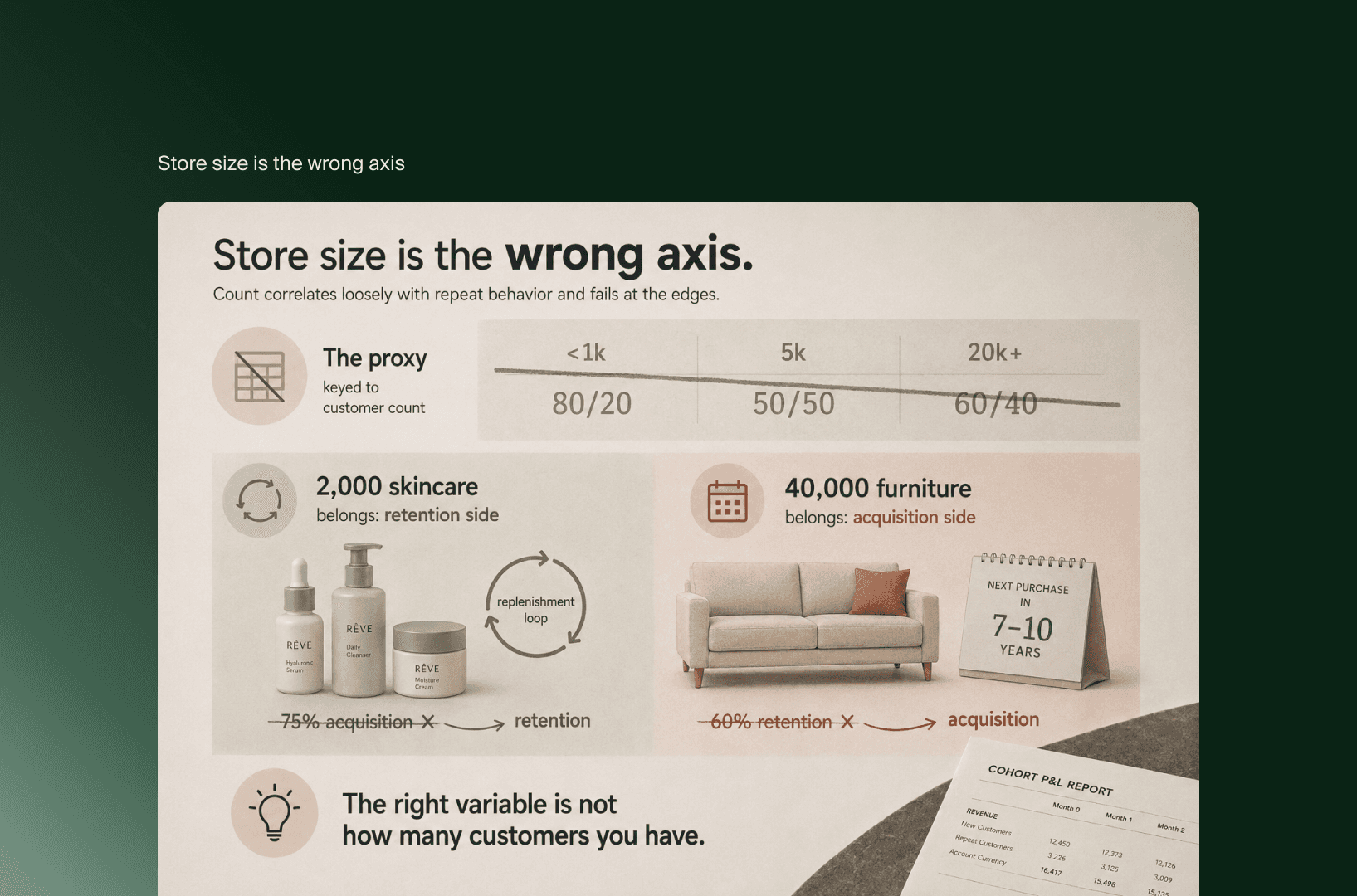
Why splitting by store size sends the next euro to the wrong place
The ranking guides almost all answer this question with a table keyed to store maturity. Under 1,000 customers, spend 80/20 on acquisition. At 5,000 spend 50/50. Past 20,000, tip toward 60/40 retention. It reads like a rule. It is a proxy, and the proxy breaks on the exact stores that most need a clear answer.
Customer count is standing in for the thing that actually matters, which is how much repeat behavior your base is capable of. Store size correlates with that loosely and fails at the edges. A twelve-month-old skincare brand with 2,000 customers and a genuine replenishment cycle sits structurally on the retention side of the line, even though the maturity table would still have it pouring 75% into acquisition. A five-year-old furniture retailer with 40,000 customers who each buy once every several years sits on the acquisition side, even though the table would tell it to defend a 60% retention allocation that has almost no repeat behavior to act on.
Size-based splits fail because they answer a question about averages (“what do stores like mine usually spend”) when the euro in your hand is a question about margins (“what does my next euro return”). The right variable is not how many customers you have. It is how many of them come back, and what each order is worth once costs are out.
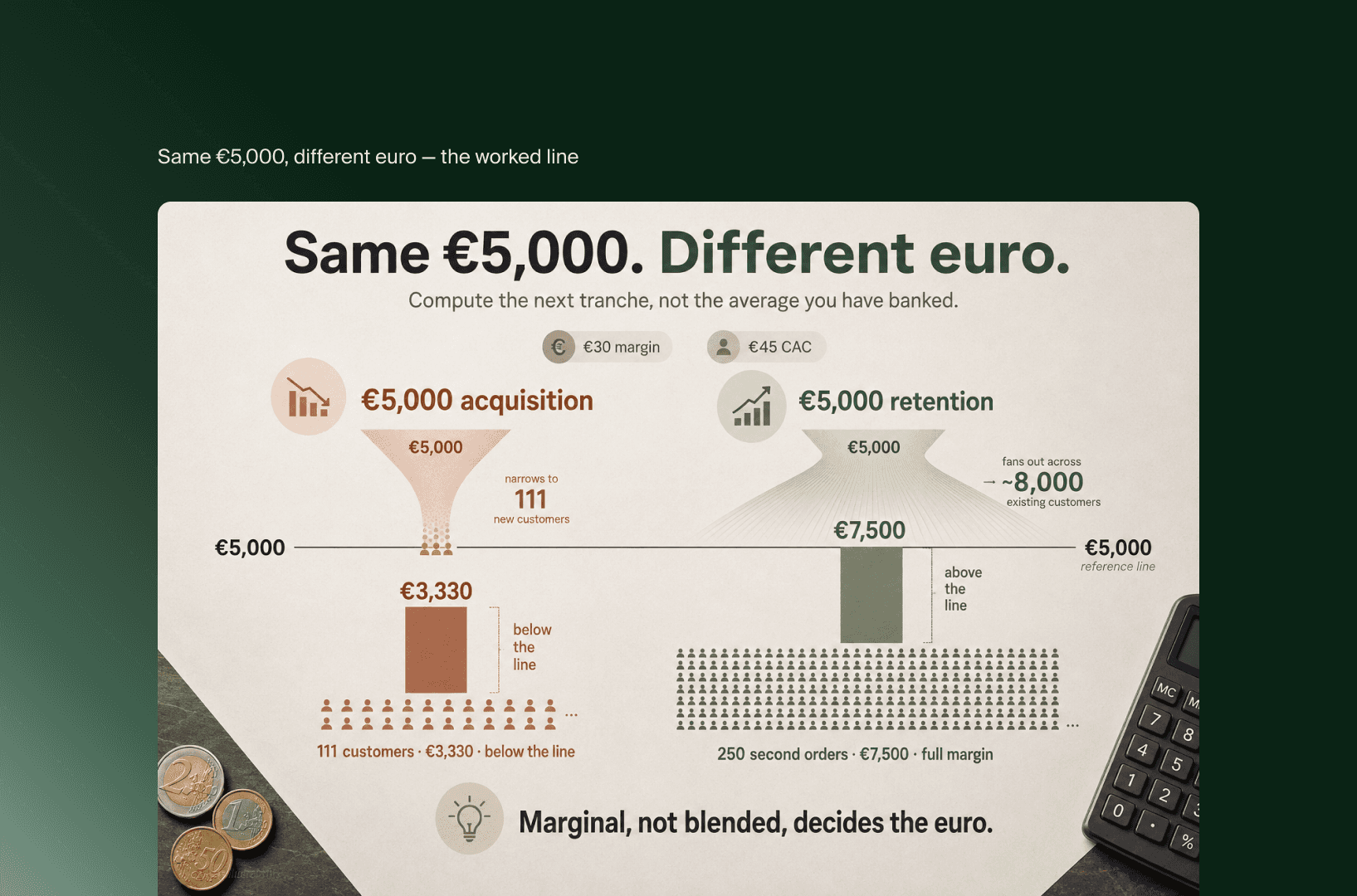
The line that decides it: repeat rate against your margin
Here is the reading that replaces the table. The next acquisition euro returns roughly the incremental customers it buys, multiplied by the margin those customers will eventually deliver across their life, minus the CAC toll paid up front. The next retention euro returns roughly the incremental repeat orders it produces across your existing base, at full contribution margin, with no toll. The line, the point the row’s hook calls the threshold, is where those two next-euro returns are equal. Below it, acquisition wins. Above it, another acquisition campaign is the worse investment.
Two forces push you above the line as repeat rate climbs. First, the retention euro acts on your whole existing base, which is almost always far larger than the trickle of new customers a marginal acquisition euro can buy. Second, every euro of margin from a retained order is kept, because you are not paying to acquire that person again. So as your repeat rate rises, the retention euro compounds against a big base at full margin while the acquisition euro keeps paying the same toll on the first order. That is why the answer is not fixed. It slides with your repeat rate.
Work it with your own numbers rather than a borrowed ratio. Suppose contribution margin runs about €30 per order, blended CAC about €45, and you have a base of 8,000 customers. A €5,000 acquisition tranche at that CAC buys roughly 111 new customers, whose first orders contribute about €3,330 in margin. That is below the €5,000 spent, so the first purchase loses money and the entire return depends on whether those 111 come back. Now put the same €5,000 into a retention improvement that lifts repeat behavior across the 8,000-strong base. If it produces on the order of 250 additional second orders at €30 margin, that is €7,500 in contribution with no acquisition cost attached. The exact figures are illustrative, and yours will differ. The structure is the point: the retention euro works a large base at full margin, the acquisition euro pays a toll first, and the gap between them widens as repeat rate rises.
The discipline this asks for is to compute the return on the next tranche of spend, not the average return you have already banked. A store can have excellent average retention economics and still find its next retention euro returns little, because it already captured the easy repeat behavior. Marginal, not blended, is the number that decides the euro. If you want to see where retention spend has already stopped returning, a revenue-focused Klaviyo audit is the kind of exercise that surfaces it.
Acquisition and retention, read side by side
Set on the same axes, the two do not compete on ideology. They compete on where your store sits on five practical dimensions.
What you are comparing | The acquisition euro | The retention euro |
What drives its return | Volume of new customers and their eventual repeat value | Size and responsiveness of your existing base |
Margin on the first effect | Negative until payback (CAC subtracted from first order) | Full contribution margin, no acquisition toll |
Payback timing | Months, and only if the customer returns | Weeks, acting on customers already primed to buy |
Ceiling | Total addressable market and rising ad costs | The size of your base and its natural repeat cycle |
Fails when | Repeat rate is high (you are re-buying customers you could have kept) | Repeat rate is near zero (there is little base behavior to move) |
Read down the columns and the trade-off is concrete. Acquisition converts money into reach and pays a toll to do it. Retention converts money into repeat behavior and keeps the full margin, but only where repeat behavior exists to convert. Neither is the virtuous choice. The right one is whichever column your repeat rate and margin currently favor.
Which side of the line are you on right now
Acquisition still wins the next euro when repeat behavior is genuinely thin. A new store with too small a base for retention programs to move the needle belongs here, and so does any catalog with a long or one-time purchase cycle, where there is no near-term second order to manufacture. Entering a new market is an acquisition case by definition, because the base you would retain does not exist yet. In all of these, funding acquisition is not the lazy default. It is the correct read of the line.
The next euro belongs in retention once the base is large enough and responsive enough that repeat orders outrun what a marginal acquisition euro can buy. Consumable and replenishable categories reach this point early, because the repeat cycle is built into the product. A brand like Gisou, built on beauty products with a natural repurchase rhythm, sits structurally on the retention side well before its customer count would suggest it. Rising acquisition costs move more stores across the line every year, because as the CAC toll climbs, the tolled euro returns less and the toll-free one returns relatively more. When you are on this side, the work is the flow and lifecycle architecture that turns a first order into a second, not another prospecting campaign.
Most stores are not cleanly on one side for every euro. The honest position is that early tranches of budget may still favor acquisition while later tranches favor retention, and the crossover is the thing to find, not a fixed percentage to defend.
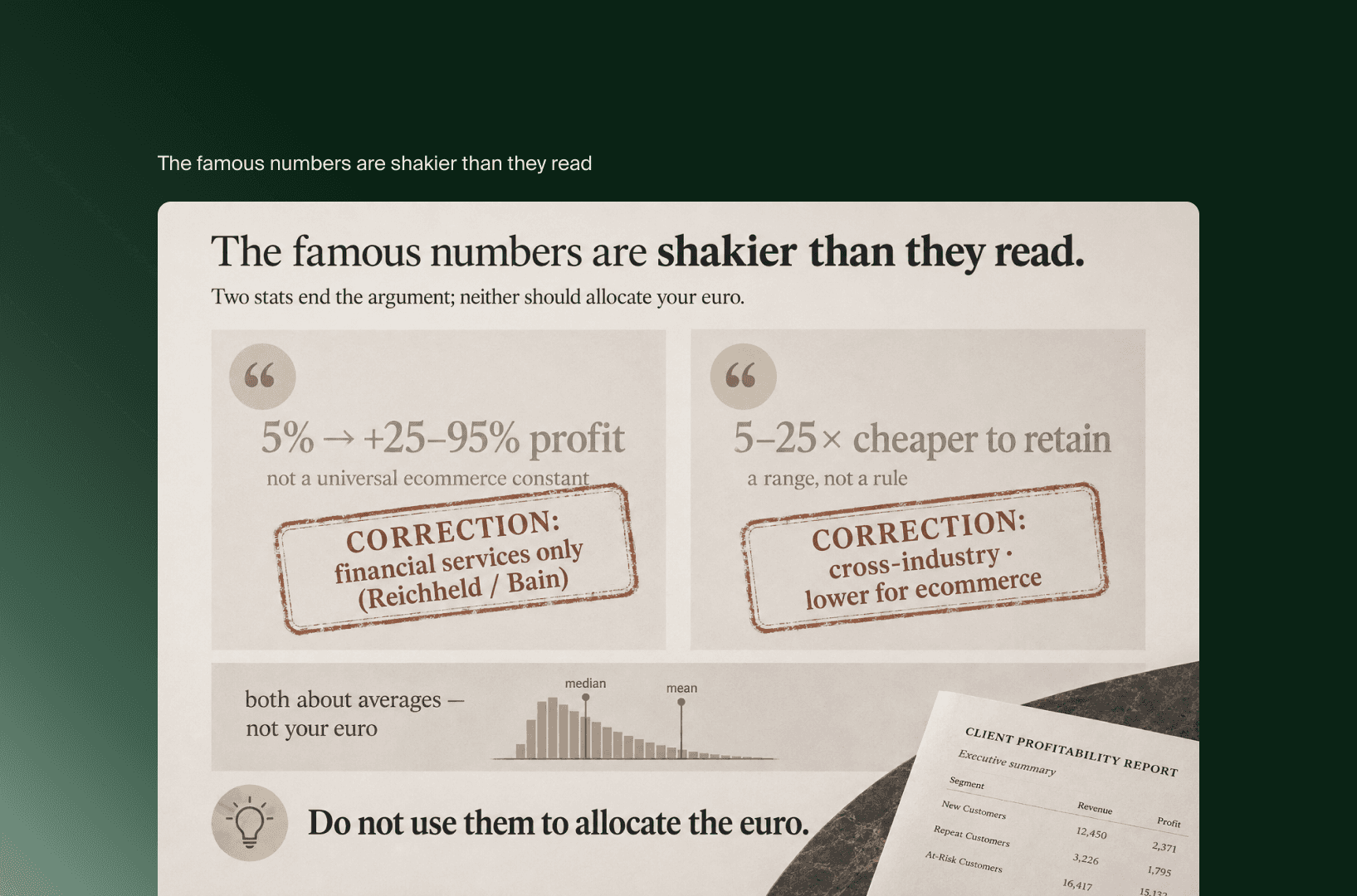
The caveat the famous retention numbers hide
Two statistics get quoted in almost every article on this topic, and both are shakier than they read. The first is that a 5% lift in retention raises profits by 25% to 95%. The second is that acquiring a customer costs five to twenty-five times more than retaining one. They are used to end the argument. They should not.
The 25% to 95% figure traces to Frederick Reichheld’s work at Bain & Company, and the original finding was specific to financial services: in that sector, a 5% increase in retention produced more than a 25% increase in profit. It was never a universal ecommerce constant, though it is repeated as one. The five-to-twenty-five-times cost multiple is a cross-industry range, and for ecommerce specifically it tends to land nearer the lower end. The widely cited Harvard Business Review treatment presents these as directional truths about the value of the right customers, not as an allocation formula for your next campaign euro.
The deeper problem is that both numbers are about averages, and the budget decision is about the margin. A headline that retention is “cheaper” tells you nothing about whether your next retention euro returns more than your next acquisition euro, because it says nothing about where your base already is. Use the statistics to take retention seriously as a discipline. Do not use them to allocate the euro. For that, only your own repeat rate and margin, read at the margin, will do.
Use the right diagnostic
This page answers one question: where the next euro of budget should go. If your question is a different one, start with the diagnostic that fits it.
Acquisition looks profitable, but cash is tight. Check whether blended CAC is hiding what a new customer really costs.
Repeat purchase is weak. Work out how much repeat purchase your margin needs, then fix the post-purchase flow that earns the second order.
The question is how to split the budget. Stay on this page: the line between repeat rate and margin above is your diagnostic.
For the strategic argument behind all three, read why profitable DTC growth starts with your binding constraint.
Frequently asked questions
What is the right acquisition-to-retention budget split?
There is no fixed right split, and any single ratio quoted without your numbers is a guess. The split is an output, not an input: it falls out of comparing the marginal return of the next acquisition euro against the next retention euro, which depends on your repeat purchase rate and contribution margin. Compute that, and the split follows.
Does a new store just focus on acquisition?
Usually yes, and not because acquisition is superior. A new store has too little repeat behavior for retention spend to act on, so the next euro genuinely returns more in acquisition. That changes as the base grows and a repeat cycle establishes, at which point the line moves and later euros start favoring retention.
How do I know when to shift budget toward retention?
Watch the marginal return, not the calendar or the customer count. When a tranche of retention spend across your existing base produces more contribution than the same tranche of acquisition spend produces in eventual new-customer margin, you have crossed the line. A cohort view of repeat rate and margin per order is enough to see it.
Is retention always cheaper than acquisition?
On average, often. At the margin, not necessarily. Once you have captured the easy repeat behavior, the next retention euro can return very little, while a store with strong latent repeat demand may still have highly profitable retention euros left. Blended averages hide this. The marginal read does not.
Key takeaways
Treat acquisition vs retention spend as a marginal decision, not a fixed ratio. The next euro goes wherever its next-euro return is higher.
The deciding variable is your repeat purchase rate read against contribution margin, not your customer count. Store-size split tables are a proxy that breaks at the edges.
The acquisition euro pays a CAC toll and returns nothing until payback. The retention euro acts on your existing base at full margin. The gap widens as repeat rate rises.
Compute the return on the next tranche of spend, not the average you have already banked. Marginal, not blended, decides the euro.
The famous retention statistics were financial-services and cross-industry findings. Use them to take retention seriously, never to allocate the budget.
If your repeat rate sits above the line, the next campaign euro is often the one quietly returning the least, and that is worth knowing before you renew the plan. Reading that line for a specific store, by repeat rate and margin rather than by rule of thumb, is part of how Flatline approaches retention as a Klaviyo Master Platinum Partner. If you want a second set of eyes on where your next euro actually returns, get in touch and we will walk through it with you.
Related articles


F.A.Q.

What is the right acquisition-to-retention budget split?
There is no fixed right split, and any single ratio quoted without your numbers is a guess. The split is an output, not an input: it falls out of comparing the marginal return of the next acquisition euro against the next retention euro, which depends on your repeat purchase rate and contribution margin. Compute that, and the split follows.
Does a new store just focus on acquisition?
Usually yes, and not because acquisition is superior. A new store has too little repeat behavior for retention spend to act on, so the next euro genuinely returns more in acquisition. That changes as the base grows and a repeat cycle establishes, at which point the line moves and later euros start favoring retention.
How do I know when to shift budget toward retention?
Watch the marginal return, not the calendar or the customer count. When a tranche of retention spend across your existing base produces more contribution than the same tranche of acquisition spend produces in eventual new-customer margin, you have crossed the line. A cohort view of repeat rate and margin per order is enough to see it.
Is retention always cheaper than acquisition?
On average, often. At the margin, not necessarily. Once you have captured the easy repeat behavior, the next retention euro can return very little, while a store with strong latent repeat demand may still have highly profitable retention euros left. Blended averages hide this. The marginal read does not.