The Cheapest LTV Lever You Already Own: Post-Purchase Flows and the Second-Purchase Problem

By Robin Laseur

Every brand under acquisition pressure already owns the highest-return automation in its stack, and most have it half-built. The post-purchase flow costs nothing in media, it speaks only to customers you have already paid to acquire, and it works the single inflection where lifetime value actually compounds: the second purchase. There is a catch that decides whether the flow earns that purchase or wastes the moment. Most post-purchase sequences are built to cross-sell, when the data shows the second purchase is overwhelmingly a reorder of the same product, and a fast one. This guide lays out the flow architecture that earns the second purchase, in dependency order, using data your store already holds.
Why the second purchase is the whole game
The reason to build around the second purchase specifically is that it is the point where a customer stops being a transaction and starts being a relationship. A first-time buyer has roughly a 27 percent chance of ever coming back, but once a customer makes a second purchase, the probability of a third rises sharply, to somewhere around 45 to 54 percent depending on the dataset, per retention benchmarks synthesised by Intempt and Sender from sources including Adobe. The odds keep climbing with each order after that. The first repeat is the steepest hill; every hill after it is gentler.
That single step forward moves lifetime value more than almost anything else you can do, because a modest lift in repeat purchase rate corresponds to a much larger lift in average customer lifetime value, on the order of 25 to 40 percent for a ten-point improvement, on the same benchmark syntheses. And you capture it through an owned channel, at near-zero marginal cost, aimed at people who have already cleared the expensive hurdle of a first purchase. That combination, high leverage and near-zero cost, is what makes the post-purchase flow the cheapest LTV lever you own. Treat the percentages as directional and check them against your own cohorts.
The assumption most post-purchase flows get wrong
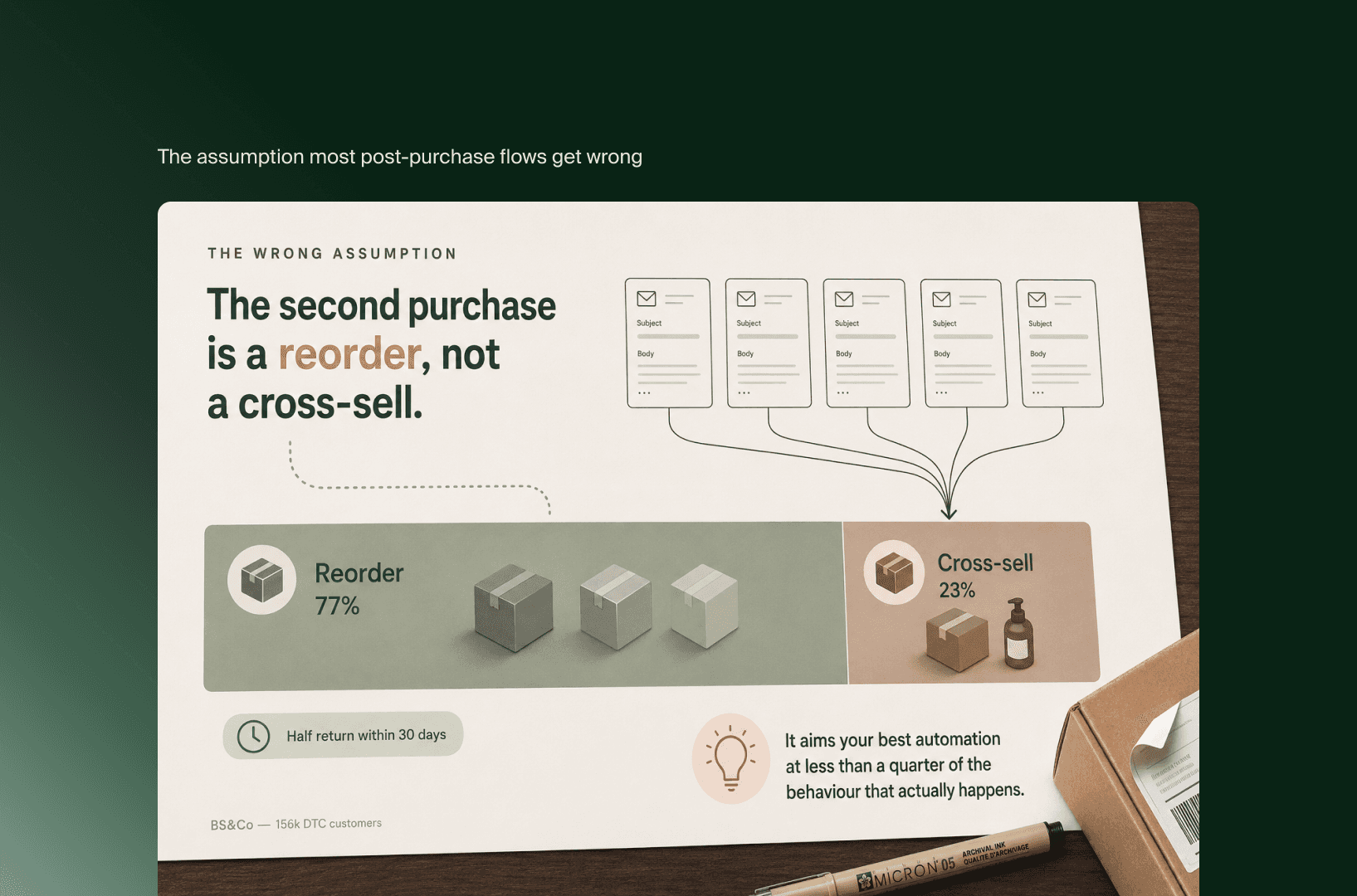
Here is the part that changes how the flow should be built. Most post-purchase marketing runs on the cross-sell assumption: you bought X, so here is Y you might also like. The behavioural data does not support leading with it. On BS&Co’s analysis of more than 156,000 DTC customers, 77 percent of second purchases were reorders of the same product, and only 23 percent were cross-sells. Half of returning customers came back within 30 days.
That reframes the job of the flow. If the dominant second purchase is a fast reorder, the flow’s primary task is to make reordering the path of least resistance and to arrive at the moment the product is running low, not to distract a satisfied customer with an unrelated recommendation. Cross-sell is real, but it is the minority path, and building the whole sequence around it aims your best automation at less than a quarter of the behaviour that actually happens. The architecture below puts the reorder at the centre where the data says it belongs, and keeps cross-sell as the secondary track it is.
The flow, stage by stage
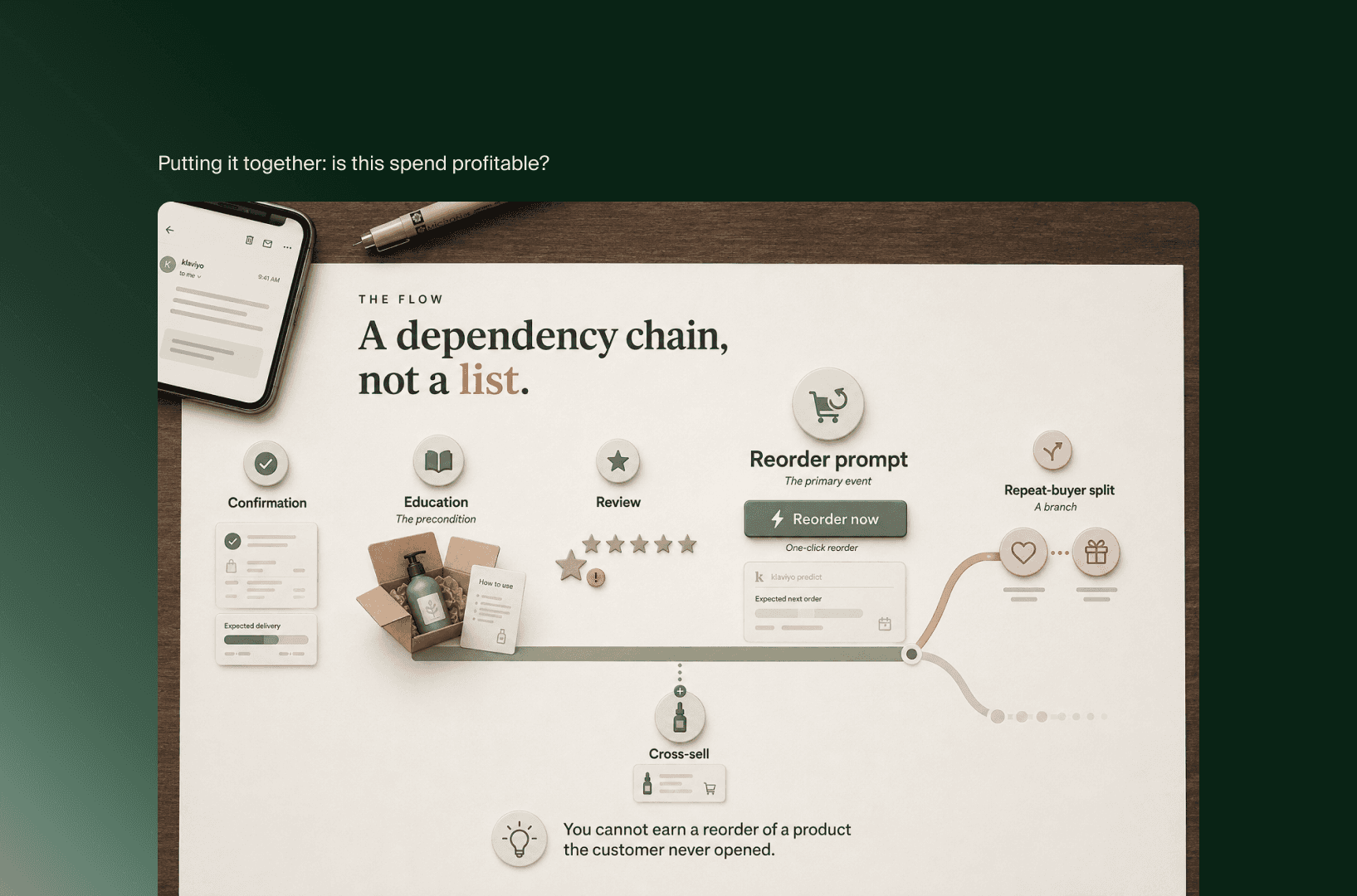
Treat this as a dependency chain rather than a list. Each stage exists because the one before it created the condition it needs, and reordering them breaks the logic.
Order confirmation, the transactional anchor
The flow opens on the Placed Order trigger with the confirmation. This message is transactional rather than marketing, it carries the highest open rate you will ever get from the customer, and its job is narrow: confirm the order, set delivery expectations, and reduce the anxiety gap between paying and receiving. It earns the attention the rest of the flow spends. It is not the place to sell anything.
Education and usage, the step everything else depends on
After the product arrives, the flow’s next job is to get it used. This is not a soft brand-building nicety, it is the load-bearing dependency of the whole sequence, because you cannot earn a reorder of a product the customer never opened or never understood how to use. Usage is the precondition for repurchase. Time this message to when the product would realistically be in hand and starting to be used, and spend it on getting the customer to a good first experience: how to use it, what to expect, how to get the most from it. Reducing early buyer’s remorse here is what protects every later stage.
The review request, social proof and an early warning
Once enough usage time has passed, the flow asks for a review. This stage depends on the previous one, because a review requested before the customer has actually used the product is premature and reads as such. It does two jobs. It generates the social proof that helps acquire the next customer, and, more quietly, it surfaces dissatisfaction before it turns into silent churn. A customer who had a bad experience, or who returned the item, is far less likely to buy again, and a return event in particular is one of the strongest negative signals for a second purchase. The review request is your chance to catch that unhappiness while you can still resolve it, rather than discovering it as a customer who simply never came back.
The reorder prompt, the primary event
This is the stage the whole flow is built to reach. Timed to the product’s real consumption cycle, it makes reordering as frictionless as possible: a one-click reorder, a reminder of what they bought, and, where it fits the product, an offer to put the reorder on a subscription so the decision is made once. Because most second purchases are reorders and many happen fast, the timing of this message matters more than its creativity. Arrive a little before the customer runs out and the message meets a need that already exists. Arrive weeks late and you are trying to reactivate a lapsed buyer instead of serving an active one, which is harder and more expensive.
Cross-sell, the secondary track
For products that genuinely are not repurchased on a cycle, or for customers who have already reordered, the flow offers a complementary product based on what they bought. This is the 23 percent path, and it belongs here, after the reorder logic rather than in front of it. Leading with cross-sell is the common mistake; placing it as the secondary track for the minority of cases where a reorder does not apply is the correction.
The repeat-buyer split, branch the moment they come back
The final piece of the architecture is a branch, not a message. The moment a customer makes that second purchase, they should exit the first-timer flow and enter a different track, because they are now a fundamentally different customer: one whose odds of buying again have roughly doubled. Continuing to send “come back” messaging to someone who already came back wastes the moment and can read as tone-deaf. The second purchase is the trigger to escalate them into a repeat-buyer or VIP track with different messaging, higher expected frequency, and loyalty mechanics. Detecting the second order and rerouting on it is the dependency that makes the split work.
Timing it with what you already own
The one variable that most decides whether the reorder prompt lands is timing, and you can move from guesswork to prediction with data already sitting in your email platform. Klaviyo’s predictive analytics, on the platform’s own documentation, generate per-customer fields including predicted customer lifetime value, churn risk, average time between orders, and an Expected Date of Next Order built from that customer’s own cadence and the patterns of your whole customer base. You can trigger the reorder prompt a few days before that expected date, so it arrives just before the customer runs low, and you can route customers whose churn risk climbs into a win-back before they lapse rather than after.
Two honest caveats keep this from being oversold. The predictions need a baseline of data before they are reliable, on the order of a few hundred customers and several months of history, so a young store times the reorder from its own median time-to-second-purchase instead. And the Expected Date of Next Order is cadence-based, not product-level: Klaviyo notes it reflects overall order behaviour rather than the specific product a customer bought, so for true replenishment you combine it with what you know about how long your product actually lasts. Used with those limits in mind, the predictive layer turns the reorder stage from a static “30 days later” guess into a moving target aimed at the moment that matters.
One compliance note worth building in from the start: several of these stages are marketing rather than transactional, so for contacts in the EU and UK they require marketing consent before the flow may send. The confirmation is transactional and always sends; the reorder, cross-sell, and win-back stages do not, unless the customer opted in.
This is one flow in a wider program, and the full lifecycle of email flows around it, welcome, browse, cart, and win-back, matters too. But the post-purchase flow is the one with the highest return per hour of build, because it works the inflection where value compounds. Architecting it, and wiring in the predictive layer that times it, is the kind of email work Flatline does with DTC brands as a Klaviyo partner. The starting move costs nothing: map your own median time to second purchase, and build the reorder prompt to meet it.
Whether this flow deserves more budget than new-customer spend is a separate call, covered in deciding between acquisition and retention spend.
Key takeaways
The post-purchase flow is the cheapest LTV lever because it is an owned channel, at near-zero marginal cost, aimed at customers you already paid to acquire, working the second-purchase inflection where value compounds.
The second purchase roughly doubles the odds of a third, and a modest lift in repeat purchase rate drives a much larger lift in lifetime value. Treat the benchmark percentages as directional and check your own cohorts.
Most post-purchase flows are built to cross-sell, but around 77 percent of second purchases are reorders of the same product, often within 30 days. Build the flow to earn the reorder; keep cross-sell as the secondary track.
The stages form a dependency chain: confirmation, then education and usage (the precondition for any reorder), then review, then the reorder prompt, then cross-sell, then a branch into a repeat-buyer track the moment the second order lands.
Time the reorder with predictive fields you already own, a few days before the expected next order, with the honest limits that the model needs baseline data and is cadence-based rather than product-level.
FAQ
What should a post-purchase email flow actually contain?
An order confirmation on purchase, a usage or education message once the product arrives, a review request after enough usage time, a reorder prompt timed to the product’s consumption cycle, a secondary cross-sell for cases where a reorder does not apply, and a branch that moves the customer into a repeat-buyer track once they buy again. The stages run in that order because each depends on the one before it.
Why is the second purchase so important for LTV?
Because it is the inflection where a one-time buyer becomes a returning one. A first-time buyer has roughly a 27 percent chance of returning, but after a second purchase the probability of a third rises to somewhere around 45 to 54 percent on published benchmarks, and the odds keep compounding. Earning that one purchase changes the economics of the whole customer relationship.
Should my post-purchase flow cross-sell or ask for a reorder?
Lead with the reorder. Analysis of a large DTC customer base found roughly 77 percent of second purchases are reorders of the same product and only 23 percent are cross-sells, so a flow built primarily to cross-sell aims at the minority behaviour. Make reordering frictionless and well-timed, and keep cross-sell as the secondary path for products that are not bought on a cycle.
Related articles


F.A.Q.

What should a post-purchase email flow actually contain?
An order confirmation on purchase, a usage or education message once the product arrives, a review request after enough usage time, a reorder prompt timed to the product’s consumption cycle, a secondary cross-sell for cases where a reorder does not apply, and a branch that moves the customer into a repeat-buyer track once they buy again. The stages run in that order because each depends on the one before it.
Why is the second purchase so important for LTV?
Because it is the inflection where a one-time buyer becomes a returning one. A first-time buyer has roughly a 27 percent chance of returning, but after a second purchase the probability of a third rises to somewhere around 45 to 54 percent on published benchmarks, and the odds keep compounding. Earning that one purchase changes the economics of the whole customer relationship.
Should my post-purchase flow cross-sell or ask for a reorder?
Lead with the reorder. Analysis of a large DTC customer base found roughly 77 percent of second purchases are reorders of the same product and only 23 percent are cross-sells, so a flow built primarily to cross-sell aims at the minority behaviour. Make reordering frictionless and well-timed, and keep cross-sell as the secondary path for products that are not bought on a cycle.