Acquisition keeps getting more expensive: shifting weight to the channels you already own

By Robin Laseur

The paid budget went up again this quarter, and the new-customer count stayed flat. Same campaigns, same creative discipline, more spend to stand still. Most teams read that line as a bidding problem and go hunting for a cheaper channel or a sharper audience.
Rising customer acquisition cost is rarely a bidding problem. It is a dependence problem. When paid channels are the only route new demand takes to reach your store, you are renting growth from an auction whose price you do not set. Shifting weight to owned channels (the email and SMS files, the content, the known-customer data you already hold) is less a cost-saving move than a hedge against that exposure.
That distinction changes what you do next. A bidding problem sends you looking for arbitrage. A dependence problem sends you to build assets that reach customers without paying the toll every time. This piece is about the second thing: why the cost keeps climbing, why “owned is cheaper” is the wrong reason to act on it, and how to decide how much weight to move and when.
Why acquisition keeps getting more expensive
Acquisition costs are rising for structural reasons, not a temporary spike you can wait out. Three inputs moved against advertisers at once: more competition inside the same ad auctions, less targeting precision after privacy changes, and fewer signals feeding the algorithms that used to find buyers efficiently. When all three shift together, the price of a new customer climbs and stays climbed.
The numbers are consistent across the field. Shopify’s 2026 acquisition data puts the average ecommerce customer acquisition cost around €41 and notes that roughly 73% of shoppers do not buy again after a first order. Benchmark tracking from MobiLoud shows CAC up about 40% in two years, with Google Ads cost-per-click rising close to 13% year over year. iOS App Tracking Transparency and the slow deprecation of third-party cookies removed much of the signal that made paid targeting cheap in the first place.
The point that matters for planning is the word structural. A cyclical cost comes back down. A structural one resets the floor. Brands that treat auction inflation as weather (something to wait out) keep bidding into the same rising curve. The ones holding margin treated it as climate and changed what they were building.
The part most teams get wrong: dependence, not price
Hunting for a cheaper channel treats the symptom. The condition underneath is that close to all of your new demand is intermediated by platforms that reprice whenever they choose. Even a brilliant media buyer operating at the efficient frontier is still buying every customer at a price the auction sets, in a market where more bidders keep arriving.
A store that can only reach new customers by buying them is priced by the auction, not by its own economics.
Owned demand is the exception to that rule. When a returning buyer opens your email, reads a piece of your content that ranks, or reorders because your post-purchase flow reached them at the right moment, that customer arrived without a per-impression toll. The reach was already paid for, once, when you built the asset. In the mid-market DTC and B2B operations we work with, the pattern holds regardless of category: the brands whose blended cost stayed flat were not the ones with the sharpest bidding. They were the ones where a meaningful share of demand no longer needed the auction at all.
This is why “owned channels are cheaper” understates the case and points at the wrong benefit. The value is not a lower cost per customer this month. The value is optionality: when the next round of auction inflation lands, a brand with owned demand can absorb it, and a brand without one has no move except to pay.
What “owned channels” actually are, and the cost nobody prices in
Owned channels are the audiences and data a brand can reach directly without paying per impression or per click: email, SMS, on-site experiences, organic content, community, and the first-party or known-customer data that sits underneath all of them. The defining trait is control of the connection. Nobody prices your access to your own list.
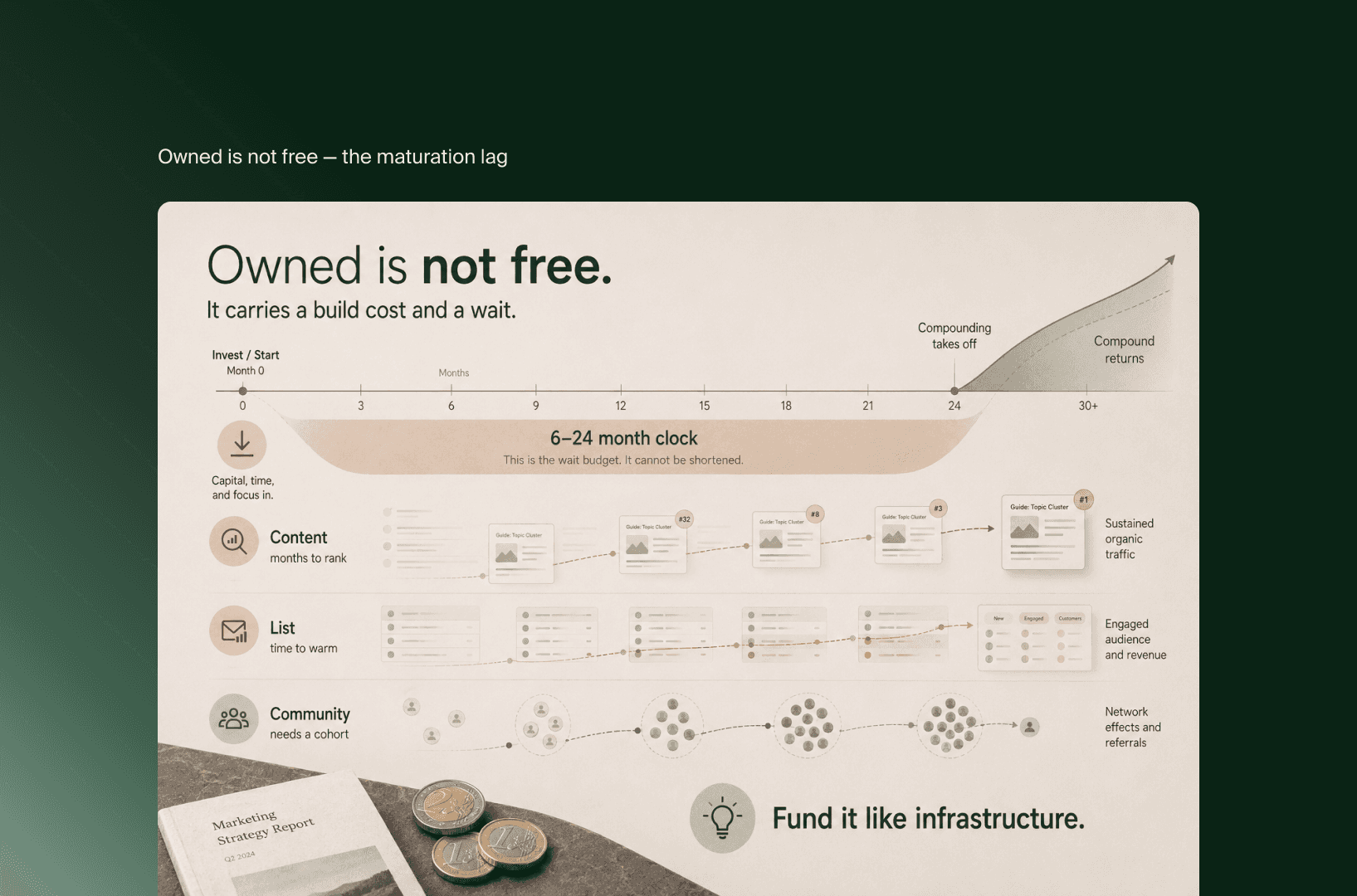
Here is the part the vendor content leaves out. Owned is not free. Every owned channel carries a build cost and a maturation lag before it returns anything. A content cluster takes months to rank. An email list takes time to grow, warm, and segment before it converts at a rate worth counting. A community needs a founding cohort and a reason to participate before it refers anyone. The hedge is real, and it carries a premium: the work and the wait between the investment and the payoff.
That premium is exactly why owned programs so often disappoint. A brand treats the list as free traffic, sends the occasional discount blast, sees weak returns, and concludes owned “does not work for us.” What actually happened is that the asset was never built past its first week. Owned channels reward the brands that fund them like infrastructure, not the ones that treat them as a costless afterthought once paid gets expensive.
How much weight should actually move onto owned
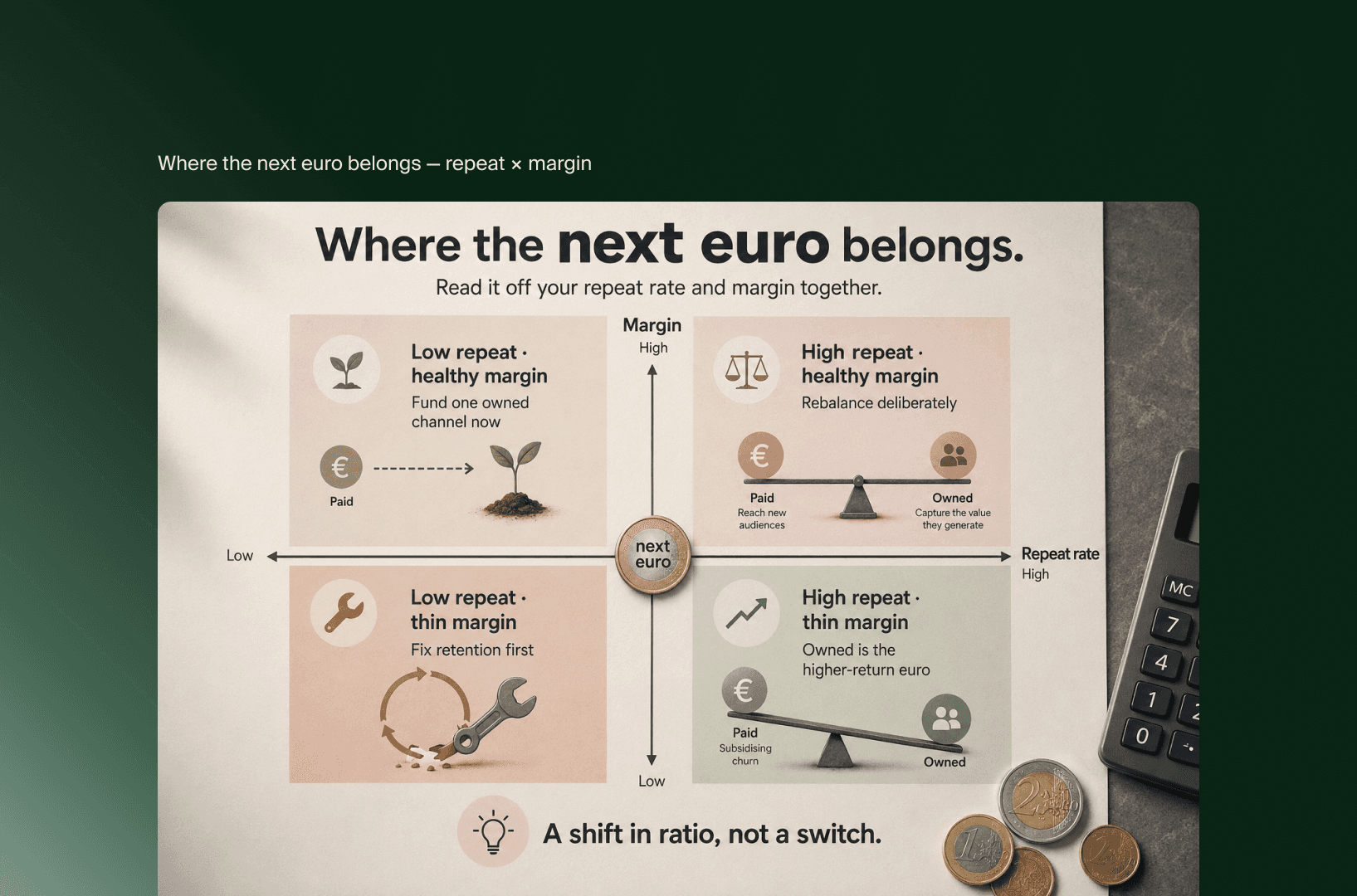
The honest answer is: it depends on your repeat rate and your margin, and the two together tell you where the next euro belongs. Below a certain repeat rate, acquisition still earns more at the margin, because you do not yet have enough returning demand for owned channels to compound against. Above it, another prospecting campaign is often the worse investment, because the customers you already have are the cheaper growth you are underusing.
A rough way to read your own position:
Your situation | Where the next euro tends to return |
Low repeat rate, thin margin | Fix retention economics first. Neither more paid nor more owned pays until the second purchase happens. |
Low repeat rate, healthy margin | Paid still earns at the margin, but start funding one owned channel now so it matures before you need it. |
High repeat rate, thin margin | Owned is the higher-return euro. Paid is quietly subsidising churn you could hold with better flows. |
High repeat rate, healthy margin | Rebalance deliberately: paid to reach genuinely new audiences, owned to capture the value they generate. |
The move is a shift in ratio, not a switch. Paid channels remain the way you reach audiences who have never heard of you. What changes is the job you give them: less “buy a one-time purchase,” more “put a new customer into an owned relationship you can grow.” A brand that measures paid only on first-order return will always underinvest in the customer lifetime value that owned channels are built to compound.
When to start, and why timing decides whether the hedge pays
Because owned channels mature on a lag, the value of starting is highest before the auction forces the decision. A brand that begins building owned demand while paid still works is funding the hedge from a position of strength, on its own timeline, with budget that is not yet under pressure. A brand that waits until paid economics break is building the same infrastructure in the least favourable conditions: margins already squeezed, and a 6-to-24-month maturation clock that no amount of budget shortens.
Swapfiets is a useful illustration of the far end of this idea. A subscription model builds owned, recurring demand into the business by design, rather than bolting it on after acquisition gets expensive. Most brands cannot restructure into a subscription, but the principle transfers: owned demand created early, as part of how the business runs, is worth more than owned demand assembled in a hurry once the auction has already repriced you.
The uncomfortable version of this is that the right time to build was a year ago, and the second-best time is now, before the number forces it. Timing is not a detail here. It is most of whether the hedge ever pays.
Which owned channel to build first, given your constraints
There is no universal first channel, which is precisely what the single-vendor guides get wrong. The right starting point follows from your category and your data, not from whichever platform published the advice.
If you have a genuinely repeatable product and a decent list, build retention flows first. Post-purchase, replenishment, and winback sequences on email and SMS return fastest because the audience and the intent already exist.
If your category is high-consideration and you have real expertise, build content. Organic content compounds slowly but reaches buyers who are actively searching, at zero marginal cost per visitor once it ranks.
If your growth depends on recognising repeat buyers across touchpoints, start with first-party data and loyalty. Knowing who your customers are is the layer every other owned channel runs on.
Brands with strong repeat purchase behaviour, common in DTC categories like the beauty and personal-care space Gisou operates in, tend to see retention flows pay back first, which is why that is the usual starting point when the data supports it. The sequencing is a judgement call about where your particular business already has latent demand it is not yet reaching directly.
Before you move budget onto owned channels, check whether your next euro belongs in acquisition or retention.
Frequently Asked Questions
Does shifting to owned channels mean cutting paid?
No. Paid channels remain the most effective way to reach audiences who have never encountered your brand. The shift is in ratio and in role: paid moves from buying one-time purchases to feeding new customers into owned relationships, while owned channels capture and compound the value those customers generate over time.
Are owned channels actually cheaper per customer?
Not necessarily upfront. Owned channels carry a build cost and a maturation lag, so the early cost per customer can be high. The saving shows up two ways over time: lower exposure to auction inflation, and compounding returns as a list, content library, or community grows without proportional reinvestment.
How long until owned channels pay back?
It varies by channel. Email and SMS improvements can return within weeks once behavioural flows are in place. Content typically takes several months to rank and longer to generate meaningful traffic. Community and loyalty compound over quarters. The full effect, where the channels reinforce each other, tends to become visible over a one-to-two-year horizon.
What is the first metric to watch?
Blended CAC trend alongside repeat purchase rate. A blended cost that holds or falls while the business grows is the clearest signal that owned demand is doing real work, rather than the brand simply spending more to buy the same growth.
Key Takeaways
Rising customer acquisition cost is structural, not cyclical: more auction competition, less targeting signal, and higher cost-per-click have reset the floor, and waiting it out is not a strategy.
The sharper framing is dependence, not price. A brand that can only reach new customers by buying them is priced by the auction. Owned demand is the demand that reaches customers without paying the toll each time, which makes it a hedge against exposure rather than just a cheaper channel.
Owned channels are not free. They carry a build cost and a maturation lag, and the brands that treat them as costless afterthoughts are the ones who conclude they do not work.
How much weight to move follows from repeat rate and margin together, and it is a shift in ratio, not a switch. Timing decides whether the hedge pays: build owned demand before the auction forces it, because the maturation clock cannot be shortened with budget.
Which channel comes first is a constraint question, not a template. Repeatable product points to retention flows, high-consideration categories to content, recognition-dependent growth to first-party data and loyalty.
Worth saving before the next budget review, and worth sharing with whoever owns the paid line.
Related articles


F.A.Q.

Does shifting to owned channels mean cutting paid?
No. Paid channels remain the most effective way to reach audiences who have never encountered your brand. The shift is in ratio and in role: paid moves from buying one-time purchases to feeding new customers into owned relationships, while owned channels capture and compound the value those customers generate over time.
Are owned channels actually cheaper per customer?
Not necessarily upfront. Owned channels carry a build cost and a maturation lag, so the early cost per customer can be high. The saving shows up two ways over time: lower exposure to auction inflation, and compounding returns as a list, content library, or community grows without proportional reinvestment.
How long until owned channels pay back?
It varies by channel. Email and SMS improvements can return within weeks once behavioural flows are in place. Content typically takes several months to rank and longer to generate meaningful traffic. Community and loyalty compound over quarters. The full effect, where the channels reinforce each other, tends to become visible over a one-to-two-year horizon.
What is the first metric to watch?
Blended CAC trend alongside repeat purchase rate. A blended cost that holds or falls while the business grows is the clearest signal that owned demand is doing real work, rather than the brand simply spending more to buy the same growth.