Klaviyo Customer Hub: 3 Advanced Plays to Increase Customer Lifetime Value

By Robin Laseur

Customer acquisition is getting more expensive. Expectations are rising. And yet, many ecommerce brands still treat customer experience as a support function rather than a revenue channel.
According to Klaviyo’s latest research, 74% of consumers expect personalized experiences in 2025, but only 27% recall receiving a personalized offer in the last six months. At the same time, 33% of shoppers cite inconsistent pricing and promotions across channels as their biggest frustration, and 1 in 5 will abandon a brand after a single negative experience. These are not branding gaps. They are orchestration failures.
Klaviyo Customer Hub enters the picture as more than a self-service account area. It extends marketing automation beyond email and SMS into the on-site experience, turning every logged-in interaction into actionable customer data. Instead of operating in silos, brands can connect behavioral signals, support interactions, loyalty activity, and purchase history inside one unified environment.
This shift matters because Customer Lifetime Value is no longer improved through more campaigns alone. It is improved through smarter segmentation, predictive analytics, and personalized marketing across the full customer journey. Klaviyo Customer Hub gives ecommerce teams the infrastructure to move from batch-and-blast messaging to connected, full-funnel revenue orchestration.
In this article, we break down how to use Klaviyo Customer Hub strategically, with three advanced plays that increase Customer Lifetime Value and turn customer experience into measurable revenue growth.
Why Klaviyo Customer Hub changes the role of marketing automation
Marketing automation in ecommerce has traditionally been channel-based: Email flows, SMS reminders, WhatsApp messages, push notifications, campaign calendars built around promotions. Effective, but reactive.
The limitation is not creativity. It is scope.
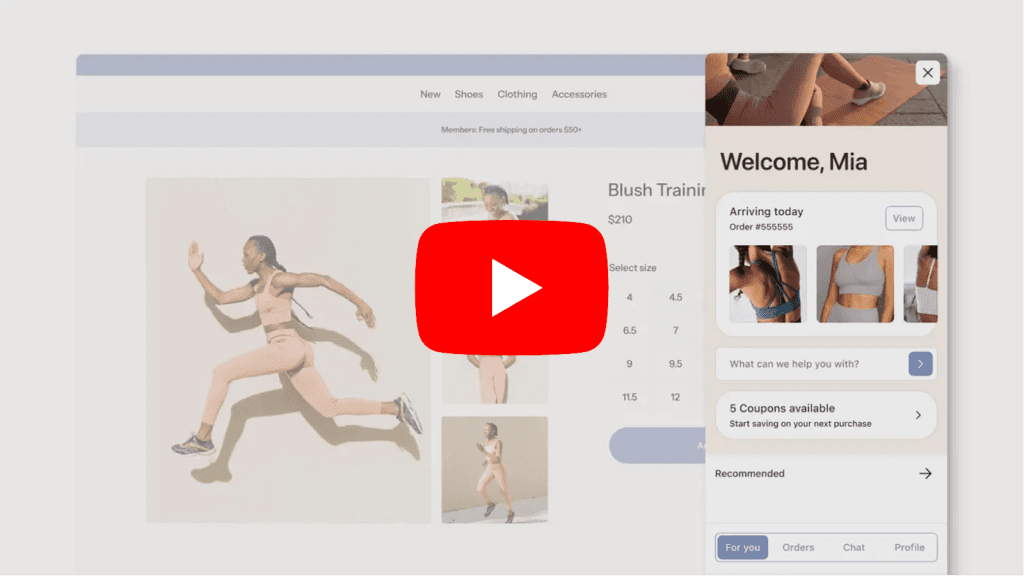
Most brands collect rich behavioral data across their storefront, loyalty programs, returns, subscriptions, and support interactions. Yet much of that data remains disconnected from the automation layer. Marketing responds to purchases and opens, while high-intent signals inside the logged-in experience go unused.
Klaviyo Customer Hub expands marketing automation beyond the inbox. It brings the on-site experience into the same environment that powers Klaviyo flows, segmentation, and predictive analytics. When a customer tracks an order, adds an item to their wishlist, redeems loyalty points, initiates a return, or browses while signed in, that activity becomes actionable data.
Instead of relying on static segments such as “Engaged 30 Days,” teams can build dynamic segments based on real behavioral signals:
Customers who viewed a specific category multiple times without purchasing
Loyalty members with available rewards who have not redeemed them
High predicted CLV customers browsing without adding to cart
Customers who initiated a return within the last 7 days
These signals can immediately trigger personalized marketing sequences across email, SMS, WhatsApp, and push. The storefront and the automation engine operate as one system.
This is where Klaviyo Customer Hub shifts the role of marketing automation from campaign execution to revenue orchestration. It connects marketing, service, and behavioral data into a unified customer profile, allowing predictive models such as Expected Next Order Date and Predicted CLV to inform when and how brands act.
For ecommerce teams facing rising acquisition costs, that shift is structural. Growth no longer depends on sending more campaigns. It depends on activating the right data at the right moment to increase Customer Lifetime Value.
Play 1: Behavioral segmentation that moves beyond Engaged 30 Days
Segments like “Engaged 30 Days” or “Opened Last 14 Days” measure activity. They do not measure intent.
Klaviyo Customer Hub allows brands to use signed-in onsite behavior as segmentation input. Browsing history, wishlist activity, loyalty rewards, order tracking, and returns are captured inside the customer account environment and immediately synced with Klaviyo.
This means segmentation can reflect what customers are actually doing inside their account, not just how they interact with campaigns.
Recipe 1: Logged-in category engagement without conversion
Segment logic
Customer logged into Customer Hub
Viewed a specific product category multiple times
Has not placed an order in that category
This is authenticated account-level behavior. It signals interest inside the signed-in experience, not anonymous traffic.
Action
Trigger a Klaviyo flow that:
Displays dynamic recommendations from the viewed category
Surfaces available loyalty rewards if applicable
Aligns messaging across email, SMS, WhatsApp, and push
Suppresses duplicate promotional campaigns during the flow window
Instead of sending generic browse abandonment emails, the flow responds to identified intent captured inside Customer Hub.
Recipe 2: Return interaction as a retention signal
Segment logic
Customer initiated or completed a return via Customer Hub
No follow-up purchase
Return activity inside Customer Hub is not just operational data. It is a structured lifecycle event connected to the customer profile.
Action
Trigger a retention flow that:
Acknowledges the return
Recommends alternative or complementary products
Aligns follow-up messaging across email, SMS, WhatsApp, and push
Sequences value-first communication before incentives
Because return behavior feeds directly into Klaviyo, marketing can respond immediately and consistently across channels.
Why this approach drives Customer Lifetime Value
By shifting segmentation from shallow engagement metrics to authenticated, behavior-driven intent, Klaviyo Customer Hub makes automation more predictive and less reactive.
Instead of sending campaigns to everyone who opened an email last month, automation responds to meaningful onsite actions captured inside the customer account experience. Browsing, wishlist activity, loyalty engagement, and return interactions feed directly into segmentation and immediately activate flows.
Because this behavior is tied to identified profiles, messaging can be coordinated across email, SMS, WhatsApp, and push without conflicting incentives or duplicated campaigns.
This is where Customer Hub impacts Customer Lifetime Value.
When onsite behavior continuously updates the customer profile, and that profile directly informs flow logic, brands move from campaign-based marketing to lifecycle orchestration. Marketing dollars follow intent. Incentives become more strategic. Retention becomes structured rather than reactive.
Behavior-based segmentation does not just refine audience lists. It strengthens how automation captures intent, triggers flows, and drives measurable revenue over time.
Play 2: Using predictive analytics to increase Customer Lifetime Value
Behavior tells you what a customer has done. Predictive analytics tells you what they are likely to do next.
Klaviyo Customer Hub strengthens predictive models by feeding real on-site behavior into unified customer profiles. Wishlist activity, browsing patterns, loyalty engagement, returns, and support interactions all refine how Klaviyo calculates metrics such as Expected Next Order Date and Predicted CLV.
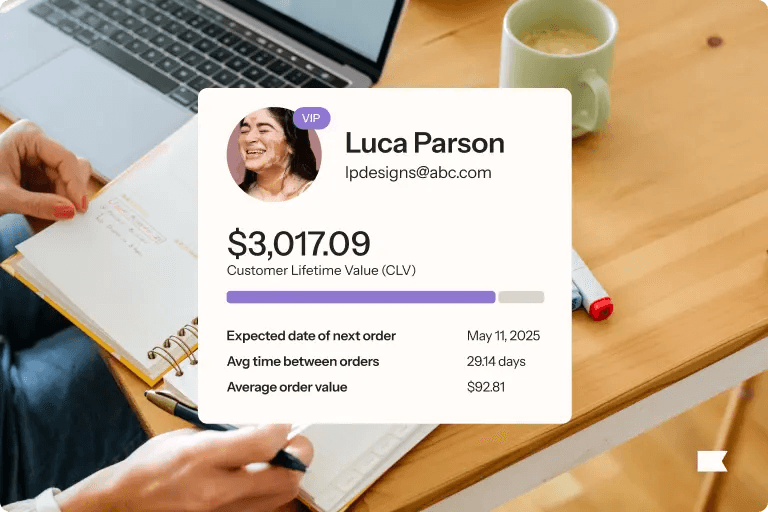
Instead of reacting to churn, brands can act before it happens.
Recipe 1: Trigger before the next purchase window
Segment logic
Expected Next Order Date within the next 5–7 days
No purchase yet
Action
Launch a reminder flow that:
Highlights replenishment items
Surfaces complementary products
Uses incentives only if no action occurs
Rather than sending generic promotions, this approach aligns messaging with predicted buying cycles. It captures revenue without over-discounting.
Recipe 2: Allocate incentives based on predicted CLV
Segment logic
High predicted Customer Lifetime Value
Repeat purchase history
Action
Prioritize early access launches
Offer VIP-tier benefits instead of blanket discounts
Increase cross-sell exposure
Brands like Ruffwear have demonstrated that smarter segmentation reduces unnecessary discounting while still driving revenue growth. By aligning offers with predicted value, marketing protects margin while increasing repeat purchase rate.
Recipe 3: Intervene when churn risk rises
Segment logic
Increasing churn risk
Declining engagement
No purchase within predicted cycle
Action
Trigger a retention flow that:
Acknowledges inactivity
Provides educational or value-based content
Tests incentive sensitivity through conditional splits
Research from Klaviyo shows that 50% of customers are willing to give a brand a second chance after a negative experience if compensation is offered. Predictive churn modeling ensures that incentive is deployed strategically, not universally.
Why predictive activation matters
Predictive analytics becomes significantly more powerful when paired with on-site behavior from Klaviyo Customer Hub. Every logged-in interaction refines forecasting models, making segmentation more accurate over time.
This is the difference between reactive automation and forward-looking revenue orchestration. Brands that activate predictive CLV and reorder timing do not simply recover churn. They extend Customer Lifetime Value systematically.
Play 3: Omnichannel consistency without spamming the customer
More channels do not automatically mean more revenue. Inconsistent messaging across email, SMS, WhatsApp, push notifications, and on-site touchpoints creates friction instead of growth.
According to Klaviyo research, 33% of shoppers cite inconsistent pricing and promotions across channels as their biggest frustration. When offers differ between email, SMS, WhatsApp, push, and the storefront, trust erodes. When frequency increases without coordination, unsubscribe rates follow.
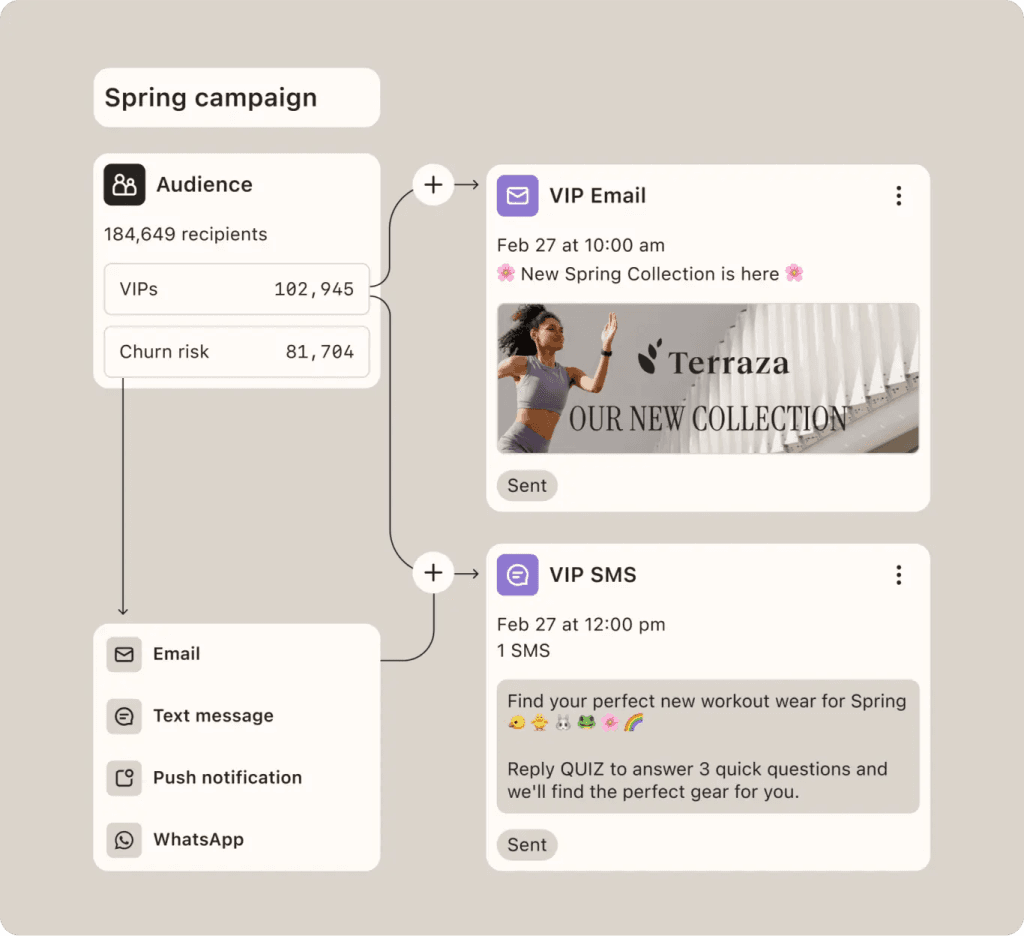
Klaviyo Customer Hub centralizes onsite behavior inside a unified profile. That profile becomes the control layer for coordinated marketing automation across channels.
Here is how to operationalize that consistency.
Recipe 1: Cross-channel suppression logic
Segment logic
Customer received SMS in the last 24 hours
Customer clicked an email in the last 12 hours
Action
Build conditional splits inside Klaviyo flows that:
Suppress duplicate promotional messages
Adjust channel priority based on historical engagement
Prevent stacking email, SMS, WhatsApp, and push within short time windows
If a subscriber consistently engages more via SMS than email, prioritize SMS for time-sensitive campaigns. If engagement shifts, update channel weight accordingly.
Consistency is not about sending more. It is about sending with coordination.
Recipe 2: Smart timing across channels
Segment logic
Identified optimal engagement window using Smart Send Time
High predicted CLV segment
Action
Deliver campaigns at predicted high-engagement times
Align email, SMS, WhatsApp, and push timing to avoid overlap
Reflect the same promotion inside Customer Hub simultaneously
When a customer logs into their account, onsite messaging mirrors what they received via other channels. No conflicting incentives. No duplicated urgency.
Recipe 3: Align loyalty and promotions across touchpoints
Segment logic
Loyalty member with available rewards
Active browsing session inside Customer Hub
Action
Display redeemable points directly inside Customer Hub
Trigger reminder flows only if no action occurs
Suppress generic discounts when loyalty value is available
Loyalty data should inform promotion logic across email, SMS, WhatsApp, and push, not operate separately. When incentives are coordinated, brands reduce discount dependency while increasing repeat purchase likelihood.
Why omnichannel orchestration protects Customer Lifetime Value
When marketing automation operates in silos, frequency increases while effectiveness declines.
Klaviyo Customer Hub connects onsite experience with email, SMS, WhatsApp, and push flows through a unified profile layer. That coordination reduces message fatigue, prevents pricing conflicts, and preserves customer trust.
For brands facing rising acquisition costs, protecting Customer Lifetime Value depends on orchestration. Consistency across channels is not optional. It is structural.
From email tool to customer data platform
Klaviyo is often described as an email marketing platform. That definition no longer reflects how the system operates. Email and SMS are only the output layers. The real value lies in the data infrastructure behind them.
Klaviyo Customer Hub strengthens that infrastructure by connecting on-site behavior directly to the customer profile. When customers log in to manage orders, initiate returns, redeem loyalty points, or browse products, those interactions do not sit in isolation. They update segmentation, refine predictive metrics, and influence automation logic in real time.
This is where Klaviyo functions as a Customer Data Platform in practice.
A CDP is not defined by dashboards. It is defined by unified, actionable data. With Klaviyo Customer Hub, brands can centralize:
Transaction history
Browsing and wishlist activity
Loyalty engagement
Support interactions
Predictive properties such as Expected Next Order Date and Predicted CLV
Instead of sending campaigns based only on opens and clicks, automation responds to intent signals from across the entire customer lifecycle.
This structural shift matters in an environment where loyalty is limited and acquisition costs continue to rise. When post-purchase behavior feeds pre-purchase personalization, marketing and service stop operating in silos. Every interaction strengthens segmentation accuracy and improves how Customer Lifetime Value is modeled.
Klaviyo Customer Hub does not replace marketing automation. It expands it. By embedding the on-site experience into the same data environment that powers Klaviyo flows, brands move from channel optimization to lifecycle orchestration.
That is the difference between using an email tool and operating a Customer Data Platform.
How Flatline activates Klaviyo Customer Hub at scale
Klaviyo Customer Hub becomes powerful when the underlying data structure is solid. Without clear segmentation logic, flow architecture, and deliverability strategy, even the best tools underperform.
As a Klaviyo Master Platinum Partner, Flatline works with ecommerce brands that operate at scale. The focus is not on sending more campaigns, but on building infrastructure that supports lifecycle orchestration.
For example, with Dekbed-Discounter, one of the largest online bedding retailers in the Benelux, Flatline rebuilt their Klaviyo environment for over 2.6 million contacts. The project centered on structured segmentation, lifecycle flow design, and predictive-driven retention logic.
The result was a scalable foundation that allows behavioral data to drive automation instead of relying on generic campaign blasts. That same strategic approach applies when activating Klaviyo Customer Hub. On-site interactions, loyalty signals, and service data only create impact when they are embedded into a structured automation framework.
Customer Hub is not a plug-and-play growth lever. It performs best when integrated into a broader Customer Data Platform strategy.
Audit your welcome flow before investing more in acquisition
When acquisition costs rise, the instinct is to increase spend. More ads. More traffic. More top-of-funnel pressure.
But sustainable growth rarely breaks at the top. It breaks in retention.
Before allocating additional budget to paid acquisition, audit what happens after a customer enters your ecosystem. Review your welcome flow. Examine your segmentation logic. Assess whether your automation reflects real behavioral signals or outdated engagement rules.
Ask yourself:
Are predictive metrics such as Expected Next Order Date and Predicted CLV actively shaping your flows?
Does your on-site experience align with your email and SMS messaging?
Are loyalty activity and service interactions integrated into your automation logic?
Is Klaviyo Customer Hub feeding data back into segmentation in real time?
Customer Lifetime Value increases when these systems operate as one.
Klaviyo Customer Hub provides the infrastructure to connect on-site behavior, marketing automation, and service data into a unified lifecycle strategy. The opportunity is not simply to launch new flows. It is to build a retention engine that compounds over time.
If your current setup relies on broad engagement segments and reactive campaigns, start with a structured audit of your welcome flow and retention architecture. The fastest path to growth may not be more traffic, but better orchestration of the customers you already have.
And if you need a second pair of eyes to evaluate your Klaviyo setup, Flatline works with ecommerce brands to transform automation into a scalable Customer Data Platform strategy.
Related articles


F.A.Q.

How can Klaviyo Customer Hub increase customer lifetime value?
Customer Hub connects logged-in onsite behavior, loyalty activity, order management, returns, and browsing signals with Klaviyo profiles. Those richer profiles improve segmentation, prediction, and lifecycle automation so brands can respond to customer intent more precisely.
How is Customer Hub segmentation different from basic engagement segments?
Basic segments such as Engaged 30 Days measure activity, while Customer Hub can capture intent signals such as category browsing, wishlist behavior, loyalty interactions, and returns. These signals help brands target customers based on what they are likely trying to do next.
How does predictive analytics support retention in Customer Hub?
Onsite behavior strengthens metrics such as expected next order date, predicted customer lifetime value, and churn risk. Brands can use those predictions to time replenishment messages, allocate incentives more carefully, and intervene before a valuable customer disengages.
How can brands coordinate channels without overwhelming customers?
Brands can use shared suppression rules, consistent promotion logic, and coordinated timing across email, SMS, WhatsApp, push, and onsite experiences. This reduces duplicated messages, conflicting offers, and excessive frequency while preserving a consistent customer journey.