Klaviyo AI features every eCommerce brand should know

By Robin Laseur

Artificial intelligence is no longer a futuristic concept in marketing. For eCommerce brands, it has become a practical tool to optimize workflows, personalize campaigns, and scale customer engagement without adding more manual work. According to Klaviyo’s latest insights, AI and machine learning tools are the number one technology investment marketers plan to make in 2025. Marketers using AI are 46% more likely to exceed their goals compared to those who are not, highlighting a clear competitive advantage for early adopters.
Klaviyo has positioned its AI capabilities to directly address the needs of B2C businesses, combining real-time customer data, automation, and predictive insights in one platform. From audience segmentation and send-time optimization to personalized product recommendations and automated post-purchase flows, Klaviyo AI features are designed to help brands turn data into action.
In this article, we will explore the most impactful Klaviyo AI features every eCommerce brand should know, complete with real-world use cases from global companies. Whether your goal is to improve deliverability, increase conversions, or streamline operations, these AI-driven tools can help you achieve measurable results faster.
Why Klaviyo is positioned for AI-powered marketing
Klaviyo is the only CRM built specifically for B2C, bringing together marketing and service functions in a single, data-first platform. Its architecture is designed to remove silos, connect channels, and make customer insights actionable from day one.
Data-first, built in
Real-time profiles: Klaviyo unifies customer, purchase, and behavioral data into a single view, enabling marketers to react instantly to new interactions.
No limits, no silos: Seamless integration with other systems means all relevant data can be used to inform campaigns without manual imports or fragmented tools.
1:1 personalization without complexity
All channels, fully integrated: Email, SMS, mobile push, ad orchestration, and even WhatsApp can be managed in one place.
Precise segmentation in real time: Historical and live data help deliver perfectly timed, relevant interactions to each customer.
All-in-one platform for marketing and service teams
Tailored for scale: Capable of handling high-volume transactions and personalization without slowing down operations.
These foundations make Klaviyo a natural fit for embedding AI into its core features. Instead of adding AI as an external add-on, Klaviyo integrates it directly into existing workflows, allowing brands to automate 1:1 experiences faster, build advanced campaigns without IT support, and save time by consolidating marketing and service stacks. The result is an average ROI increase of 228% for businesses that fully leverage these capabilities.
Before diving into the individual AI features, it is worth noting Klaviyo’s strategic approach: Analyze, Create, Optimize. This framework ensures that AI is not just automating tasks, but also enhancing decision-making and delivering measurable impact at every stage of the customer journey.
Klaviyo AI features and real-world use cases
With a strong data foundation and seamless multi-channel integration, Klaviyo has embedded AI into its core features to help eCommerce brands work smarter, not harder. These tools are not standalone experiments, they are built directly into the platform’s existing workflows, so marketing teams can immediately apply them without disrupting operations.
Below are the key Klaviyo AI features every eCommerce brand should know, complete with practical use cases from global brands:
1. Segments AI: Target any customer you can describe
Audience segmentation has always been a cornerstone of effective marketing. Klaviyo’s Segments AI takes this a step further by allowing marketers to create precise audience segments simply by describing them in natural language. Instead of manually defining filters and conditions, you can type prompts like “customers who purchased red wine in the last 90 days but have not engaged with our last two campaigns” and let AI build the segment instantly.
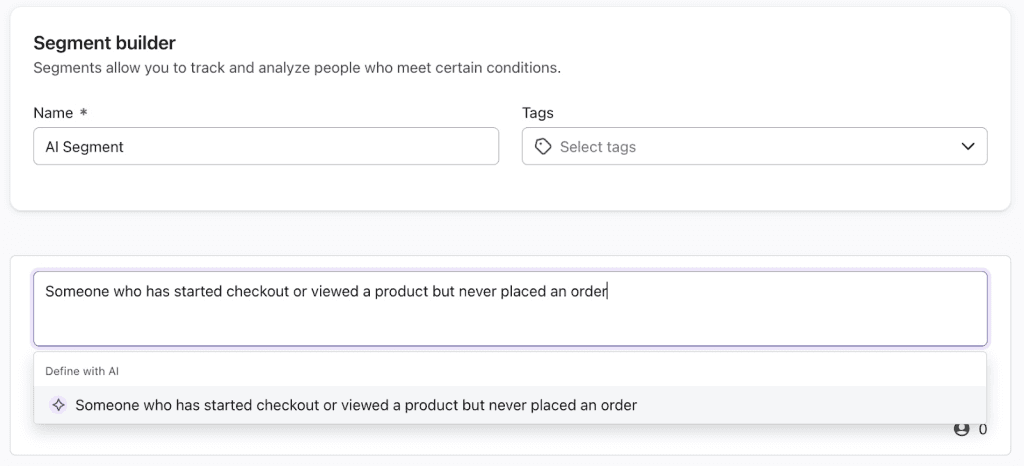
This feature is particularly useful for:
Launching targeted campaigns faster without technical know-how
Testing niche audience groups to refine messaging
Eliminating repetitive manual segmentation tasks
Example: Wine retailer CrushWineXP used Segments AI to quickly identify and target a high-value niche of customers, resulting in more relevant messaging and improved campaign performance. By describing the desired audience in plain language, their team reduced setup time from hours to minutes, freeing resources for creative and strategic work.
When combined with Klaviyo’s predictive analytics, Segments AI can also uncover opportunities that might otherwise go unnoticed, such as customers who are likely to purchase again soon or those at risk of churning.
2. Smart send time: Find the best time to message your customers
Timing can make or break a campaign. Even the most compelling content can underperform if it lands in a customer’s inbox at the wrong moment. Klaviyo’s Smart Send Time feature uses historical engagement data to identify the optimal time for each recipient, ensuring your message arrives when they are most likely to open and interact.
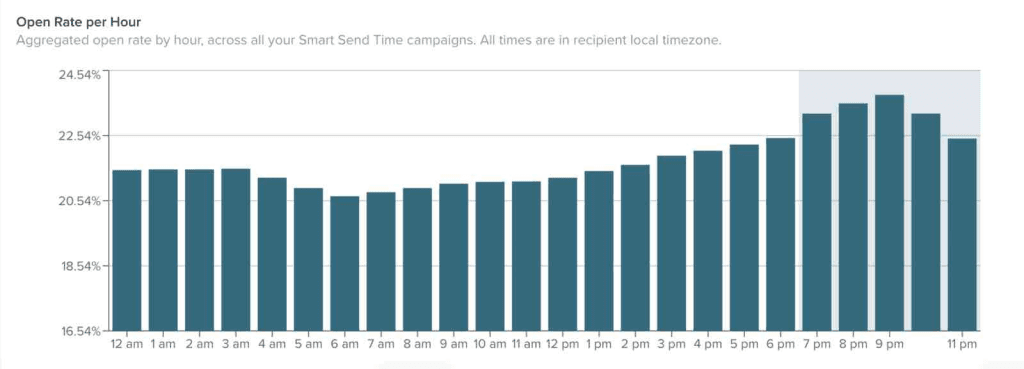
Instead of relying on generic send schedules, the system analyzes patterns from previous campaigns, purchase behavior, and engagement signals. This helps brands:
Increase open rates and click-through rates without changing the message
Reduce send fatigue by avoiding irrelevant delivery times
Optimize performance across different time zones automatically
Example: Wine subscription company Swirl Wine implemented Smart Send Time during a promotional campaign and saw a 14% increase in open rate and a 17% uplift in revenue compared to their standard scheduling approach. By letting AI determine the best delivery windows, their messages reached customers when they were most receptive, driving both engagement and sales.
Smart Send Time is especially powerful for brands with international audiences or seasonal peaks, as it removes guesswork and lets data guide delivery strategy.
3. Forms display optimization: Grow your list
Building a high-quality subscriber list is a constant priority for eCommerce brands, but simply showing a sign-up form is not enough. Klaviyo’s Forms Display Optimization uses AI to determine when and how to present forms for maximum conversion without interrupting the customer experience.
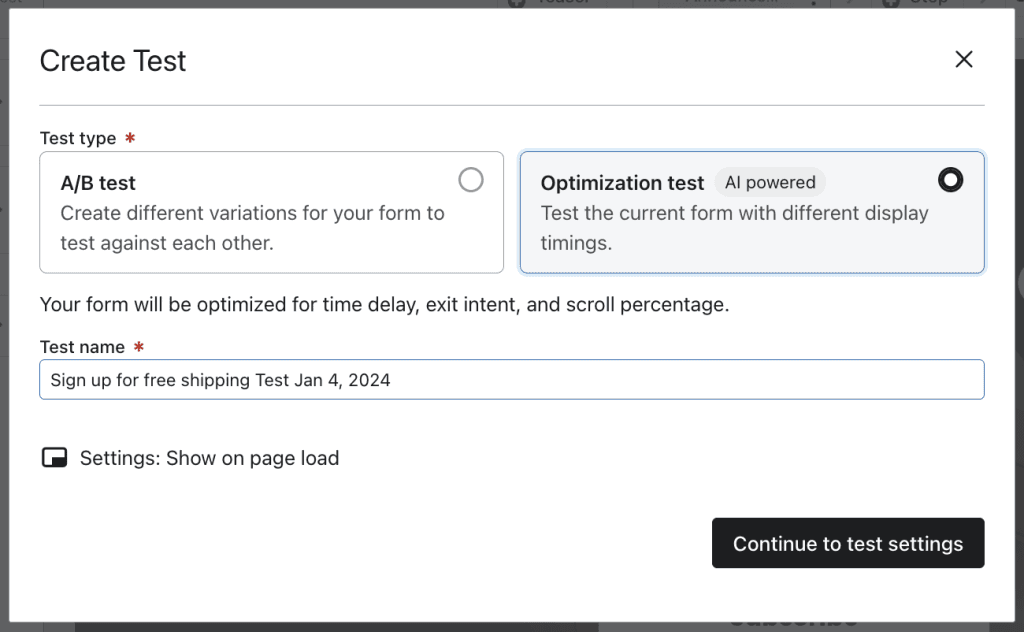
The feature analyzes visitor behavior, such as time on site, scroll depth, and interaction patterns, to display forms at the most effective moment. This ensures that prompts feel relevant and timely, rather than intrusive.
Key benefits include:
Higher form completion rates without increasing bounce rates
More accurate targeting for different customer segments
The ability to test multiple form variations automatically
Example: Skincare brand Tata Harper implemented AI-powered form display rules and saw a significant lift in new subscriber acquisition. By allowing AI to decide the ideal trigger points, they captured more qualified leads while keeping their on-site experience smooth and brand-aligned.
For brands preparing for peak sales events like BFCM, optimizing form timing can make the difference between capturing a ready-to-buy customer and losing them to a competitor.
4. SMS Assistant AI: Refine your SMS messaging
SMS remains one of the highest-engagement channels for eCommerce, but crafting concise and effective copy within a strict character limit can be challenging. Klaviyo’s SMS Assistant AI helps marketers generate on-brand, high-converting SMS messages in seconds, reducing the time spent on trial-and-error drafting.
By using brand voice guidelines and past campaign performance data, the AI can:
Suggest short, impactful copy that fits within the character limit
Adapt tone to match different campaign goals (promotional, conversational, or urgent)
Provide multiple variations for A/B testing to improve results over time
Example: Mattress retailer Ortho Mattress leveraged SMS Assistant AI to refine their promotional messages during a seasonal sale. The generated copy aligned with their brand tone and improved click-through rates, all while cutting down on manual copywriting time.
For brands running frequent or flash promotions, this feature ensures that every SMS is optimized for clarity, engagement, and conversion, without sacrificing speed or consistency.
5. Predictive analytics: Target churn risks and big spenders
Not all customers contribute equally to a brand’s revenue. Some are high-value repeat buyers, while others are at risk of never returning. Klaviyo’s Predictive Analytics uses historical purchase and engagement data to forecast key customer metrics, such as Customer Lifetime Value (CLV), likelihood to purchase again, and churn probability.
With these predictions, brands can:
Identify high spenders for VIP programs or early access offers
Detect at-risk customers and launch win-back campaigns before they disengage
Personalize discounts and incentives based on purchase potential
Example: Seafood company Svenfish applied predictive analytics to identify customers who were both high-value and at risk of churning. This insight allowed them to create targeted re-engagement campaigns, ultimately increasing retention rates and average order value.
Predictive analytics transforms reactive marketing into proactive engagement. By knowing who is likely to buy, who might leave, and how much each is worth over time, brands can allocate budget and effort more efficiently, maximizing ROI from every campaign.
6. Subject line AI: Create top-performing subject line copy on demand
The subject line is often the deciding factor between an opened email and one that gets ignored. Klaviyo’s Subject Line AI helps marketers craft compelling, on-brand subject lines in seconds, informed by historical campaign performance and engagement data.
By analyzing what has worked in the past, both for your brand and within similar industries, the AI can:
Suggest multiple high-performing variations for A/B testing
Optimize for open rates without resorting to clickbait
Adapt tone and style to different campaign types, from product launches to seasonal sales
Example: Media and lifestyle brand Barstool Sports used Subject Line AI to inspire creative, relevant subject lines that resonated with their audience. This not only improved open rates but also freed their marketing team from spending hours brainstorming copy ideas.
For busy eCommerce teams, Subject Line AI acts as both a time-saver and a performance booster, ensuring that every campaign starts with the best possible first impression.
7. Dynamic product feeds: Send AI-personalized recommendations at scale
Personalization is a proven driver of eCommerce revenue, but manually curating product recommendations for every customer segment is time-intensive. Klaviyo’s Dynamic Product Feeds use AI to automatically deliver product suggestions tailored to each customer’s browsing history, purchase patterns, and engagement signals.
With this feature, brands can:
Recommend products based on individual behavior and preferences
Highlight items frequently purchased together or relevant to recent orders
Automate personalized cross-sell and upsell opportunities without extra setup
Example: Fashion brand Meshki used AI-driven product feeds to deliver highly relevant product suggestions in email campaigns and on-site widgets. As a result, they increased average order value while reducing the time spent manually selecting products for each promotion.
To make the most of dynamic product feeds, your product catalog needs to be synced with Klaviyo in a way that supports both accuracy and scalability. There are two main methods for syncing, Catalog feed and Catalogs API, each with different benefits:
Catalog feed | API | |
Setup | Straightforward setup directly from Klaviyo’s UI | Create categories, items, and variants via API |
Variant support | No native variant support; track variants as separate items in a feed | Native variant support |
Update frequency | Every 6 hours | Real-time, with the ability to push items |
Size limit | 100 MB | No size limitations |
Choosing the right method depends on your store’s complexity and technical resources. For stores with frequent product updates or variant-heavy catalogs, the API offers greater flexibility and real-time syncing. Smaller catalogs with less frequent updates can start with the simpler feed setup and still leverage AI-driven recommendations effectively.
8. Flows AI: Create multi-branch flows
Automation flows are at the heart of Klaviyo’s marketing engine, but building complex, multi-branch workflows can be time-consuming, especially for teams without technical resources. Klaviyo’s Flows AI simplifies this process by using natural language prompts to generate sophisticated automation structures in minutes.
Marketers can describe the goal, triggers, and desired customer paths, for example, “create a post-purchase flow for first-time buyers that offers a discount on their next purchase if they have not ordered again within 30 days”, and the AI will map out the branching logic, timing, and recommended messages.
Benefits include:
Faster setup of advanced flows without coding or IT involvement
Consistent customer experiences across multiple touchpoints
The ability to test and optimize variations with minimal manual changes
Example: A retail brand used Flows AI to build a post-purchase campaign that automatically adjusted follow-up messages based on whether the customer engaged with the first email. This adaptive approach improved conversion rates while saving the team hours of manual flow configuration.
Flows AI turns automation planning into a collaborative process between marketer and machine, giving teams more time to focus on strategy and creative execution.
Bonus: Fuel paid strategies with high-performance segments
AI-driven audience insights are not only valuable for owned channels like email and SMS, they can also power paid media strategies. Klaviyo’s high-performance segments can be synced directly to ad platforms such as Meta, Google, and TikTok, enabling brands to retarget their most valuable customers or lookalike audiences with precision.
By combining Segments AI with predictive analytics, marketers can:
Retarget high-value customers with relevant offers
Exclude recent buyers from acquisition campaigns to avoid wasted spend
Build lookalike audiences that mirror top-performing segments for prospecting
Example: A consumer goods brand exported their high-value segment from Klaviyo into Facebook Ads Manager to run a limited-time offer. The campaign achieved a lower cost per acquisition and higher return on ad spend compared to broad targeting, proving the efficiency of AI-powered segmentation in paid channels.
This integration between Klaviyo’s segmentation engine and ad platforms ensures that marketing budgets are spent on the audiences most likely to convert, bridging the gap between CRM data and paid media execution.
How these AI features impact eCommerce performance
AI adoption in eCommerce is not just about keeping up with technology trends, it delivers measurable business outcomes. By integrating AI directly into everyday marketing workflows, Klaviyo enables brands to achieve:
1. Greater marketing team efficiency
Automation of repetitive tasks like segmentation, send-time scheduling, and content generation frees teams to focus on strategy and creative execution. This shift can reduce campaign setup time from hours to minutes, especially during high-demand periods like BFCM.
2. Improved campaign performance metrics
AI features such as Smart Send Time and Subject Line AI directly influence open rates and click-through rates (CTR). For example, Swirl Wine achieved a 14% increase in open rate and a 17% revenue uplift by letting AI determine send times. Personalized product recommendations, meanwhile, can drive higher conversion rates by ensuring customers see products that match their interests.
3. Higher revenue per customer
Predictive analytics and dynamic product feeds make it easier to identify high-value customers and cross-sell relevant products, increasing average order value and overall customer lifetime value.
Industry context: According to McKinsey, companies that excel at personalization generate 40% more revenue from those activities compared to their average competitors. Klaviyo’s AI features help brands apply this level of personalization at scale, without increasing operational overhead.
Getting started with Klaviyo AI
Adopting AI in Klaviyo does not require a complete overhaul of your marketing operations. Brands can start small and expand as they see results.
1. Activate AI features within your existing workflows
Most AI tools in Klaviyo, like Segments AI, Smart Send Time, and Subject Line AI, are built into the platform and can be enabled directly from campaign or automation setup screens.
2. Start with one or two high-impact use cases
Focus on features that will make an immediate difference for your goals. For example, if your challenge is low engagement, start with Smart Send Time and Subject Line AI. If retention is your priority, experiment with predictive analytics and post-purchase flows.
3. Use data as your foundation
The effectiveness of AI depends on the quality of your customer data. Ensure that integrations are properly connected and that profiles contain up-to-date behavioral and transactional information.
4. Test, measure, and optimize
Run A/B tests on AI-generated content, compare performance against previous campaigns, and refine based on results.
Unlock the full potential of Klaviyo AI
AI is reshaping how eCommerce brands connect with their customers, enabling precise targeting, predictive insights, and personalized experiences at a scale that manual workflows cannot match. Klaviyo’s AI capabilities allow you to focus on strategy and creativity while automation handles the execution, ensuring every campaign is timely, relevant, and backed by data.
Brands that strategically integrate these features see improvements across the board, from higher engagement and conversion rates to stronger customer lifetime value. The advantage comes not from using AI in isolation, but from aligning it with business objectives and executing it with expertise.
As a Klaviyo Master Platinum Partner, we work alongside brands to implement, optimize, and scale AI-powered workflows that deliver measurable results. We're a digital marketing agency in Amsterdam first, so we pair that Klaviyo expertise with the campaign strategy needed to turn AI-driven segments into revenue. Get in touch with our Klaviyo experts to explore how we can transform your customer data into strategies that drive growth.
Related articles


F.A.Q.

What is Klaviyo AI?
Klaviyo AI is the set of AI features built into Klaviyo's marketing platform for B2C brands. It includes Segments AI, Smart Send Time, form display optimization, an SMS assistant, predictive analytics, subject line suggestions, AI-driven product feeds and Flows AI. Because the tools work inside the existing campaign and flow screens, teams can use them without separate software or technical setup.
How does Klaviyo Segments AI work?
You describe the audience you want in plain language and Klaviyo builds the segment for you. A prompt such as "customers who bought red wine in the last 90 days but did not open our last two campaigns" replaces manually stacking filters and conditions. It speeds up targeted campaigns, and combined with predictive analytics it can surface likely repeat buyers or customers at risk of churning.
What is Klaviyo Smart Send Time?
Smart Send Time picks the best moment to send a campaign, based on how your recipients engaged with earlier messages. Instead of one fixed send time, Klaviyo uses historical opens, clicks and purchase behavior to find the window in which your audience is most likely to respond, which also helps with audiences across time zones. Wine subscription company Swirl Wine saw 14% more opens and 17% more revenue.
What can Klaviyo predictive analytics predict?
It forecasts customer lifetime value, the likelihood that a customer buys again and the risk that they churn. Klaviyo bases these predictions on historical purchase and engagement data. You can use them to invite high spenders to VIP programs or early access, start win-back campaigns before customers drop off, and match discounts to each customer's purchase potential instead of offering everyone the same deal.
How do you get started with Klaviyo AI?
Start with one or two features that match your biggest challenge. Low engagement calls for Smart Send Time and subject line suggestions; retention goals fit predictive analytics and post-purchase flows. Most features can be switched on from the campaign or flow setup. Make sure your store data syncs correctly, then A/B test AI output against earlier campaigns. A Klaviyo partner such as Flatline can help with the setup.