High add-to-cart, low checkout completion: reading the drop-off between intent and purchase

By Robin Laseur

High add-to-cart with low checkout completion is not a sign of indecision. A high add-to-cart rate is itself evidence of intent, because people do not fill a cart they do not want, so a cart that never checks out is friction with a location rather than a shopper who changed their mind. The gap between add-to-cart and paid is a short sequence of steps, and the money leaks at a specific one. It is readable, provided you instrument the sequence instead of guessing at the word “checkout.”
This piece is about reading that gap precisely. The common explanation, that these shoppers were never serious, is comfortable because it requires nothing of the store, and it is wrong often enough to be expensive. What follows is the harder and more useful reading: why a full cart is a signal worth taking seriously, how the short journey from cart to payment breaks down into steps that each leak for a different reason, and how to find which step is costing you the sale, so the fix lands on the friction that is actually there rather than on a generic checkout that may have been fine.
The easy reading: they were not serious
The reflexive explanation for a full cart that never converts is that the shopper was window-shopping, comparing, or idly curious, and simply drifted off. There is a grain of truth in it. Some share of every store’s cart activity is genuinely people saving items to consider later, checking a delivery estimate, or using the cart as a wishlist, and no design change converts a shopper who was never going to buy in that session. That baseline exists and it is real.
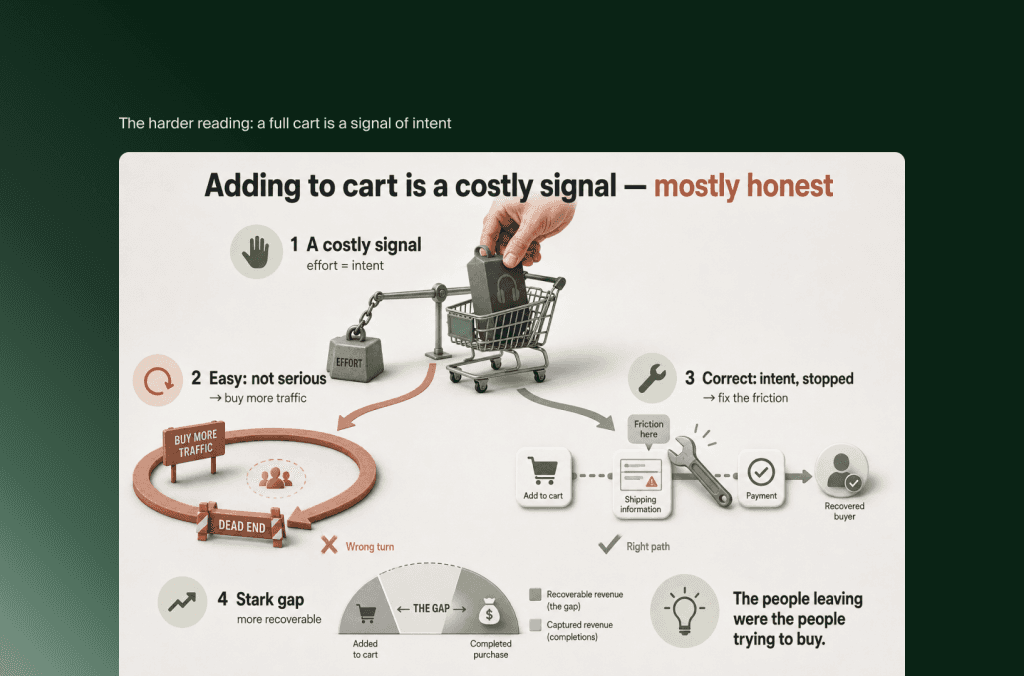
The problem is treating that baseline as the whole story, because doing so quietly reclassifies a fixable problem as an unfixable one. If the reason carts do not convert is that shoppers are not serious, there is nothing to do but buy more traffic and hope a larger pool yields more of the serious kind, which is exactly the reflex that sends money at a leak it cannot reach. The “they were not serious” reading is an explanation that conveniently absolves the store, and any explanation that requires no change to the thing you control should be the first one you distrust. When the add-to-cart rate is high and completion is low, the browsing baseline cannot account for the gap on its own, and the part it does not account for is the part worth reading.
The harder reading: a full cart is a signal of intent
Here is the reframe that changes the diagnosis. Adding an item to a cart is not a passive act; it takes deliberate effort and expresses a decision, however provisional. It is a costly signal in the economic sense, and costly signals are, on average, honest ones. That means the population of shoppers who added to cart and did not finish is weighted toward people who wanted the product, not away from it. The very gap that looks like weak intent is built out of demonstrated intent that did not convert.
That inverts the diagnosis. If the abandoning group is disproportionately people who wanted to buy, then their abandonment is dominated by something that stopped them, not by an absence of desire, and something that stops a willing buyer is friction with a location in the store you control. The more dramatic the split, a genuinely high add-to-cart rate against a genuinely low completion rate, the more strongly it points to located friction rather than soft demand, because the intent side of the equation is not in question. This is why the easy reading is not just incomplete but backwards: the stores with the starkest add-to-cart-to-completion gap are often the ones with the most recoverable revenue sitting in a fixable step, precisely because the people leaving were the people trying to buy.
The gap is a sequence, and it breaks at one step
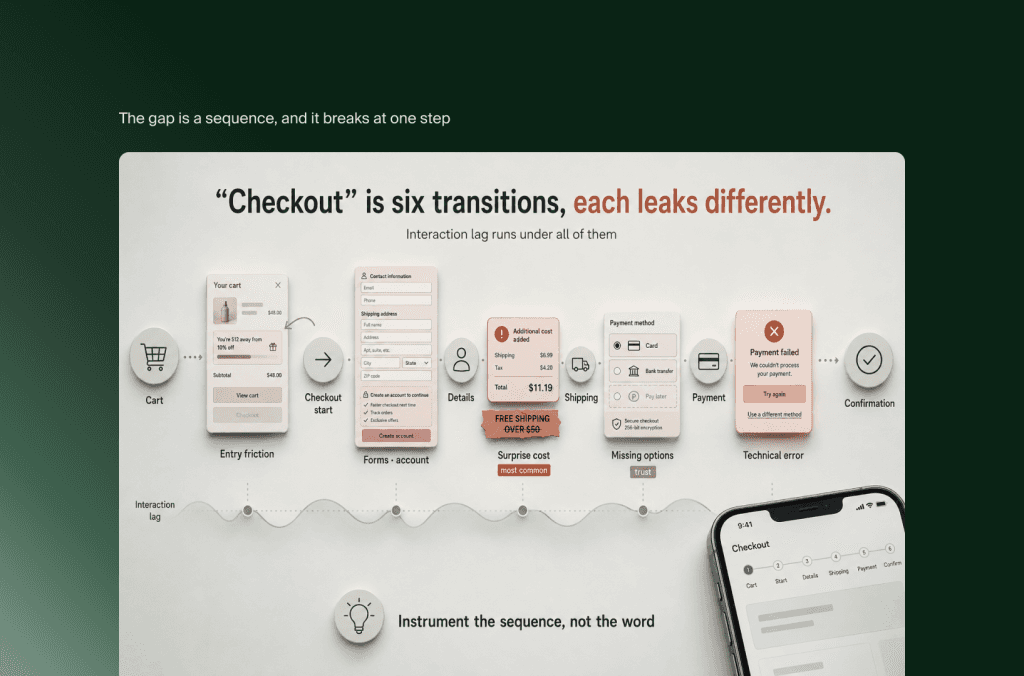
The move that makes the leak readable is to stop treating “checkout” as one thing. The distance between a full cart and a paid order is a short sequence of distinct steps, and abandonment concentrates at one of them for a reason specific to that step. Read as a sequence, it looks roughly like this: the cart view, the transition into checkout, entering contact and shipping details, the moment shipping cost and options are revealed, the payment step, and the final confirmation. Each transition leaks differently.
The cart-to-checkout-start transition breaks on entry friction: a checkout button buried in a slide-out drawer, a forced choice, a distraction that pulls the shopper out of the flow. The checkout-start-to-details transition breaks on form friction and forced account creation, the demand that a first-time buyer register before they are allowed to pay. The details-to-shipping transition is where the single most common located leak lives, the moment an unexpected cost appears; a shipping fee or tax revealed here, after the shopper has invested effort, reads as a broken promise rather than a line item, and the reaction is not to the fee but to the surprise. The shipping-to-payment transition breaks on missing payment options and on trust hesitation at the exact moment money is committed. The payment-to-confirmation transition breaks on technical or payment errors at the last step, the most expensive place of all to lose someone.
Running underneath all of these is a friction that is not a design choice at all: technical lag at the moment of action. A slow interaction response steals the tap on add-to-cart or the checkout button at the precise instant the shopper reached for it, and there is no more costly place in the funnel to introduce hesitation than the one where intent was about to become a purchase. On mobile the effect compounds, because the mobile journey is already a chain of small taxes charged at load, at thumb-reach, and at checkout, and a full cart on a phone can stall for reasons that have nothing to do with desire and everything to do with a checkout that rendered slowly or a button that did not respond.
How to read where it breaks, and which step to instrument first
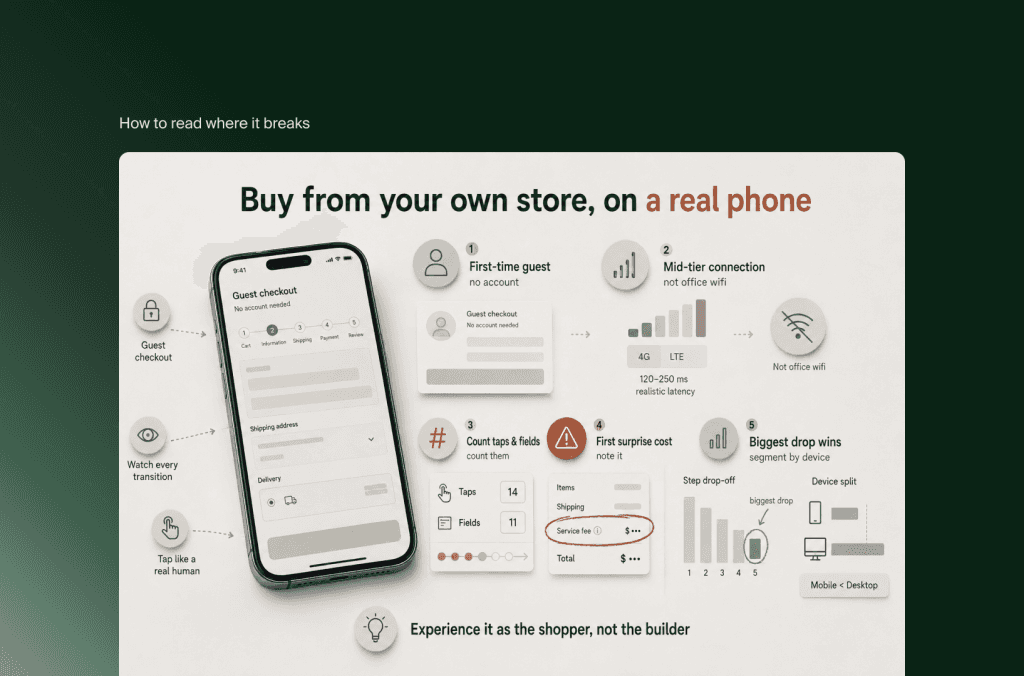
Because the gap is a sequence, the diagnosis is to instrument the sequence and find the single biggest drop, rather than assume the culprit is “the checkout.” Measure the pass-through at each transition, cart to checkout-start, checkout-start to details, and so on, and the leak usually reveals itself as one transition where the fall-off is far steeper than the others. The number worth watching is drop-off by step, because it tells you which stage to look at first, where the store-wide conversion rate only tells you that sales are being lost somewhere.
The fastest instrumentation is not a dashboard at all; it is a manual walkthrough. Open your own checkout on a real phone, as a first-time guest, on an ordinary mid-tier connection rather than office wifi, and buy something. Count the fields. Count the taps. Note the first moment a cost appears that you did not expect, the field that fights your thumb, the step that takes a beat too long to load. That single pass usually surfaces the biggest friction faster than any report, because you experience the sequence as the shopper does rather than as the person who built it. Two rules make the reading reliable: segment by device, because mobile completion routinely runs far below desktop and a blended number hides it, and let the biggest measured drop, not your intuition, pick the step to fix first. The cost-reveal transition is the highest-prior suspect and worth checking early, but the right first move is the leak the instrumentation actually finds, not the one you expected.
What this changes about the fix
Reading the gap this way changes the economics of fixing it. Because the abandonment is located friction acting on real intent, the intervention is narrow rather than sweeping: remove the specific friction at the specific step where the sequence breaks, not a general “optimise the checkout” program that spreads effort evenly across steps that were converting fine. A single surprise-cost fix at the cost-reveal transition, or a guest-checkout option at the account-creation step, or a resolved interaction lag on the payment button, can recover more than a season of scattered checkout tweaks, because it closes the one gap the buyers were actually falling through.
And because the people leaving this stage had already demonstrated intent, closing the leak here is the highest-return fix in the funnel. Every earlier stage works to create intent; this stage is about not losing intent that already exists, which is cheaper to protect than to generate. A shopper who filled a cart and reached the payment step has done almost all the work of converting, so the store’s only job was to not get in the way, and where it did get in the way, the fix returns a buyer who was already trying to pay. That is the diagnosis worth running before any broad optimisation effort: find the one step in the cart-to-paid sequence where willing buyers are being turned away, and start there.
Frequently asked questions
Why do people add to cart but not complete checkout?
Some are genuinely browsing or saving items for later, which is a natural baseline no store can design away. But a high add-to-cart rate is itself a signal of real intent, so when completion is low, much of the gap is located friction rather than weak desire: an unexpected cost, forced account creation, a confusing or slow checkout step. Those shoppers wanted to buy and something specific stopped them.
Does high cart abandonment mean low buying intent?
Usually the opposite. Adding to a cart takes deliberate effort, so it is a costly and mostly honest signal of intent, which means shoppers who add and abandon are weighted toward people who wanted the product. A stark gap between high add-to-cart and low completion points more strongly to a fixable friction in the checkout sequence than to soft demand, because the intent side is not in question.
Where do shoppers drop off between cart and payment?
At one of a few distinct transitions: cart to checkout-start (entry friction), checkout-start to details (form friction and forced account creation), details to shipping (the moment an unexpected cost appears, the most common leak), shipping to payment (missing payment options or trust hesitation), and payment to confirmation (technical or payment errors). Technical lag at the moment of a tap can break any of them. The leak concentrates at one step, which is why measuring by step matters.
How do you find where checkout is leaking?
Measure the pass-through rate at each step of the cart-to-paid sequence and find the single biggest drop, rather than assuming it is “the checkout.” The fastest method is a manual walkthrough: buy from your own store on a real phone, as a first-time guest, on a mid-tier connection, and note the first unexpected cost, the field that fights you, and the step that lags. Segment by device, since mobile hides its own leaks in a blended number.
Why is mobile checkout completion lower?
Because mobile stacks several frictions the desktop journey does not: slower connections and heavier pages mean load and interaction lag at the moment of action, small screens make forms and taps harder, and a slow-rendering checkout or an unresponsive button costs the sale at the exact point of intent. Mobile completion routinely runs well below desktop, so a blended conversion figure can hide a mobile-specific leak that only appears when you segment by device.
Key takeaways
High add-to-cart with low checkout completion is not indecision. A full cart is a costly signal of intent, so the abandonment is weighted toward people who wanted to buy and were stopped by located friction.
The easy reading, that shoppers were not serious, reclassifies a fixable problem as an unfixable one. A browsing baseline exists, but it cannot account for a large add-to-cart-to-completion gap on its own.
The cart-to-paid gap is a sequence, not one step. It breaks at entry, at forms and forced account creation, at the cost reveal (the most common leak), at payment, or at the final confirmation, and technical lag can break any of them.
Instrument the sequence and find the single biggest drop rather than assuming “checkout.” The fastest instrumentation is buying from your own store on a real phone as a first-time guest, and segmenting by device.
The fix is narrow and high-return: remove the specific friction at the step that leaks. Because these shoppers already had intent, closing a located leak here recovers buyers who were already trying to pay.
A full cart that never becomes an order is one of the most misread signals in ecommerce, because the comfortable explanation and the correct one point in opposite directions. The comfortable one says the shoppers were not serious and sends you back to buying traffic. The correct one says they were serious, and something in a short sequence of steps turned them away. Read the sequence, find the step, and the drop-off between intent and purchase stops being a mystery about people and becomes a specific, fixable fact about your store.
Related articles


