WhatsApp or SMS at Shopify Checkout? A Market-by-Market Opt-In Decision Guide

By Robin Laseur
Choose WhatsApp or SMS opt-in at Shopify checkout by assessing each market’s customer evidence, messaging readiness and operating costs. Prefer the channel your team can support with verified consent handling and a relevant program. Use the market worksheet below to record the choice, its evidence and the conditions that would change it.
Your CRM team may have a mature SMS program while a regional team wants to introduce WhatsApp. Both can have a reasonable case. The checkout decision needs a shared method so the person configuring the store can translate those competing priorities into a specific, reviewable allocation.
Documentation checked: September 11, 2026. The decision framework and worksheet are proposed planning tools. No merchant results or provider integrations were tested for this article.
For what changed in the September 10 release, see Shopify’s new WhatsApp marketing consent at checkout.
Define the checkout decision before comparing channels
The immediate decision is which marketing opt-in your checkout should present in the regions you serve. Keep that scope explicit when comparing WhatsApp and SMS. Your team needs an agreed collection experience, a supported destination for the preference and a program ready to serve the people who subscribe through it.
Shopify’s checkout documentation describes regional allocation when both SMS and WhatsApp opt-in are active. You can use recommended regions or select WhatsApp regions manually. The remaining regions populate the SMS column automatically, and that column cannot be edited directly.
This gives the team configuring checkout a defined set of controls. Write the intended allocation in business terms first, then confirm how it maps to the available settings. A commercial market might contain several countries; list the actual regions the reviewer must inspect rather than leaving a broad market label open to interpretation.
Record the current allocation beside the proposed one. If you decide to investigate WhatsApp further, the checkout owner still needs to know which approved configuration should remain in place during that investigation. An unresolved channel decision should have an explicit interim state.
Compare customer evidence within the same market
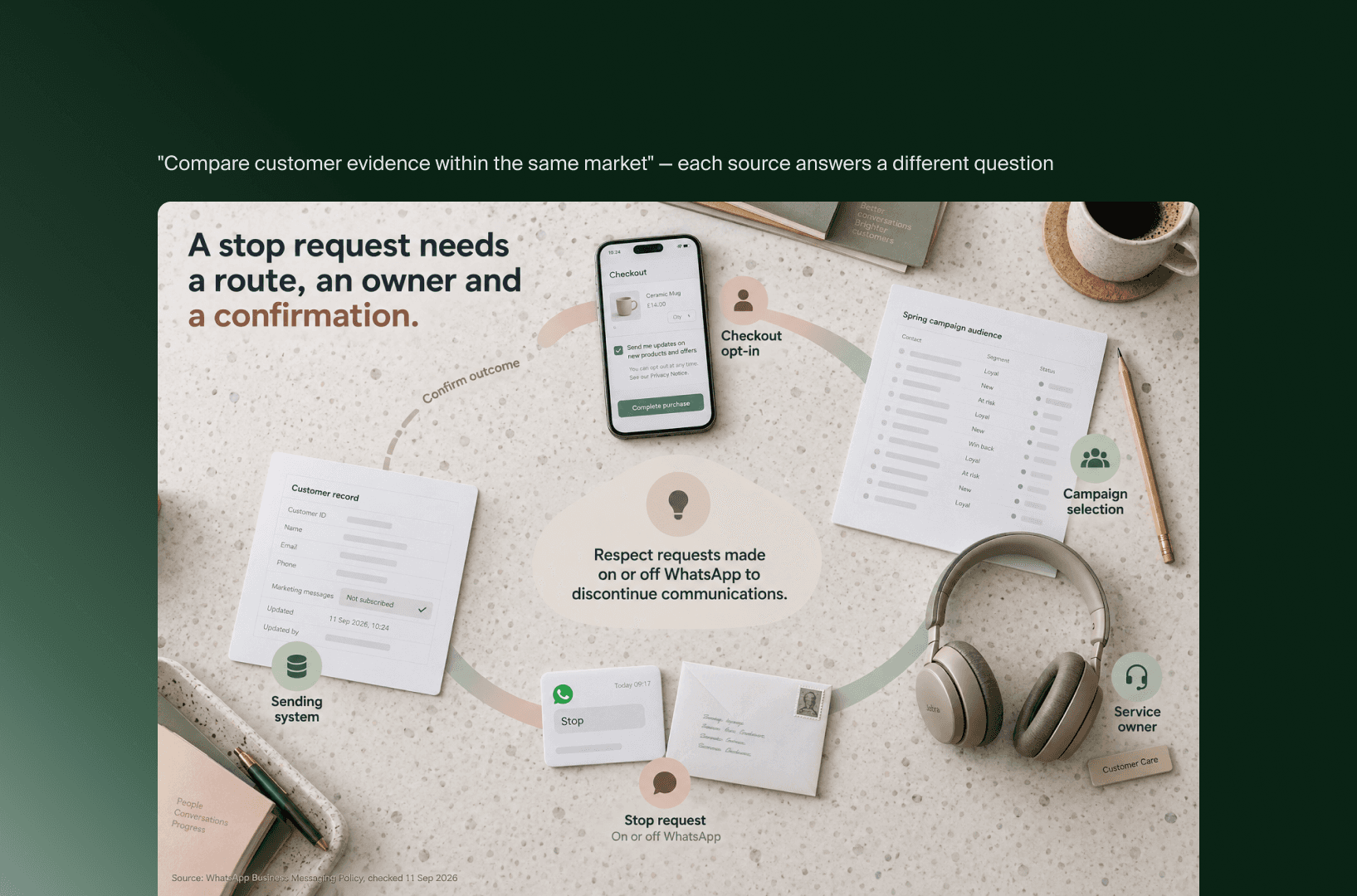
Customer evidence should explain why a particular audience would welcome the proposed marketing program through the selected channel. Evaluate comparable evidence within each market, and record its limits. A contact list, support conversation or country-level usage statistic can inform the investigation, but each answers a different question about customer behavior.
Start with evidence your team already holds: responses to a specific preference question, results from an existing permission-based program, or research into the intended use case. Note the audience, collection method and period beside each observation. That context determines how much weight the observation deserves.
For example, a customer research exercise might ask which channel people prefer for product releases. It provides a closer match to a product-release program than a count of customers contacting support through WhatsApp. Support behavior can suggest familiarity with the channel, while the research addresses the proposed marketing experience.
Treat a small or self-selected sample as directional. It can justify a scoped investigation without settling the allocation for an entire market. If evidence is absent, write down the missing observation and assign someone to collect it. “WhatsApp is popular here” is too broad to explain why your particular customers should receive your particular program there.
Keep existing channel results comparable. Different offers, customer groups or measurement periods can account for differences in performance. A higher reported figure from one campaign needs that context before it informs a checkout change.
Establish readiness before weighing the trade-offs
Channel readiness means your team can explain how the proposed program will operate for the selected audience. Establish the essential requirements before comparing expected benefits. A promising audience signal cannot resolve an unsupported consent transfer, an unassigned service responsibility or an unanswered requirement that prevents the program from operating as intended.
For each candidate channel, identify the documented method for receiving the preference, the intended sending setup and the route for handling withdrawal. Ask the relevant owner to classify each requirement as verified, needs work or unresolved. These are review states for your operation, not ratings of either channel.
The WhatsApp Business Messaging Policy requires opt-in permission and a phone number before contact, and requires businesses to respect requests to stop communications. For WhatsApp Business Platform, business-initiated conversations require approved message templates. Your policy review should consider the intended use and applicable market requirements alongside the technical setup.
Apply equivalent scrutiny to your SMS program using its provider documentation and applicable requirements. An established program deserves current evidence when its scope changes. Neither a familiar provider nor a new checkout option establishes that a particular campaign is ready.
Agree which unresolved items block launch and who can resolve them. Keep the technical review focused on proof of support; a detailed implementation procedure belongs with the team or provider responsible for that connection.
Weigh program fit, cost and operating capacity
Once the essential requirements are satisfied, compare the channels against the same proposed program. Use actual provider terms and your team’s workload assumptions. The useful comparison explains what each option would require to serve the selected audience, including content preparation, message delivery, customer responses and ongoing administration.
Build a cost estimate around a stated audience and sending schedule. Include the charges that apply under each provider’s terms, any fixed fees and the internal work needed to run the program. Label estimates as assumptions and keep them separate from observed results. A low delivery estimate can coexist with substantial preparation or service work.
Local operating capacity also matters. A central team may be able to configure a channel while the market team lacks capacity to maintain the proposed program. Name the person responsible for content and the person handling customer responses, then confirm that both can support the intended scope.
Use this matrix to capture the comparison before assigning regions. Enter evidence for both options rather than awarding points by intuition.
Decision factor | Evidence to enter for WhatsApp | Evidence to enter for SMS | How it affects the choice |
|---|---|---|---|
Customer fit | Preference evidence for the intended program and audience | Equivalent evidence for that audience | Favor the option with a clearer audience basis; label uncertainty |
Program readiness | Verified sending and consent requirements | Verified sending and consent requirements | Resolve essential gaps before approving the option |
Operating capacity | Named content and service owners with available capacity | Named content and service owners with available capacity | Match scope to the team’s ability to operate it |
Cost | Provider terms and workload estimate for the stated program | Comparable provider terms and workload estimate | Compare totals using the same audience and schedule assumptions |
There is no universal weighting behind this matrix. Decide which trade-offs your business accepts, and record that reasoning. If both options meet the requirements, the better choice depends on the market evidence and operating priorities you have documented.
Record the allocation in a working decision sheet
A market allocation sheet should make the proposed checkout experience understandable to someone outside the original discussion. Record the region, evidence, channel readiness, operating assumptions and accountable owner. Include the current configuration and a review trigger so an unresolved decision or a later change has a clear operational meaning.
Copy this vertical worksheet once for each market. Its blank cells are intended for your team’s inputs; the prompts define what a completed decision needs to contain.
Field | Input your team should record | Your entry |
|---|---|---|
Market and checkout regions | Commercial market name plus the exact regions in scope | |
Current approved configuration | The setting to retain until a new allocation is approved | |
Intended program | Message purpose, audience and proposed schedule | |
Customer evidence | Source, period, audience and limitations | |
WhatsApp readiness | Verified requirements and unresolved work, with evidence references | |
SMS readiness | Equivalent requirements and evidence references | |
Cost and capacity | Provider basis, workload assumptions and named operating team | |
Proposed outcome | WhatsApp, SMS, or defer the change with an explicit interim configuration | |
Reason for the choice | The evidence and trade-off that determine the outcome | |
Accountable owner | Person approving the allocation and coordinating implementation | |
Review date and trigger | Planned review date plus the event or evidence that would reopen the decision |
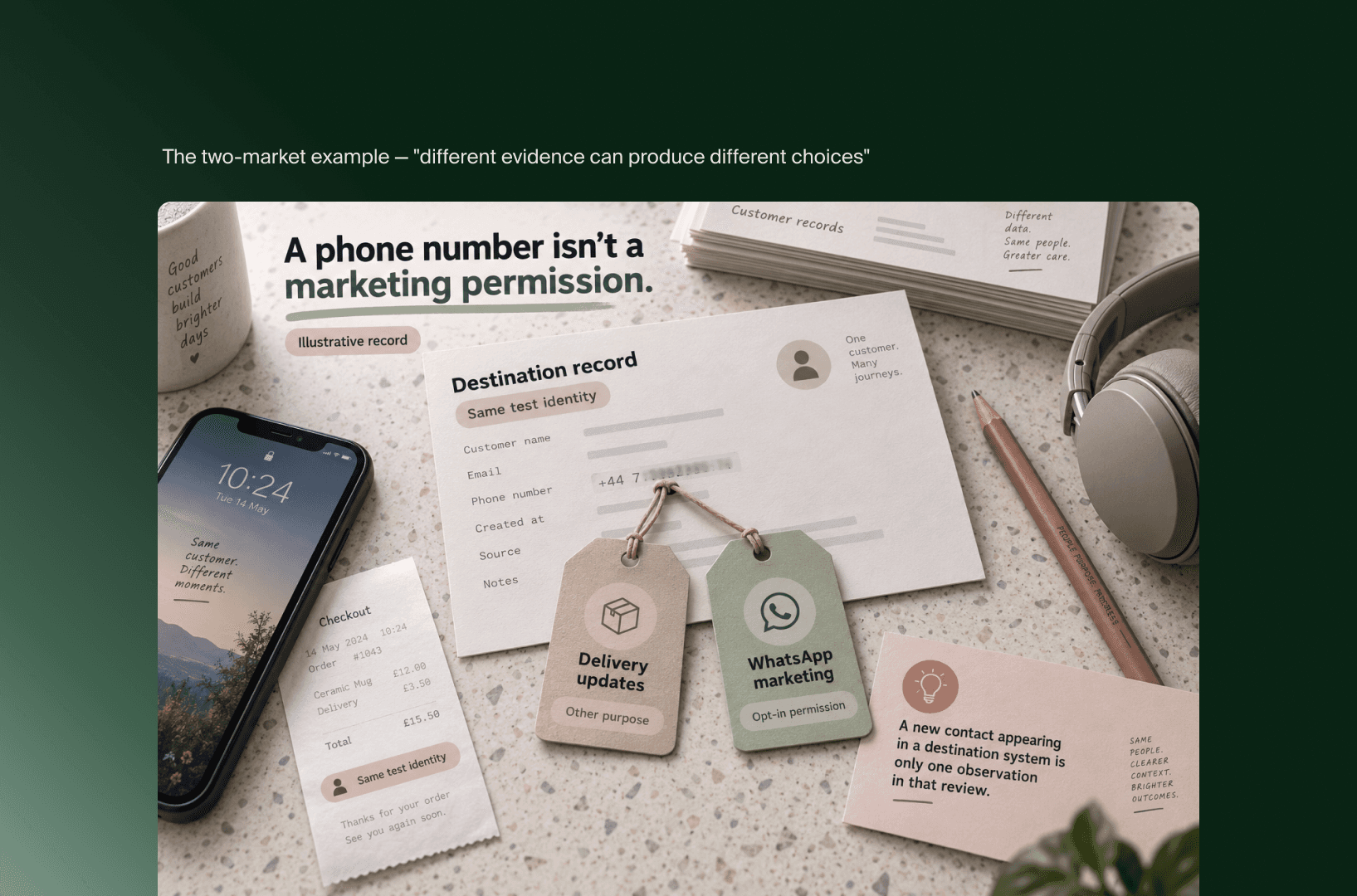
Consider a hypothetical merchant with two markets. In one, an existing SMS program has current operating evidence while the proposed WhatsApp connection remains unresolved. Retaining the approved SMS allocation during investigation is a defensible interim choice. In the other, both options are ready and customer research favors WhatsApp for the intended program; a scoped WhatsApp allocation may be justified.
The example illustrates how different evidence can produce different choices. It does not establish a preferred channel for any named country. A completed sheet should make the decisive difference visible without requiring the reviewer to reconstruct a meeting.
Validate the allocation and define its review conditions
Validate the saved configuration against the approved region list, then inspect the relevant customer journeys. Record the scope of the checks and the observed outcome. Future reviews should respond to changes in customer evidence, provider support, program requirements or operating capacity, with someone accountable for deciding whether the allocation still fits.
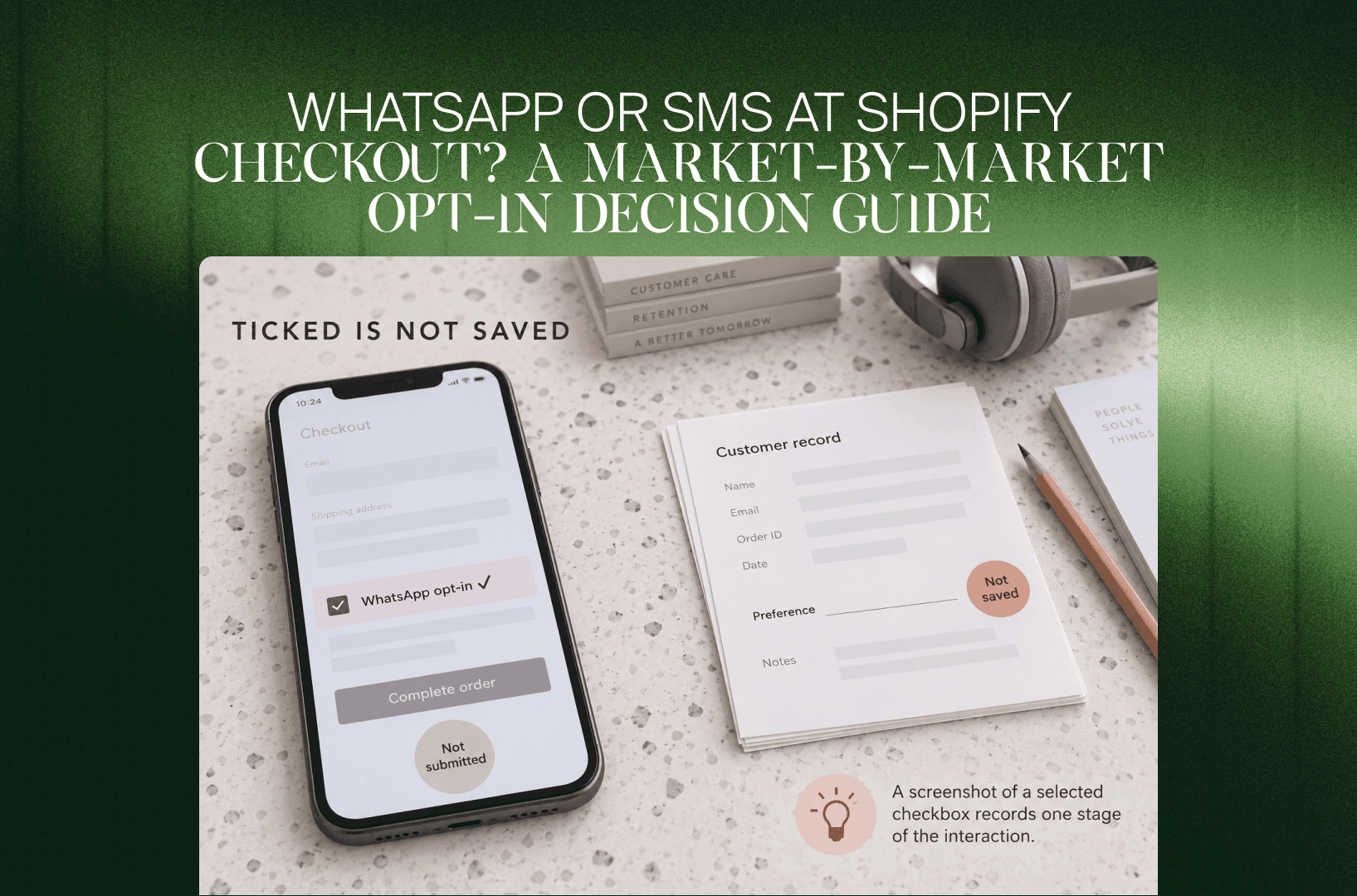
Shopify documents that customers must submit checkout for the SMS or WhatsApp marketing subscription preference to be saved. Include that condition in the review and inspect the resulting preference through the supported tools available to your team. A display check and a downstream preference check establish different parts of the journey.
Agree how the program will be evaluated before changing the allocation. Specify the audience, reporting period and definitions used for subscription and campaign results. Interpret changes alongside the offer and other checkout activity during that period. A before-and-after comparison alone does not isolate the effect of the channel choice.
Set a review date that fits your campaign cadence and add concrete reopening conditions. A documented provider change, a new program requirement or stronger customer research can justify a fresh comparison. Record the reason for keeping the allocation as well as the reason for changing it.
Key takeaways
Choose the checkout opt-in by market using evidence about the intended audience and program.
Establish essential readiness before comparing benefits, costs and team capacity.
Record the current setting, proposed choice and accountable owner in one decision sheet.
Verify the configured experience and revisit the decision when its evidence or operating conditions change.
If your team needs help translating the allocation into checkout and integration requirements, Flatline’s eCommerce services provide a starting point for reviewing the scope together.
Related articles


