Shopify Plus for food and beverage brands: what the platform changes, and what stays with your supply chain

By Robin Laseur

When a food or beverage brand starts evaluating Shopify Plus, the quiet hope is usually bigger than the storefront. Somewhere in the business case is the expectation that a serious platform will ease the things that actually keep the team up at night: thin margins, the cost and fragility of getting perishable products to a door, the complexity of selling wholesale and direct at the same time. That hope is reasonable. A replatform is expensive and disruptive, so it ought to fix more than the website.
This article is about where that expectation holds and where it quietly does not. Shopify Plus changes one layer of a food and beverage business completely and leaves another almost exactly where it was. Knowing which is which before you commit is the difference between a replatform that pays off and a disappointment you have only deferred.
What food brands expect Shopify Plus to fix
The conventional read is that moving to Plus is an operational upgrade, not just a commerce one. It is easy to arrive at, and worth taking seriously rather than dismissing. A food brand feeling the squeeze of low margins, complex fulfilment, and the constant tension between retail and direct channels looks at an enterprise platform and reasonably assumes it will absorb some of that load.
Several things reinforce the assumption. The cost and scale of a replatform make it feel like a transformation rather than a tool swap, so the expected return expands to match the spend. Agency pages aimed at the sector tend to list the industry’s hardest problems, supply chain, compliance, perishability, right before presenting the platform, which implies the two are connected. And the language around enterprise commerce, scalability, automation, robust infrastructure, sounds like it should reach into operations.
So the expectation is not naive. It is the natural conclusion of how the decision is usually framed. The problem is that a platform, however capable, acts on a specific layer of the business, and a food and beverage operation has at least one other layer that no storefront touches. The next two sections draw that line precisely, starting with what the platform genuinely changes.
What the platform actually changes
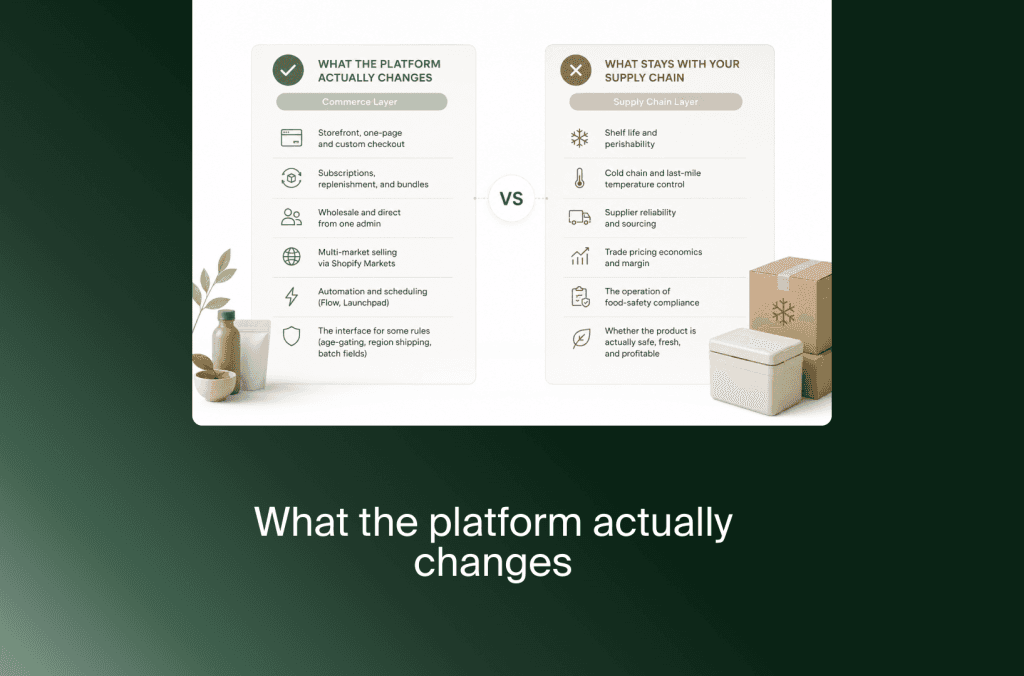
Shopify Plus changes the commerce layer. It gives a food and beverage brand a faster, customizable checkout, native subscriptions and bundles, the ability to run wholesale and direct from one admin, multi-market selling through Shopify Markets, and automation through Flow and Launchpad. It can also host the interface for some compliance rules, such as age verification and region-specific shipping. Within that layer, the upgrade is real and worth having.
Take the pieces that matter most to food and beverage specifically. Subscriptions and replenishment turn consumable products, coffee, supplements, pantry staples, into recurring revenue rather than one-off orders. Bundles let a brand sell variety packs, starter sets, and curated boxes as first-class products instead of awkward workarounds. A checkout that can be shaped to the brand reduces the friction that quietly costs orders. And Launchpad schedules seasonal releases and limited drops to fire on time rather than by hand.
The channel question is where Plus earns a lot of its keep for this sector. Most food and beverage brands sell both direct and wholesale, and those usually live in separate systems that drift apart. Plus runs both from one admin, with company accounts, custom price lists, and net terms for trade buyers alongside the DTC store, the territory covered in Shopify’s B2B features. A European specialty brand like NoordCode operating direct and into trade is the kind of profile this unification is built for.
There is a compliance nuance worth stating carefully, because it is where the line starts to blur. The platform can host the interface for certain rules: an age gate at checkout, shipping logic that respects regional restrictions, metadata fields for batch or lot numbers, allergen and nutrition display. That is genuinely useful. But hosting the interface for a rule is not the same as carrying out the operation behind it, which is exactly where the platform’s reach ends.
What the platform absorbs | What stays with your supply chain |
Storefront, one-page and custom checkout | Shelf life and perishability |
Subscriptions, replenishment, and bundles | Cold chain and last-mile temperature control |
Wholesale and direct from one admin | Supplier reliability and sourcing |
Multi-market selling via Shopify Markets | Trade pricing economics and margin |
Automation and scheduling (Flow, Launchpad) | The operation of food-safety compliance |
The interface for some rules (age-gating, region shipping, batch fields) | Whether the product is actually safe, fresh, and profitable |
The left column is what a replatform delivers. The right column is what it leaves untouched, and for a food and beverage brand the right column is usually where the hardest problems live.
What stays with your supply chain
What Shopify Plus does not touch is the physical and economic core of a food and beverage business: shelf life and perishability, cold chain and last-mile temperature, supplier reliability, trade pricing and margin, and the operation of food-safety compliance. The platform can display a batch number or an age gate. It cannot keep a product cold, fresh, safe, or profitable.
Each of these sits outside the commerce layer entirely. Shelf life is a property of the product and the way it is stored and rotated, not of the storefront that lists it; a faster checkout does nothing for a tray of items approaching their date. Cold chain is the harder version of the same point. Temperature-controlled fulfilment, insulated packaging, carrier selection, and delivery speed are logistics decisions with real cost, and no amount of front-end polish keeps the ice packs cold between your warehouse and the customer’s door. Supplier reliability works the same way: stockouts and quality issues originate upstream, and the platform can only reflect them, not resolve them.
Margin is the one brands most often expect a platform to improve, and it is worth being blunt here. Plus can display tiered wholesale pricing and run promotions cleanly, but it does not change your cost of goods, your distributor margins, or the freight bill on a heavy, low-value-density pallet. The economics of trade pricing are set in your contracts and your supply chain, and they arrive at the platform already decided.
Compliance is where the line is easiest to misread, which is why it deserves the most care. The platform can host the interface for a rule. It can present an age gate, apply region-specific shipping logic, store a batch field, and display allergen information. None of that is the same as the operation behind it. The age gate does not make you compliant with alcohol law, the batch field does not trace your supply chain, and the allergen display is only as accurate as the process that fills it in. Hosting a control is not the same as performing it. Treating an interface feature as though it were the operation is precisely how a brand ends up surprised after launch, with a better storefront sitting on top of the same unresolved problems.
Why this gap persists
If the line is this clear once you look, the obvious question is why so few evaluations draw it. The answer is not that anyone is being dishonest. It is that the ordinary incentives around a replatform all push in the same direction.
The first is a simple mental shortcut. The platform is the visible, decisive purchase, the thing that gets chosen, budgeted, and announced, so it quietly absorbs the hope attached to every adjacent problem. “Better platform” slides into “better operations” without anyone deciding it should. The second is what is marketable. A commerce layer is easy to show: screenshots, demos, conversion numbers. A cold chain is not. Sellers naturally lead with what photographs well, and supply chain does not photograph well.
Then there is the momentum of the project itself. Once a brand is committing six figures and several months, the story tends to inflate to match the spend, because a tool swap is a harder thing to get signed off than a transformation. And the way the sector’s content is structured reinforces all of it. Agency pages list the industry’s genuinely hard problems, supply chain, perishability, compliance, in the paragraphs right before they present the platform, which leaves an implied connection between the two that the page never actually has to claim.
The platform is sold as the answer to problems it never touches. The line between what it changes and what it cannot is rarely drawn, because almost no one in the transaction is paid to draw it.
None of this requires a bad actor. It is the default output of how the decision is sold and bought. Which means the responsibility for drawing the line falls to the brand doing the buying, and that is a question of sorting your own problems honestly before you start.
How to tell which side your problem is on
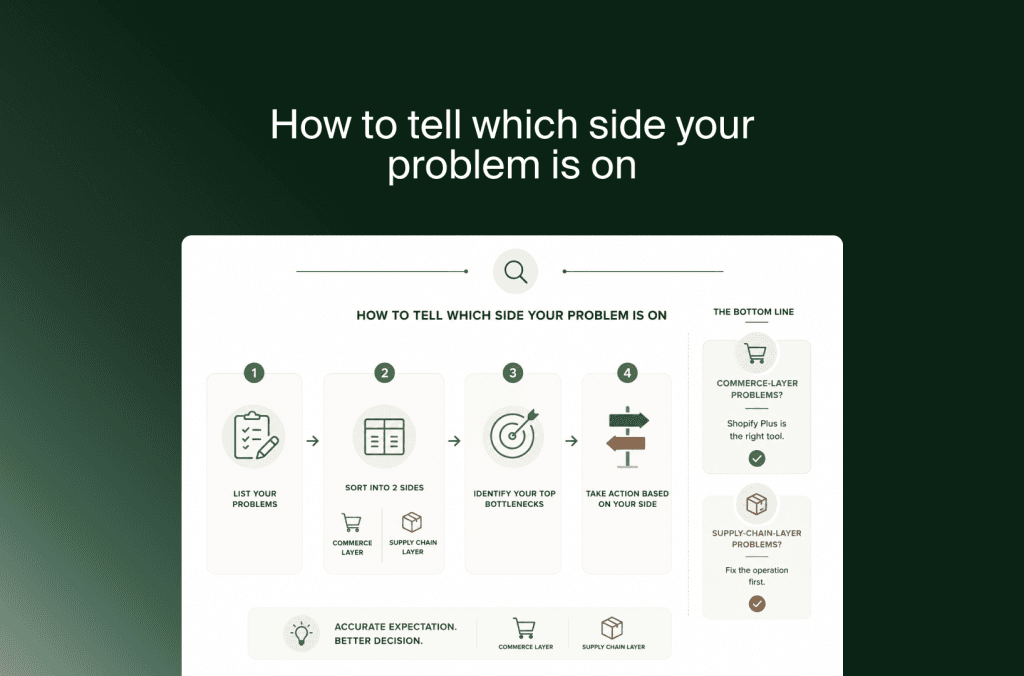
The way to avoid a deferred disappointment is unglamorous but reliable: sort your own problems before you evaluate any platform. The exercise takes an afternoon and changes the entire decision.
Write down the problems you actually want solved. Be specific. Not “grow the business” but “wholesale orders are processed by hand,” “the cart abandons at the shipping step,” “we cannot put customers on a subscription,” “our margin on heavy orders is thin.”
Sort each one into commerce-layer or supply-chain-layer. The test is simple. Would a better storefront, checkout, or admin touch this problem, or does it live in the warehouse, the truck, the supplier contract, or the food-safety process? Be honest about which column each item belongs in.
If your top bottlenecks are commerce-layer, Plus is the right tool. Manual wholesale, checkout friction, no subscription capability, fragmented direct and trade channels: these are exactly what the platform changes, and a replatform will pay off. Proceed with confidence.
If your top bottlenecks are supply-chain-layer, do that work first or alongside. Spoilage, cold-chain cost, supplier reliability, and trade margin will not move because the storefront improved. Replatforming in the hope that they will is how the disappointment gets built in.
The revised expectation is not a lower one. It is a more accurate one. Shopify Plus is excellent at the commerce layer, and for a food and beverage brand whose real constraints sit there, a considered move to it is a genuinely strong one. The brands that come away satisfied are the ones that bought it for the problems it actually solves and kept their operational work where it belongs. The narrower question of when the Plus tier specifically becomes worth its cost is worth taking on its own terms, once you know which of your problems the platform was ever going to touch.
Frequently asked questions
Is Shopify Plus good for food and beverage brands?
Yes, for the commerce layer. It gives a customizable checkout, native subscriptions and bundles, wholesale and direct from one admin, and multi-market selling. What it will not do is fix supply-chain, margin, or compliance operations. It is a strong move when your main bottleneck sits in how you sell, and the wrong fix when your bottleneck sits in how you source, store, or ship.
Can Shopify Plus handle perishable or cold-chain shipping?
It can display shipping options, rates, and rules, but cold chain itself is logistics, not platform. Temperature-controlled packaging, carrier selection, and delivery speed are operational decisions the storefront only reflects. The platform presents what your fulfilment can do; it does not keep the product cold between your warehouse and the customer’s door.
Can Shopify Plus handle alcohol age verification and regional shipping rules?
It can host the interface: an age gate at checkout and shipping logic that respects regional restrictions. That is useful, but it is not the same as compliance. Licensing, jurisdiction-specific rules, and record-keeping remain your legal responsibility. The platform presents the control; it does not guarantee that your operation behind it is actually compliant.
When is Shopify Plus worth it for a food or beverage brand?
When your main bottlenecks are commerce-layer, manual wholesale, checkout friction, no subscription capability, fragmented direct and trade channels, and you have the volume and complexity to use the advanced features. If your real constraints are supply chain or margin, the platform will not move them, and the spend is better sequenced after that work.
Key takeaways
Shopify Plus changes the commerce layer of a food and beverage business completely and the supply chain not at all. The whole decision turns on which side your real problems sit.
What the platform absorbs: storefront, checkout, subscriptions, bundles, wholesale and direct from one admin, multi-market, automation, and the interface for some compliance rules.
What stays yours: shelf life, cold chain, supplier reliability, trade margin, and the operation of food-safety compliance.
The gap persists because the commerce layer is visible and marketable while the supply chain is not, and no one in the transaction is paid to draw the line.
Sort your bottlenecks into commerce-layer and supply-chain-layer before evaluating. If they sit in the commerce layer, Plus is a strong move. If they sit in the supply chain, that work comes first.
A replatform is one of the larger decisions a food and beverage brand makes, and it goes well when it is made for the right reasons. Shopify Plus is a strong commerce layer and a poor substitute for operational work it was never built to do. Before you evaluate platforms or sit through a demo, spend the afternoon sorting your real problems into the two columns. That single list will tell you whether a replatform is the answer to your bottleneck or an expensive way to defer it. If it turns out your bottlenecks are commerce-layer, our Shopify Plus agency team has run this exact sorting exercise with plenty of food and beverage brands before committing to a build. Worth sharing this with whoever owns operations as much as whoever owns the storefront, because the decision belongs to both.
Related articles