What Shopify Plus Offers a Fashion Brand That Standard Platforms Don't

By Robin Laseur

Ask a fashion brand how it chose its eCommerce platform and the answer usually starts with the storefront. The theme looked right. The product photography sat beautifully on the page. The whole thing felt like the brand. These are real considerations, and for a business built on craft and feel, caring about them is not vanity. It is instinct.
But the storefront is the part of a platform you see, and it turns out to be the part that matters least when deciding between serious platforms. The decisions that actually shape a fashion operation sit underneath it: how the platform handles variants when the catalog grows into the thousands, what it does when a drop sends a quarter’s worth of traffic at the site in an hour, how it carries the constant flow of returns and exchanges that fashion lives with. None of that shows up in a demo. All of it shows up in the work.
This article is about that underneath. Not a feature tour of Shopify Plus, but an honest look at the operational layer where platforms genuinely differ, what that layer actually demands of a fashion brand, and what Shopify Plus offers there that a standard platform does not. The storefront is what you look at. The rest is what you live with.
What fashion brands expect a platform to be about
When a fashion team pictures an eCommerce platform, it pictures the front of the store. That is natural, because the front of the store is where the brand lives, and for a fashion business the brand is the asset. The trouble is that this instinct quietly narrows the platform decision down to the one dimension where the platforms barely differ, while the dimensions that decide the operation never enter the conversation.
Why design is the first thing everyone evaluates
Design is evaluable on sight. You can open a demo store, look at it, and form an opinion in seconds, and that immediacy makes it feel like the substance of the decision. For a fashion brand the pull is even stronger, because the team has spent years making everything the brand touches look considered, and a storefront is the most visible surface of all. So the evaluation starts where the eye starts, with how the thing looks.
There is nothing wrong with caring how it looks. A storefront that undercuts the brand is a real problem. The issue is one of sequence and weight: design arrives first in the evaluation and takes up most of the room, which leaves little attention for the parts of the platform that are harder to see and far more consequential.
The part of the decision that feels like the whole decision
Because design is so immediate, it tends to stand in for the entire platform. A team sees a beautiful demo, concludes the platform is good, and treats the rest as detail to be worked out later. The storefront becomes a proxy for the platform as a whole, and the proxy is misleading, because how a platform renders a homepage tells you almost nothing about how it behaves when your catalog, your traffic, and your returns volume all grow at once.
This is the quiet substitution at the heart of most platform decisions. The question “is this a good platform for our fashion brand” gets answered as if it were the question “does this storefront look right,” and those are not the same question. One is about a surface. The other is about an operation.
What this lens leaves out
What the design lens leaves out is everything that happens after launch. The catalog that starts at a few hundred products and grows into thousands of variants. The drop that turns a normal Tuesday into the highest-traffic hour of the quarter. The returns that arrive every day because fit and size are part of how fashion is bought. None of these are visible in the demo that wins the decision, and all of them are decided by the platform underneath.
That is the gap this article is about. Not because design does not matter, but because design is the part of the decision a brand is already equipped to judge. The operational layer is the part that gets skipped, and it is the part that determines whether the platform becomes a foundation the brand grows on or a ceiling it grows into.
What actually shapes a fashion operation
If the storefront is not where platforms differ, where do they? Three places, and all of them are specific to how fashion actually sells. A fashion catalog is structurally more complex than most, a fashion launch is a deliberate traffic event, and a fashion sale is only provisional until the return window closes. Each of these puts a kind of pressure on a platform that a beautiful theme has nothing to do with, and each is where the real differences live.
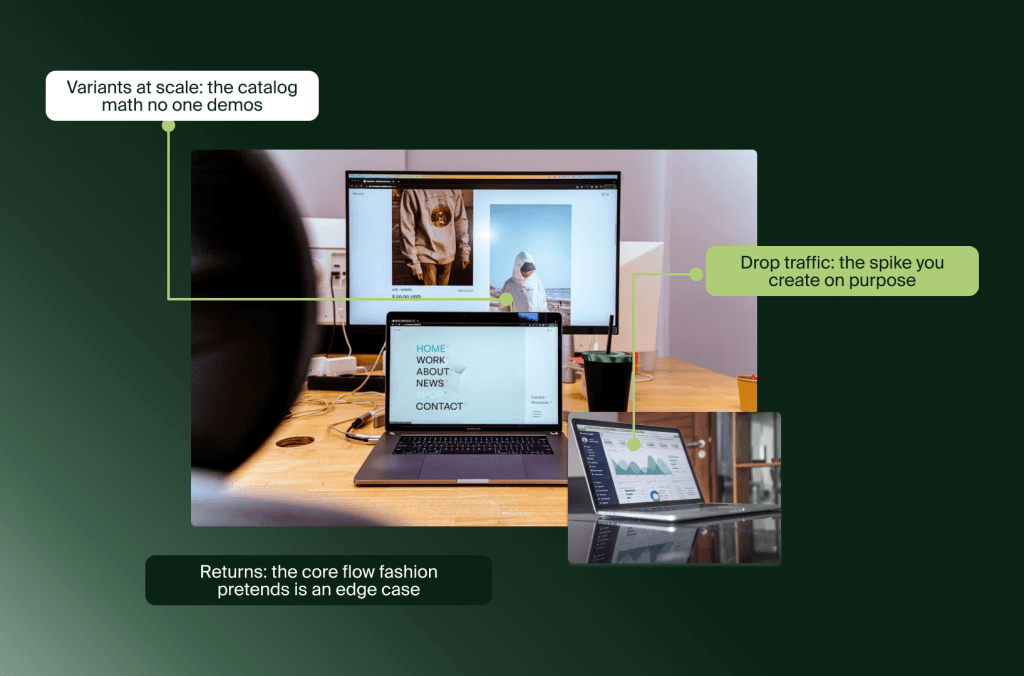
Variants at scale: the catalog math no one demos
A fashion product is rarely one item. A single style comes in sizes, and colors, and sometimes fits, and each combination is its own sellable unit with its own stock level. A modest-looking catalog of a few hundred styles becomes thousands of variants once the size and color matrix is multiplied out, and every one of those variants has to be tracked, merchandised, and kept in sync with inventory.
This is the catalog math no demo ever shows, because a demo store has a dozen products and the math stays invisible. It only becomes real in production, when the variant count climbs and the platform’s handling of it starts to matter: how cleanly it models the size-color-fit matrix, how it behaves when a single color sells out across every size, how merchandising logic holds up when the catalog is large. Standard platforms have more room than a small brand will ever need on day one, and less than a growing fashion catalog will need soon after. The ceiling is real; it is just not where you are standing when you choose.
Drop traffic: the spike you create on purpose
Most traffic spikes are things a business reacts to. A drop is a spike a fashion brand creates on purpose. The whole point of a launch is to concentrate demand into a narrow window, to tell everyone to show up at the same moment, and that is precisely the condition under which an eCommerce platform is most likely to struggle. The event designed to drive the quarter is also the event most capable of breaking the store.
What gets tested on drop day is not the storefront. It is the checkout under concurrent load, the inventory sync keeping a limited release from overselling, and the infrastructure holding steady while thousands of people try to buy the same thing at once. A platform that renders beautifully at normal traffic can buckle at the spike, and the cost of that is not abstract: it is the launch that turns into the day the site went down, in front of exactly the audience the brand worked hardest to gather.
Returns: the core flow fashion pretends is an edge case
In most retail, a return is an exception to handle. In fashion, it is part of the model. People buy two sizes intending to keep one. Fit is uncertain until the garment is on. A meaningful share of what sells will come back, and the experience of sending it back, or exchanging it for another size, is not a footnote to the customer relationship. It is often the moment that decides whether a first order becomes a second.
Yet returns are routinely treated as an edge case in platform decisions, something to configure later, because they are unglamorous and invisible in a demo. The reality is that the returns and exchange flow is a core fashion operation, and how well a platform supports it, size-for-size exchanges, refund timing, keeping inventory accurate as items come back into stock, is a genuine point of difference. A platform that treats returns as an afterthought passes that same treatment on to the customer at one of the most sensitive points in the relationship.
Why design is the least useful platform criterion
There is a sharper way to put all of this. Design is not just an incomplete criterion for choosing a fashion platform. It is close to the least useful one, and for a specific reason: it is the dimension on which the serious platforms have already converged. Choosing on design means choosing on the one thing that no longer separates your options, while staying blind to the things that separate them enormously.
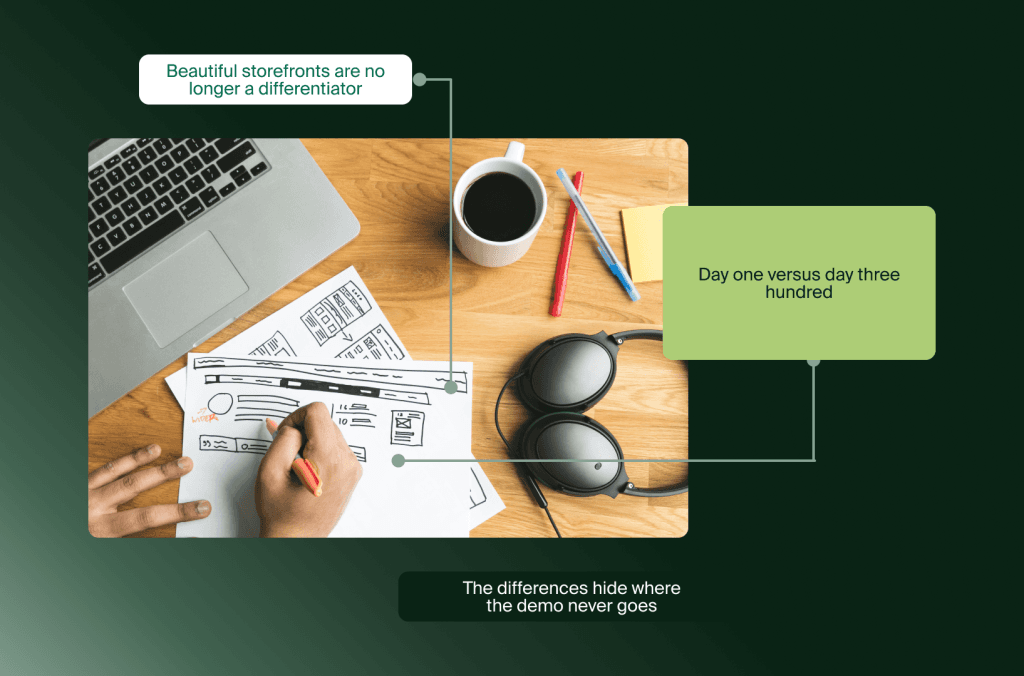
Beautiful storefronts are no longer a differentiator
A decade ago, a beautiful, fast, flexible storefront was a real differentiator, because building one was hard and many platforms could not. That is no longer the situation. The modern platforms a growing fashion brand would seriously consider can all produce a storefront that looks excellent and reflects the brand, given a competent design and build team. Beauty has become table stakes.
When a quality becomes available everywhere, it stops being a basis for deciding between options. If every serious platform can give you a storefront you would be proud of, then how the demo looks tells you only that you are looking at a serious platform, not which one fits your operation. The thing that feels most decisive is the thing that has quietly become the least discriminating.
The differences hide where the demo never goes
The real differences between platforms have moved to exactly the places a demo is designed not to go. A demo shows the storefront at rest: a handful of products, no traffic, no returns, no inventory under strain. The variant ceiling, the behavior under drop-day load, the quality of the returns flow, none of these are visible in that setting, because the setting was built to show the part that always looks good.
So the evaluation and the differences point in opposite directions. The evaluation concentrates on the storefront, where the platforms are nearly identical. The differences live in the operational layer, where the platforms diverge sharply, and which the evaluation never reaches. This is why two brands can choose the same beautiful platform and have completely different experiences a year later. They chose on the surface they could see, and the divergence was always underneath it.
Day one versus day three hundred
The cleanest way to see the gap is to separate two moments. Day one is launch: the storefront is new, the catalog is curated, traffic is normal, and everything looks the way it did in the demo. Day three hundred is the operation in full motion: the catalog has multiplied, several drops have come and gone, returns are a daily flow, and maybe wholesale or a second market has been added. Design decides how day one looks. The operational layer decides how day three hundred holds.
A platform chosen on day-one criteria can quietly become the constraint on everything that happens by day three hundred. The brand does not notice the moment it happens, because each individual friction is small: a catalog change that takes longer than it should, a drop that ran hot, a return that frustrated a good customer. Added together, over time, they are the platform showing you what it actually offered, long after the demo that sold it. The useful criterion was never how it looked. It was how it would hold.
What Shopify Plus offers at the operations layer
With the operational layer in view, the question the title asks becomes answerable. What Shopify Plus offers a fashion brand that standard platforms do not is not a better-looking storefront, because that is no longer where anything is decided. It is more room and better behavior in exactly the three places fashion operations are put under pressure: high-variant catalogs, drop-day traffic, and the dual demands of wholesale and omnichannel. Each maps directly to the realities laid out earlier.
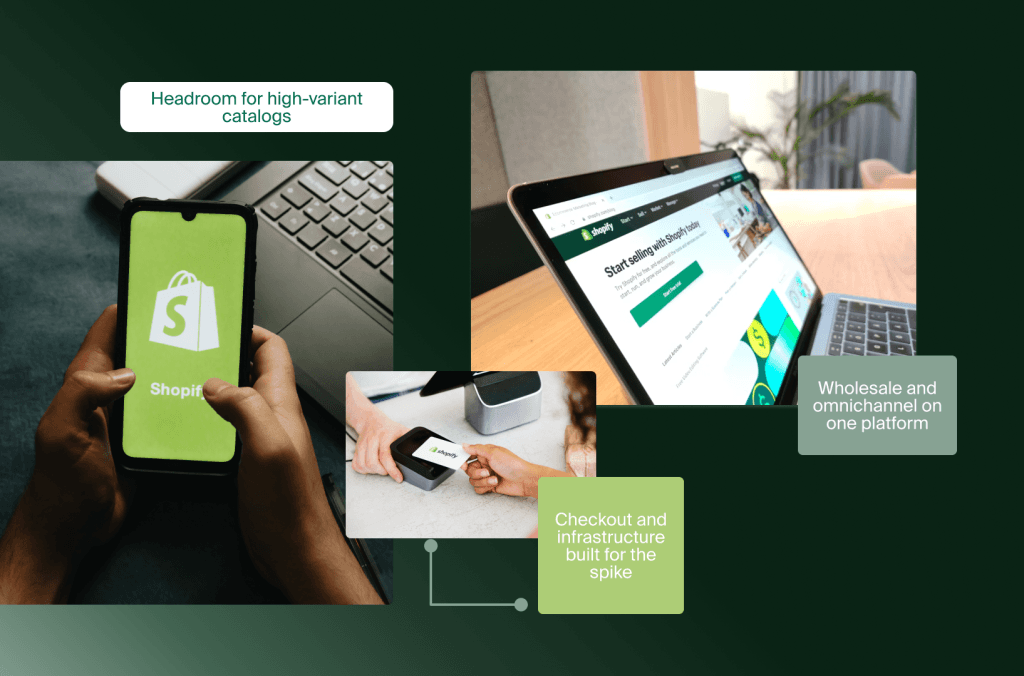
Headroom for high-variant catalogs
The first thing Shopify Plus offers is headroom where standard plans run out of it. A growing fashion catalog, multiplied across sizes, colors, and fits, presses against limits that a standard plan was never sized for, and the practical effect is felt in how much variant complexity the platform will carry before merchandising and inventory logic start to strain. Plus raises that ceiling, which for a fashion brand is not a technical nicety. It is the difference between a catalog that can keep growing and one that has to be worked around.
The value here is room to operate without fighting the platform. A brand whose catalog is expanding season after season needs the variant architecture to hold as it scales, and getting that architecture right is genuine build work rather than a setting to toggle. Flatline is a Shopify Platinum Partner that builds fashion storefronts on Shopify Plus, including award-winning work such as Mason Garments, and a large part of that work is exactly this: designing the variant and catalog structure underneath a fashion store so the operational layer holds as the brand grows. It's the kind of operational groundwork our Shopify Plus agency team builds into every fashion launch, well before drop day ever arrives. The headroom is what the platform offers; using it well is what turns it into an operation that scales.
Checkout and infrastructure built for the spike
The second thing Shopify Plus offers is infrastructure sized for the deliberate traffic event that defines fashion selling. A drop concentrates demand into a narrow window, and the parts of the platform that decide whether that window goes smoothly, checkout under concurrent load and inventory sync on a limited release, are precisely where Plus provides more capacity and more control than a standard plan. The platform is built on the assumption that some of its merchants will, on purpose, send enormous traffic at the store on a schedule.
This is the layer that turns a drop from a risk into a routine. Standard infrastructure can handle ordinary traffic and still struggle at the spike, because the spike is a different kind of demand. The point of an enterprise-grade checkout is that the launch designed to drive the quarter behaves like any other day from the store’s perspective, even as it behaves like the biggest day of the quarter from the brand’s. The infrastructure absorbs the event the brand created on purpose.
Wholesale and omnichannel on one platform
The third thing Shopify Plus offers is the ability to run more of the fashion operation on a single platform rather than stitching systems together. Many fashion brands sell both direct to consumer and wholesale, and many also sell in physical stores, and the habit has been to run each on its own system. Plus brings B2B and omnichannel capability onto the same platform as the DTC storefront, which means wholesale ordering and cross-channel inventory do not have to live in separate tools held together by manual work.
The operational gain is fewer seams. Every separate system in a fashion operation is a place where inventory can drift out of sync, where a sale in one channel is invisible to another, where someone has to reconcile by hand. Consolidating onto one platform does not erase the complexity of running multiple channels, but it removes the integration tax of running them on systems that were never meant to talk to each other. For a brand whose model spans DTC, wholesale, and retail, that consolidation is one of the clearest things Plus offers that a standard platform does not.
How to read a platform like a fashion operator
Everything to this point leads to a practical skill: how to evaluate a platform the way someone who runs a fashion operation would, rather than the way someone looking at a demo does. The shift is from passive to active. Instead of looking at what the platform shows you, you ask it what it does under the conditions your operation will actually create. Three questions do most of the work, and each one points straight at a layer where platforms differ.
Ask what happens when the catalog multiplies
The demo catalog is small and curated. Your real catalog will not stay that way, so the useful question is what happens when it multiplies. Ask how the platform handles a catalog several times larger than the one in front of you, with the full size-color-fit matrix expanded across every style. Ask what managing that catalog looks like day to day: how variants are created and updated in bulk, how merchandising logic behaves at scale, what happens to performance as the variant count climbs.
The answer tells you where the platform’s variant ceiling sits relative to where your catalog is heading. A platform that is comfortable at your current size and strained at three times that size is a platform you will outgrow on a predictable schedule. You want to know that before you choose it, not discover it in the season the catalog finally gets there.
Ask what the platform does on drop day
The demo runs at rest. Your operation will, deliberately, run at the spike. So ask what the platform does on drop day: how checkout behaves under concurrent load, how inventory stays accurate on a limited release while hundreds of people try to buy the same item at once, what the platform’s track record is for merchants who run large, scheduled launches. Ask it as an operator who intends to create that traffic, because you will.
This question separates platforms that are sized for ordinary commerce from platforms that are built for the deliberate traffic event fashion depends on. The storefront looking good at normal load tells you nothing about the spike. The only useful evidence is how the platform behaves when demand is concentrated into the narrow window you designed, which is exactly the window where a weaker platform fails most visibly.
Ask how a return actually flows
The demo never processes a return. Your operation will process them constantly, so trace one all the way through. Ask how a customer initiates a return or an exchange, how a size-for-size swap is handled, how refunds are timed, and how inventory is updated as returned items come back into stock. Follow the whole flow, because returns are not a setting you check once. They are a daily operation that touches the customer at a sensitive moment and touches inventory accuracy at every step.
How cleanly a platform handles that flow is a genuine differentiator, and it is one you can only see by walking through it deliberately. A platform that makes returns awkward is making one of fashion’s core flows awkward, and that awkwardness lands on the customer exactly when their decision to buy again is being formed. Reading the return flow closely is reading the platform’s fitness for fashion at one of the points that matters most.
The difference that shows up over time
Return to the question in the title one last time. What Shopify Plus offers a fashion brand that standard platforms do not is not visible on launch day, because on launch day almost any serious platform looks the part. The difference is something that reveals itself over time, as the catalog grows, the drops accumulate, the returns flow daily, and the operation moves into the full motion it was always heading toward. The offer is not a better first impression. It is a platform that holds as the operation gets heavier.
From how it looks to how it holds
The single most useful change a fashion brand can make to a platform decision is to stop asking how it looks and start asking how it holds. How it looks is answered in a demo, in seconds, on the dimension where the platforms have already converged. How it holds is answered over a year of real operation, on the dimensions where they diverge sharply: variant scale, drop-day load, returns, and the channels the brand runs. The first question is easy and nearly meaningless. The second is harder and decides everything.
This is not an argument against caring about design. It is an argument for putting design back in its proper place, as one consideration among several, and a relatively safe one, since the serious options all handle it well. The weight that design currently takes in most platform decisions is weight borrowed from the operational questions that deserve it more. Moving that weight is the whole shift.
The question worth carrying into the decision
So the question worth carrying into any platform decision is not which storefront is most beautiful. It is which platform will still fit when the operation is several times larger and several times busier than it is today. That question reframes the storefront from the substance of the decision to the surface of it, and brings the operational layer, where platforms genuinely differ, into the center where it belongs.
What Shopify Plus offers a fashion brand, in the end, is room and resilience in exactly the places a fashion operation comes under pressure. Whether that is the right offer for a given brand depends on where that brand is heading, how large its catalog will grow, how it sells, how it handles the moments of peak demand it creates on purpose. Those are the questions that decide platform fit, and they are questions about the operation, not the storefront. The storefront is what a brand looks at. The platform is what it builds on.
Related articles