Shopify Plus costs explained: Understanding the variable fees & true value

By Robin Laseur
When it comes to enterprise-level eCommerce, choosing the right platform is a game changer. For large businesses, Shopify Plus has become a top choice because of its flexibility, scalability, and ease of use. But with great power comes a price, and Shopify Plus pricing can seem complex at first glance. That’s why we’re breaking it down for you.
This blog will walk you through Shopify Plus pricing, how the variable fee works, the extra costs to keep in mind (like transaction fees), and why it might be a smart investment for your business. We’ll also compare Shopify Plus with Shopify Advanced, as well as give you real-world examples so you can understand what this all means for your bottom line. Let’s dive in.
Shopify Plus pricing: The variable fee explained
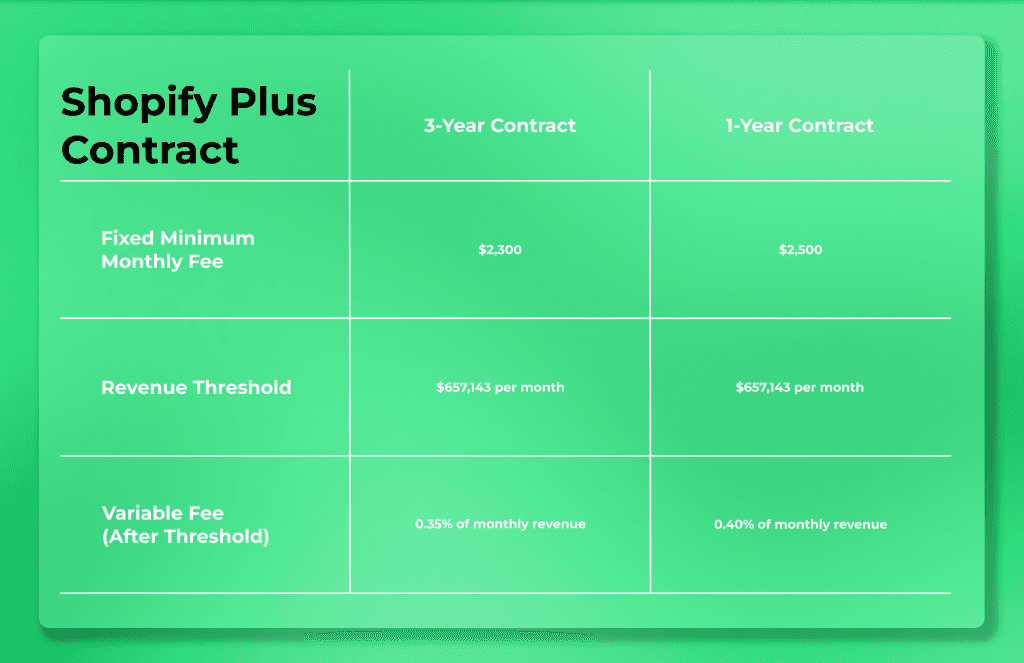
Shopify Plus pricing follows a structure that adjusts based on your revenue, giving your business flexibility as you scale. Here’s how it works:
Variable fee
Once your monthly revenue exceeds $657,143, the platform fee becomes a percentage of your revenue. On a 3-year contract, that percentage is 0.35%, and on a 1-year contract, it’s 0.40%.
Fixed minimum fee
Shopify Plus starts with a minimum monthly fee of $2,300 (on a 3-year contract) or $2,500 (on a 1-year contract).
When does the switch from fixed to variable fees happen?
The switch from a fixed fee to a variable fee happens when your store’s monthly revenue surpasses $657,143. Until you reach that threshold, you’ll pay the fixed fee of $2,300 (or $2,500). Once you’re earning more than that per month, Shopify charges a percentage of your revenue, offering a scalable solution that grows with your business.
Why use a variable fee structure?
This model allows Shopify to grow with your business, ensuring that your costs are tied to your success. When your revenue is lower, you’re only paying the fixed fee. As your sales increase, Shopify takes a percentage, but it’s designed to be cost-efficient compared to many competitors like Magento, Salesforce Commerce Cloud, or Shopware. Plus, the variable fee ensures that Shopify is motivated to help you succeed because their success depends on yours.
Transaction fees & shopify payments
In addition to the platform fee, you’ll also need to consider transaction fees, which are an inevitable part of running an eCommerce store.
Transaction fees on Shopify Plus
For every transaction in your store, a small percentage goes to the Payment Service Provider (PSP) that processes the payment. While this fee is separate from the Shopify platform fee, it’s still a significant cost to factor into your overall expenses.
To minimize these fees, Shopify encourages its users to adopt Shopify Payments, Shopify’s in-house PSP. Here’s why:
When you use third-party PSPs like Mollie, Adyen, or Pay.nl, Shopify charges an extra commission on top of the regular transaction fees. This commission covers security and compliance costs. For Shopify Plus users, the third-party commission is 0.20% per transaction, while for Shopify Advanced, it’s 0.60%.
However, there’s a way to avoid the extra commission entirely. If Shopify Plus users rely on Shopify Payments as their primary PSP (e.g., for credit card transactions), the 0.20% commission is waived. This means you could save a significant amount of money just by using Shopify Payments.
Shopify Payments: Why it’s recommended
Shopify Payments is not only a way to avoid third-party transaction fees but also simplifies your operations. It consolidates all your payment processing within the Shopify ecosystem, giving you greater control and visibility over your transactions.
If you use Shopify Payments, the fees are as follows:
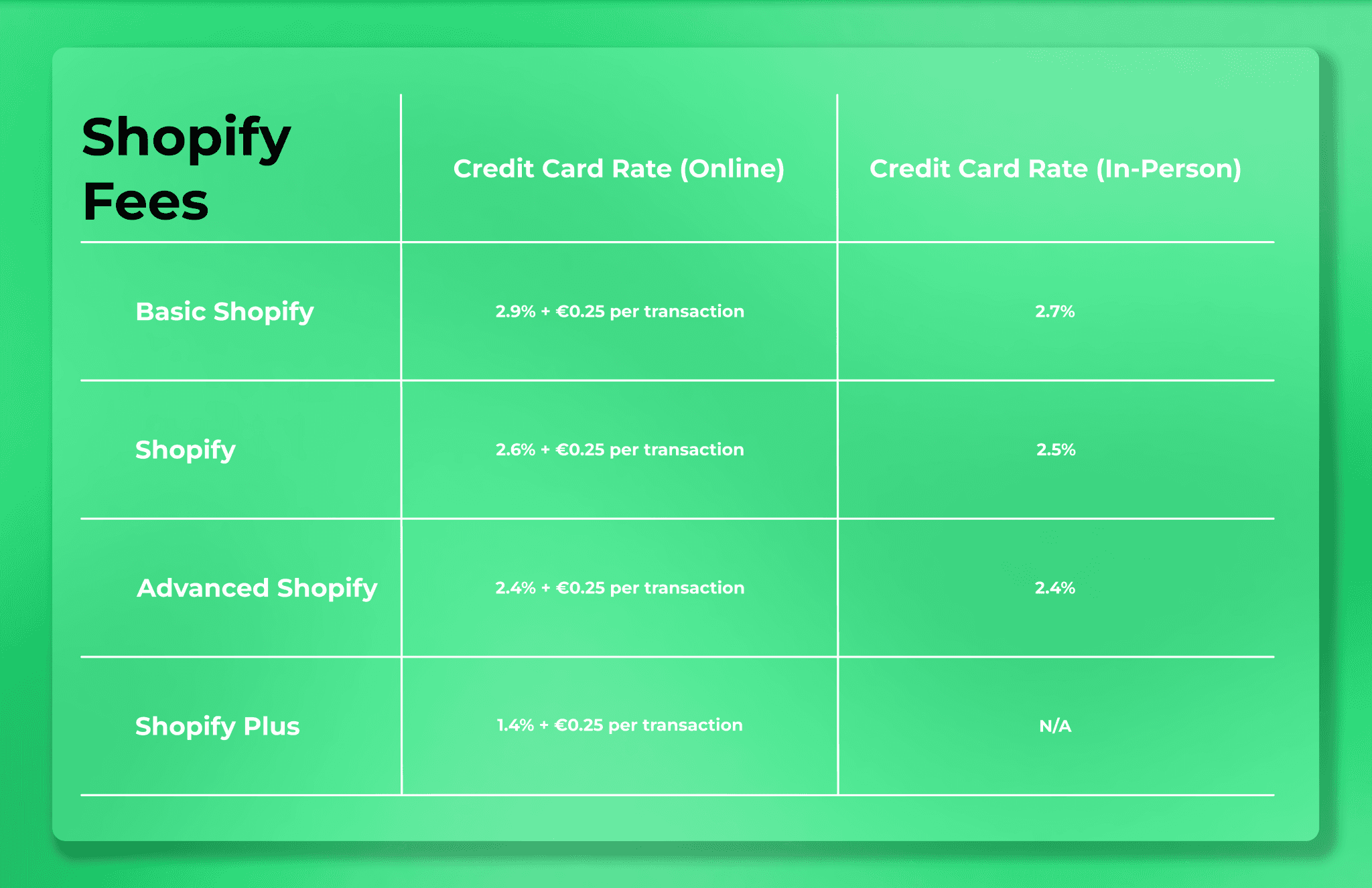
Using Shopify Payments can be a cost-saver, particularly when paired with the Shopify Plus plan, where you can avoid the additional third-party commissions. This is one of the reasons Shopify encourages its users to stick with their in-house PSP.
Real-World cost scenarios: A breakdown
Let’s take a closer look at what these fees mean in practice by walking through a few scenarios.
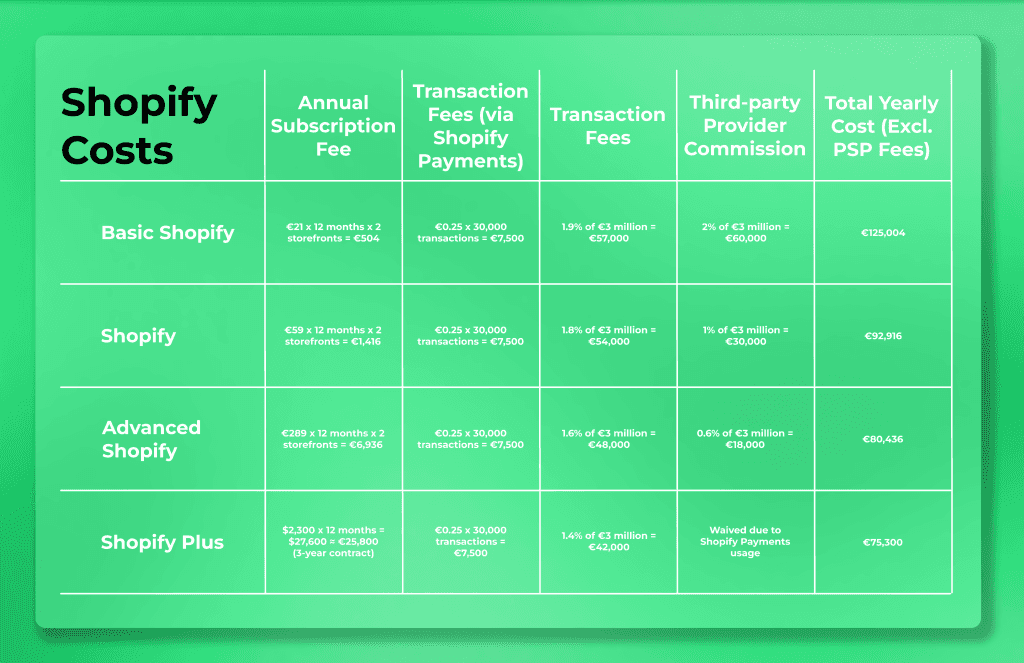
Imagine you have an online store with two localized storefronts, and your total annual revenue is €6 million. Your average order value (AOV) is €100, meaning your store processes around 60,000 transactions each year. Half of your transactions come through Shopify Payments, and the other half are processed by a third-party provider.
Here’s a breakdown of how much this would cost on each Shopify plan:
Key takeaway
As seen in these examples, Shopify Plus can actually end up being cheaper than Shopify Advanced, despite its higher base fee, because of its lower transaction fees and waived third-party commission. For high-volume merchants, Shopify Plus is not only scalable but also potentially more cost-effective.
Shopify Plus vs Shopify Advanced: Is the upgrade worth it?
If you’re already using Shopify Advanced, you might be wondering: when does it make sense to upgrade to Shopify Plus?
Cost comparison
The monthly fee for Shopify Plus is clearly higher than Shopify Advanced, but the value comes in the form of features that are essential for enterprise businesses. From automation tools to increased storefronts and advanced functionality, Shopify Plus pays for itself in ways that go beyond just the lower transaction fees.
Automation
Shopify Plus offers built-in automation tools that streamline everything from promotions to order processing.
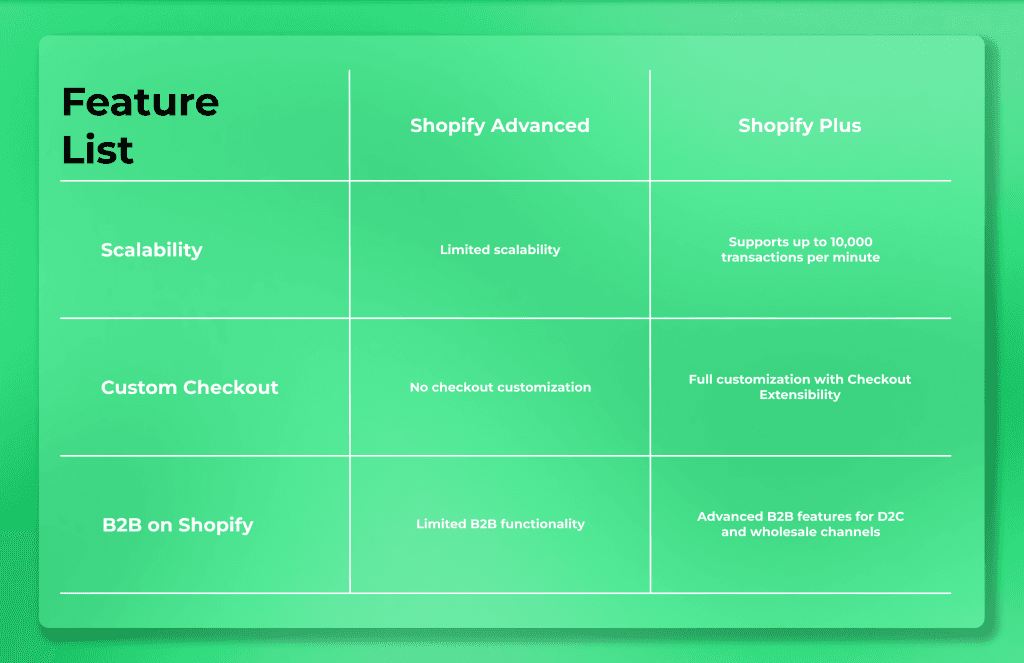
Some key reasons why businesses choose Shopify Plus over Advanced:
Unlimited scalability
Shopify Plus allows you to handle up to 10,000 transactions per minute. This is ideal for high-traffic stores.
Custom checkout
With Checkout Extensibility, you can customize the checkout experience to maximize conversion rates.
B2B on Shopify
Advanced B2B features allow you to manage direct-to-consumer (D2C) and wholesale channels from one dashboard, offering client-specific pricing, minimum order quantities, and more.
Beyond subscription fees: The total cost of running a Shopify store
The monthly platform fee and transaction fees are just part of the equation when running a Shopify store. You’ll also have to consider the costs associated with building and maintaining your online store.
For example, having your Shopify Plus store built by an agency like Flatline Agency can cost anywhere from €50,000 to €200,000, depending on the complexity of your project. This cost includes custom themes, app development, integration with third-party tools, and more.
Additionally, you may incur ongoing costs such as:
Shipping & Fulfillment
If you’re using third-party logistics (3PL) providers, their fees also need to be factored into your overall costs.
Apps
Many Shopify apps are subscription-based, and can range from €10 to €500 per month, depending on their functionality.
Marketing
Paid ads, SEO, and other marketing efforts can be a significant expense.
Conclusion: Is Shopify Plus worth the investment?
For growing eCommerce businesses, Shopify Plus offers a scalable, flexible platform that can adapt to your needs. The variable fee structure ensures that you aren’t paying more than necessary, and the waived third-party transaction fees with Shopify Payments can result in significant cost savings.
Moreover, the advanced features of Shopify Plus—from automation to B2B functionality—make it an attractive option for enterprise-level merchants. While the initial investment may seem steep, the long-term benefits often outweigh the costs, making it a worthwhile investment for businesses ready to scale.
Weighing that investment properly is exactly the kind of cost-benefit work our Shopify Plus agency walks merchants through before they sign a contract.
Still unsure? At Flatline Agency, we’ve worked with countless businesses to optimize their Shopify Plus stores for maximum efficiency and ROI. Contact us today to see how we can help you make the most out of your eCommerce investment.
Ready to build something real together with your favorite creatives and tech leads? Get into contact or fill out an inquiry form.
Related articles


