Should You Keep Meta Direct Checkout Enabled? A Shopify Readiness Guide

By Robin Laseur

Keep Shopify Meta direct checkout enabled when your store is eligible and the available purchase experience satisfies its essential requirements. Review product support, delivery and measurement before making that choice. If a mandatory requirement is unsupported or unresolved, use the online-store route while your team assesses the gap.
An active setting gives a Head of eCommerce a specific decision to own. The readiness worksheet below turns that decision into a record of requirements, evidence and accountable owners. It helps distinguish a documented platform capability from a purchase flow your own team has verified.
For what changed when Meta became a Shopify AI channel, see what Meta as a Shopify AI channel changes for your store.
Establish whether this purchase route applies to your store
Meta direct checkout lets shoppers complete a Shopify-powered purchase inside Meta surfaces. Shopify currently limits this experience to customers in the United States and specifies store and product eligibility requirements. Establish the relevant customer market and inspect your store’s actual status before investing in a detailed readiness review.
For an Amsterdam-based brand serving US customers, headquarters location alone cannot settle the decision. Identify the storefront, customer market and product offer being assessed. Record them at the top of the review so findings for one setup are not applied to another.
Use Shopify’s Meta requirements as the eligibility source. Capture the status visible to your administrator, the documentation-check date and the owner responsible for resolving any setup questions.
The Agentic plan has a different starting point: direct checkout is deactivated by default and requires setup and activation. If that is your plan, the decision is whether to activate the experience after validation. Confirming the plan prevents a default-state assumption from steering the review.
If the route does not apply to the market you currently serve, record that outcome and an event that would justify revisiting it. A future market expansion is a clearer trigger than leaving an indefinite testing task open.
Define the buying requirements that must survive
A readiness review needs explicit purchase requirements before it evaluates features. State what the customer must be able to buy, which information the business must collect and how the order must be fulfilled. Distinguish mandatory conditions from preferences so the final decision reflects the consequences of an unmet requirement.
Ask your commercial and operations owners to describe the intended offer in plain language. For a hypothetical apparel brand, an essential requirement might be accurate size selection and home delivery. A gift-message field could be optional for one range and central to another.
Write each requirement as an observable outcome. “The buyer’s selected size reaches the fulfillment record” is testable. “The checkout feels on-brand” needs a more precise definition before it can govern a release decision.
Shopify lists subscriptions, bundles, customizable products and B2B-only products as unsupported in Meta direct checkout. It also excludes checkout blocks, local delivery, store pickup and pickup points, and does not allow mandatory customer sign-in. Compare your requirements with those documented boundaries before planning tests.
An unsupported essential requirement should lead to a route decision. If it is optional, the relevant business owner can decide whether the changed experience is acceptable. Keep that acceptance explicit; an engineer should not have to infer whether a missing commercial feature matters.
Check the actual experience and any handoff
Documented support is a starting point for testing a store-specific purchase journey. Verify the chosen variant, price, required information and delivery outcome in the route your customer will use. Where a handoff occurs, inspect the resulting cart and checkout rather than assuming continuity from a setting or product listing.
Shopify documents a redirect to online-store checkout when required information cannot be collected on the Meta surface, with the cart preserved. This is not evidence that every unsupported product or custom workflow has a suitable fallback. Keep that distinction in the test plan.
Choose a representative set of customer situations based on your requirements. For a hypothetical beauty brand, the team could assess a standard single-product purchase and separately identify a subscription offer that requires the store route. This is a planning example, not a claim that a particular brand or app has been tested.
For each accessible journey, retain the test date, product reference, customer-market context and observed outcome. If the route cannot be exercised in your available environment, mark the requirement unresolved. A documentation reference and an end-to-end result provide different evidence.
The same discipline applies after purchase. Confirm that the people handling the resulting order can locate the information needed to fulfill it and answer a customer query. Record discrepancies before expanding participation or assuming existing integrations will process the new route as intended.
Decide what evidence is sufficient to measure a pilot
A pilot needs a measurement plan that matches the purchase route. Establish which order and reporting records are available, what each metric includes and which events are absent. Decide whether that evidence is sufficient for the business question before interpreting channel performance or comparing it with website conversion data.
Google Analytics and custom client-side pixels do not fire in Meta direct checkout. Treat that as a documented measurement boundary. This guide does not propose an untested server-side replacement or assume that an existing attribution app resolves it.
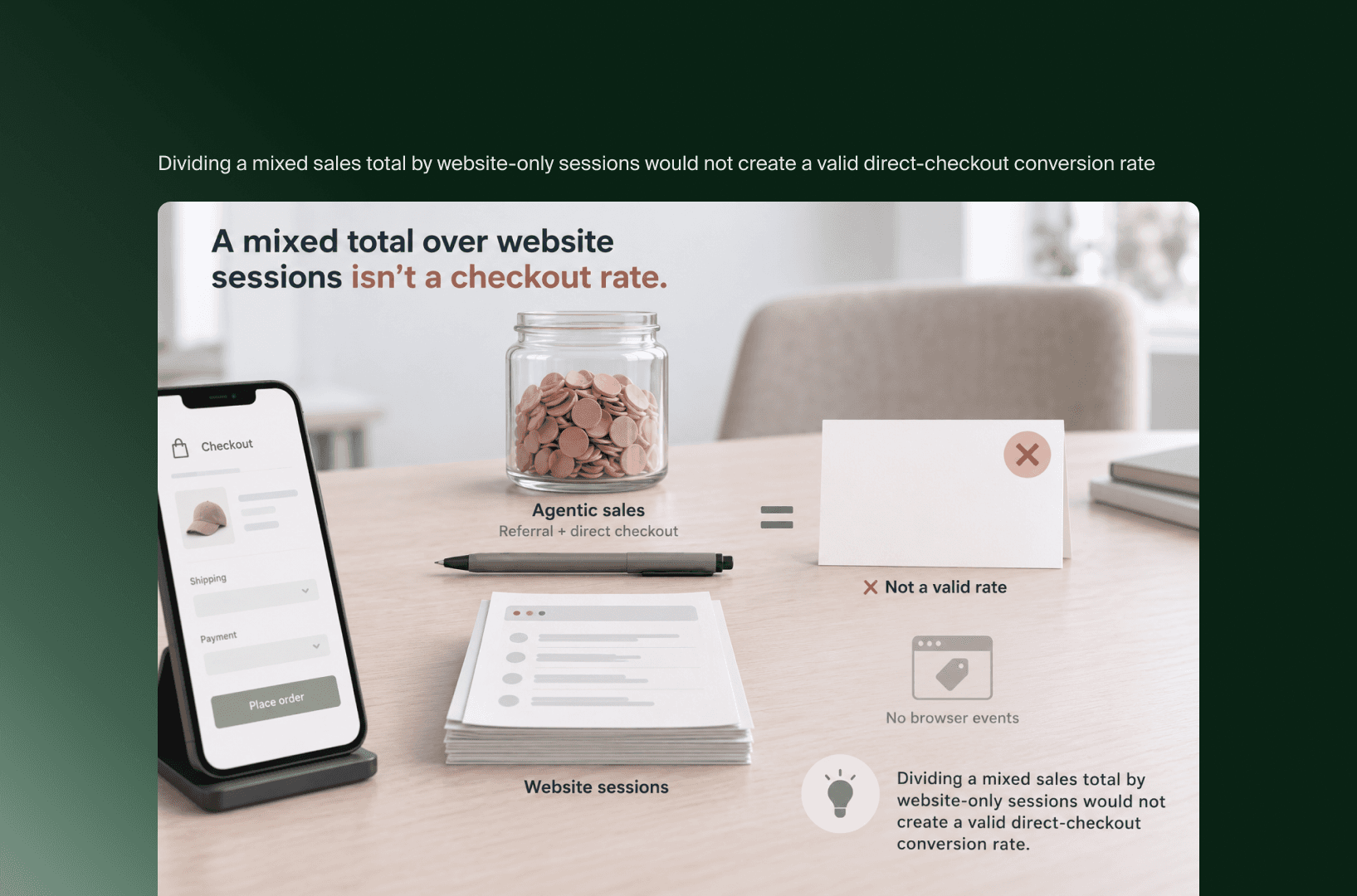
Shopify’s agentic reporting documentation says its sales data aggregates referral-based and direct-checkout sales. Online-store conversion describes website sessions that complete checkout. Agentic performance analytics are also not yet available for headless stores.
Ask the analytics owner to map the decision question to a suitable record. “Can operations identify and handle these orders?” needs different evidence from “Does this route generate incremental profit?” A small pilot can answer the first without proving the second.
If your evaluation requires a route split that the available reporting cannot establish, record the limitation and reconsider the evaluation design. Dividing a mixed sales total by website-only sessions would not create a valid direct-checkout conversion rate.
Set the pilot’s success criteria before reviewing results. Include operational correctness and customer support outcomes alongside any commercial metric the available data can support. Keep assumptions visible rather than assigning precision to an incomplete measurement path.
Complete the readiness worksheet
Use the worksheet to connect each essential requirement with evidence and a decision owner. Start with a defined store, market and offer, then mark each row Verified, Unresolved or Unsupported. A verified row needs a source or observed result appropriate to the claim; leave room for the actual evidence in your working copy.
This is an editorial decision tool, not a certification or a test already performed. Replace the suggested roles with names. Add your exact requirement and evidence reference to each row before changing its status.
Review area | Acceptance criterion to define | Evidence to retain | Suggested owner | Starting status |
|---|---|---|---|---|
Eligibility | The intended store, market and offer meet the applicable conditions. | Current eligibility and setup record. | Store administrator | Unresolved |
Product offer | Essential product choices and buying conditions are supported. | Requirement list matched to official documentation. | Commercial owner | Unresolved |
Purchase journey | Required selections and information reach the intended checkout or handoff. | Dated journey record for representative cases. | eCommerce lead | Unresolved |
Fulfillment | The resulting order contains the information operations needs. | Order and downstream record comparison. | Operations owner | Unresolved |
Customer service | Staff can identify the purchase route and handle the expected query or return. | Documented support walkthrough. | Service lead | Unresolved |
Measurement | Available records can answer the stated pilot question. | Metric definitions, sample records and exclusions. | Analytics owner | Unresolved |
Assess essential requirements individually. A total score can hide a blocking issue: several successful checks do not compensate for a missing condition that makes the intended purchase unsuitable.
Keep optional differences in a separate note with an accepting owner. This lets the team distinguish a deliberate compromise from an unfinished investigation without turning every preference into a release blocker.

Record one of three outcomes
A readiness review should end in a named decision: retain or activate direct checkout, use the online-store route, or leave the decision pending while resolving evidence gaps. Record the reason, scope and review trigger. A pending assessment still needs an explicit interim setting approved by the responsible business owner.
Retain or activate direct checkout when the mandatory criteria are satisfied and the team accepts the measurement limitations. Record which requirements were verified through documentation and which through observed behavior. Those distinctions will matter when the setup changes.
Use the online-store route when an essential requirement cannot be met or verified sufficiently for the intended use. Shopify permits direct checkout to be disabled while discovery remains available. Preserve the agreed Catalog-access decision when changing the purchase route; these settings have separate purposes.
Keep the decision pending when a specific evidence gap prevents either conclusion. Name the missing result and the person obtaining it. Pending is a review status, not a special Shopify configuration, so document what remains enabled in the meantime.
When making a configuration change, review the management mode first. Shopify’s management documentation explains that reactivating “Allow Shopify to manage for me” also reactivates the relevant agentic settings. Keep the approved choice in the channel record so another administrator can preserve its intent.
Key takeaways
Define mandatory buying requirements before evaluating the route. An active setting or general eligibility cannot establish store-specific readiness.
Use appropriate evidence for each claim, including purchase and operational checks where necessary. Record an inaccessible test as unresolved.
Choose a purchase route together with a measurement plan and named owner. Preserve the rationale so a later configuration change can be reviewed against it.
If your teams need help translating purchase requirements into acceptance checks, Flatline’s eCommerce team can help scope the review and the implementation work it identifies.
Related articles