More Tests Isn't More Revenue: Prioritizing Shopify CRO Experiments

By Robin Laseur

Prioritizing Shopify CRO Experiments; A CRO team presents its quarter. The number they lead with is velocity: forty experiments shipped, up from twenty-five. The slide radiates momentum. Then someone asks the only question that matters, what did revenue do, and the room goes quiet, because the honest answer is that it did roughly nothing. The tests ran. The needle did not move.
This is the most common failure in ecommerce CRO, and at its root it is a counting error. More tests is not more revenue. Past a point set by your traffic, more tests is actively less revenue, because the thing that compounds a testing program is not how many experiments you run but which ones you refuse to run. This piece is about that discipline: why velocity stops paying, and how to rank a backlog so the tests you ship are the few that actually move money.
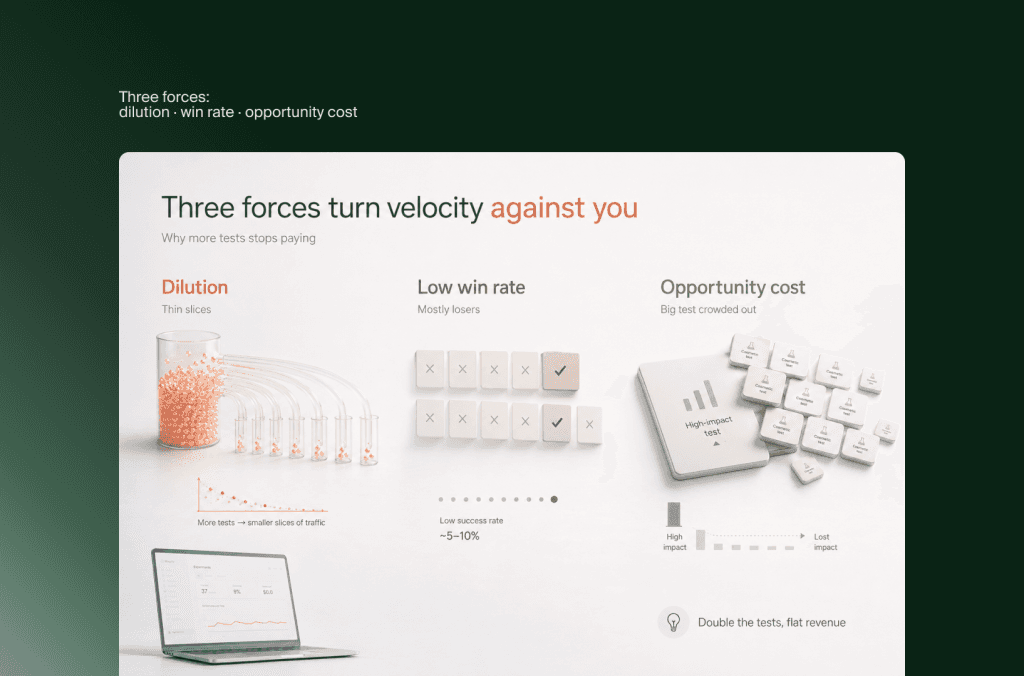
Why more tests stops producing more revenue
More tests does not produce more revenue because test value follows a power law and statistical power is finite. A few high-impact tests drive almost all the gain, most tests do not win at all, and every additional test competes for the same limited traffic each one needs to reach significance. Past a point set by your traffic, adding tests lowers the program’s return rather than raising it.
Three forces turn velocity against you, and the rest of this piece takes them in turn. The first is dilution: a store has only so many sessions and conversions, and statistical significance is bought with them, so running more tests at once means each gets a thinner slice and fewer reach a trustworthy result. The second is the win rate: most tests simply do not win, so running more low-quality experiments mostly manufactures more losers and, worse, more false positives you mistake for wins. The third is opportunity cost: because impact is concentrated in a handful of high-leverage changes, a backlog full of small cosmetic tests crowds out the few big ones that would have mattered.
Put together, these explain why a team can double its test count and watch revenue stay flat. Velocity feels like progress because it is easy to count, which is exactly what makes it a vanity metric. The program that compounds is not the one running the most experiments. It is the one that spends its finite traffic on the fewest, highest-expected-value tests, and has the discipline to leave the rest unrun. The next three sections are the mechanics of why, and the final one is how to choose.
The scarce resource is traffic, not ideas
The constraint on almost every Shopify CRO program is not a shortage of test ideas. It is a shortage of the traffic and conversions needed to tell a real winner from noise. Statistical significance is not free. It is paid for in sessions, and most stores have a smaller budget of them than their test backlog assumes.
The arithmetic is unforgiving and worth internalizing. A trustworthy A/B test generally needs on the order of a thousand or more conversions per variant, gathered over a couple of weeks or more, before the result means anything. That is why serious testing shops often refuse to run experiments on stores below roughly fifty thousand monthly sessions: beneath that, a test either takes months to conclude or never reaches significance at all. Run several tests at once on a modest store and you have not multiplied your learning, you have divided your already-thin traffic among experiments that will each now take even longer, or finish inconclusive, which is the most expensive result of all because it consumes the traffic and returns nothing.
The impact of ignoring this is a backlog that looks productive and produces noise. A weak test on a low-traffic store burns weeks waiting for a result that arrives statistically shaky and commercially trivial, and the team, hungry for a conclusion, calls it early or reads a pattern into randomness. This is where the winner’s curse lives: stop a test the moment it peeks positive, and you will bank a “win” that was luck, ship it, and wonder later why the aggregate revenue never reflects the sum of your victories.
So the first move in prioritization is not scoring ideas, it is being honest about your traffic budget. Estimate how many tests your store can actually power to significance in a quarter. For most Shopify stores that number is small, often a handful, not dozens. That single constraint reframes everything downstream: if you can only truly run a few tests, the entire game becomes making sure they are the right few. Which raises the question of what makes a test worth one of those scarce slots, and the answer starts with how rarely tests win at all.
Most tests lose, so the hypothesis is the multiplier
Most A/B tests do not win. Across the industry, the share of experiments that produce a statistically significant lift tied to a real commercial metric lands somewhere between a fifth and a third, and by stricter definitions it is closer to one in ten. That base rate is the single most clarifying fact in CRO, because it means the quality of the hypothesis behind a test, not the act of testing, is what separates a program that compounds from one that spins.
The mechanism is straightforward once you accept the base rate. If only a minority of tests win, then running more tests without improving how you choose them just moves you along the same low win rate at higher volume, generating more losers and consuming more traffic to do it. The lever is not volume, it is lifting the win rate, and win rate is a function of evidence. A test built on a real, observed problem, a checkout step where session recordings show hesitation, an exit survey where buyers name a specific doubt, a page where analytics show a sharp drop, starts with a far better chance than a test built on a meeting-room opinion about a button. The teams with unusually high win rates are almost never testing more. They are testing hypotheses grounded in quantitative and qualitative data, which is why the same change that fails as a guess can win as an evidenced bet.
The failure to respect the base rate is expensive in a way that compounds quietly. Cosmetic tests, the recolored button, the reworded microcopy with no rationale behind it, perform badly on average, yet they dominate most backlogs because they are easy to think of and easy to build. Every one of them spends a slice of your scarce traffic to test a hypothesis that was never likely to move behavior. The strongest ecommerce tests change how a customer feels, decides, or finds a product, not merely how something looks, and that is a difference of evidence, not effort.
The action follows directly. Before a test earns a slot, it has to clear an evidence bar: what specific data says this is a real problem, and why should the proposed change plausibly move it. A hypothesis that cannot answer both is not ready to test, and running it anyway is how a program keeps its win rate low while staying busy. This same discipline sits at the center of the structured CRO cycles that separate durable programs from a stream of one-off experiments.
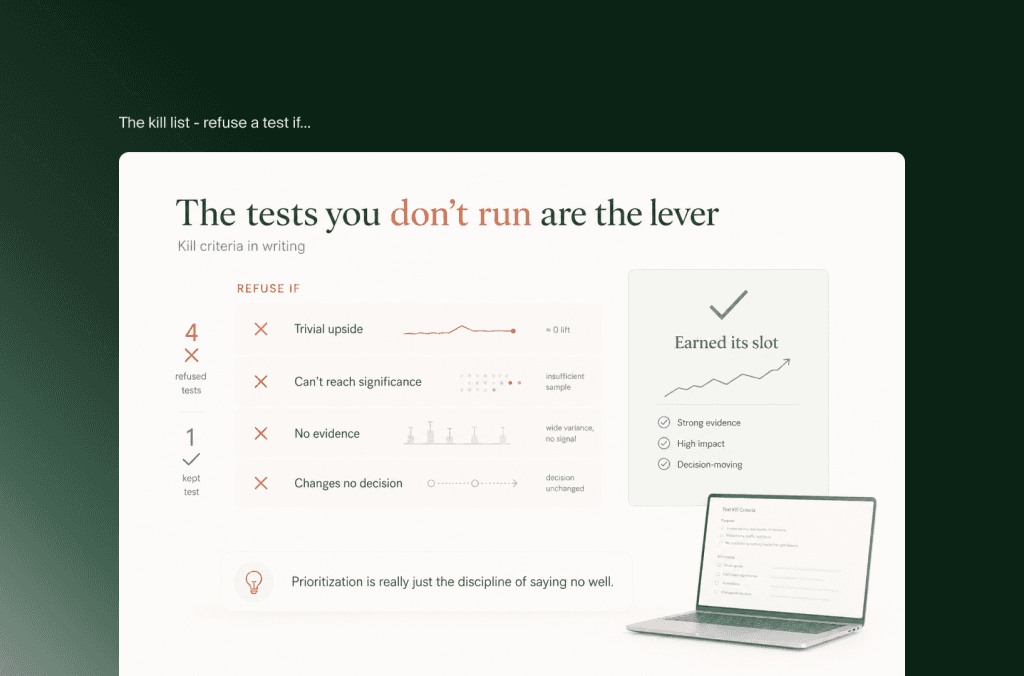
The tests you don’t run are the real lever
Here is the reframe the whole piece has been building toward. Because traffic is finite and most tests lose, the highest-leverage decision in a CRO program is not which tests to run. It is which tests to refuse. A backlog is not a to-do list to work through, it is a set of competing claims on a scarce resource, and every test you say yes to is traffic you have said no to for every other test. Prioritization is really just the discipline of saying no well.
The mechanism is opportunity cost, sharpened by the power-law shape of impact. If a small number of changes drive most of the available gain, then the cost of running a low-impact test is not merely its own weak result. It is the high-impact test that could have used those same weeks of traffic and did not, because a cosmetic experiment was occupying the slot. On a store that can only power a handful of tests a quarter, filling even one or two of those slots with trivial tests can halve the program’s real output for the period. The waste is invisible on a velocity dashboard, which counts the trivial test as a point of progress rather than the missed win it actually represents.
This is why a kill list matters more than a wish list. The tests worth refusing outright fall into recognizable groups: tests whose maximum plausible upside is commercially trivial even if they win, tests that cannot reach significance in a sane window given your traffic, tests with no evidence behind them beyond a preference, and tests whose result would not change any decision regardless of outcome. A test that fails any of these is not a lower priority to revisit later. It is a no, and saying so protects the traffic that your few real bets depend on. The uncomfortable part is cultural: killing a stakeholder’s pet idea is harder than quietly adding it to the backlog, which is exactly why weak programs run everything and strong ones do not.
The action is to make refusal explicit and cheap. Maintain the kill criteria in writing so a no is a policy rather than a personal judgment, and hold the line that an unrun test is not a failure of ambition but a deliberate allocation of scarce traffic to where it compounds. The programs that pull ahead are not braver about testing. They are more comfortable not testing, and that comfort is the second-order source of their results.
That same discipline, running fewer, better-evidenced tests, is what a specialist Shopify Plus agency brings to a CRO retainer instead of chasing velocity for its own sake.
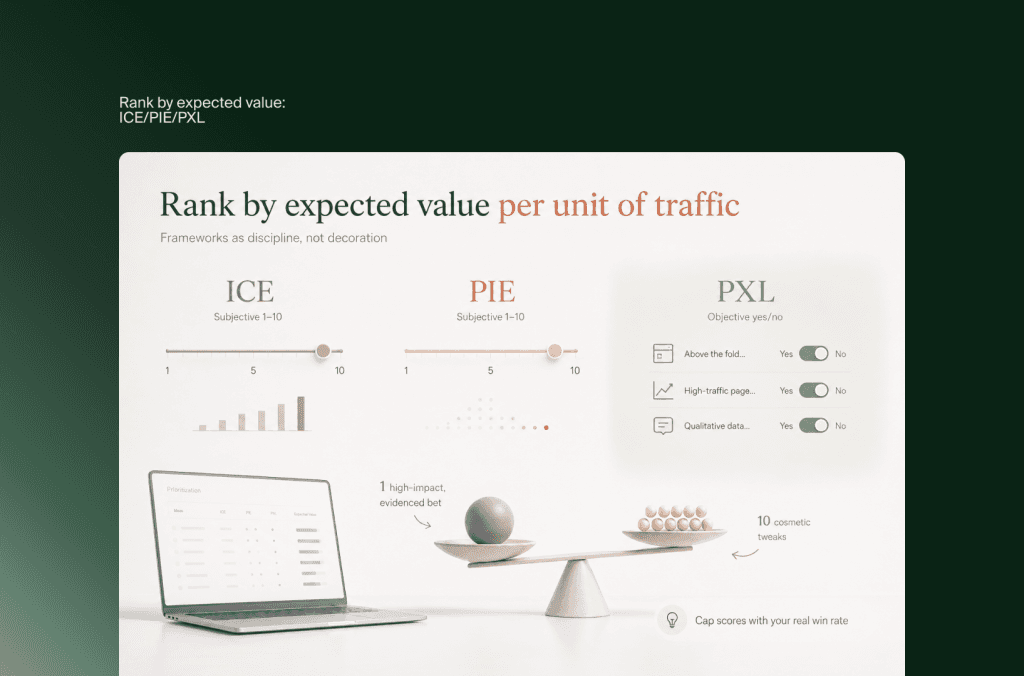
How to actually rank your tests
With the traffic budget known and the kill criteria in hand, ranking what remains is the easy part, and it comes down to one idea: rank by expected value per unit of traffic, not by how appealing the idea feels. Expected value here is the honest product of three things, the size of the prize if it wins, the probability it actually wins, and the value of the traffic it touches, divided by the traffic and time it will consume to conclude. A test with a huge potential lift on your highest-revenue page, backed by real evidence, is worth ten cosmetic tweaks on a page nobody buys from.
The established scoring frameworks are useful, provided you use them as discipline rather than decoration. ICE (Impact, Confidence, Ease) and PIE (Potential, Importance, Ease) are fine starting points, but their weakness is that the scores are subjective, and optimism inflates them until everything is a nine. PXL, the framework from the CXL team, fixes this by replacing vague one-to-ten scores with objective yes/no questions: is the change above the fold, is it on a high-traffic page, is there qualitative data supporting it. The value of any of them is not the number they produce. It is that they force the same honest inputs, evidence, effort, and where the money is, onto every test so the comparison is fair.
Ranking factor | The question to ask | Why it decides priority |
Where the money is | Does this touch a high-traffic, high-revenue, or high-drop-off page? | A win on a page nobody visits changes nothing; impact scales with the traffic and revenue behind the page |
Strength of evidence | What quantitative and qualitative data says this is a real problem? | Evidence is what lifts win rate above the dismal base rate; a preference is not evidence |
Size of the prize | If it wins, is the upside commercially meaningful? | A statistically real but trivial lift is a slot wasted on a rounding error |
Power feasibility | Can this reach significance in a sane window at our traffic? | A test that cannot conclude is traffic spent for no answer |
There is one honest input the frameworks rely on and most teams fake: your own numbers. Before your next prioritization meeting, pull your last twenty test results and calculate your real win rate and median lift. Those figures, which for most stores are humbler than anyone expects, become the ceiling on every future impact score, draining the optimism out of the exercise and grounding it in what your program actually does. Reliable win-rate and confidence benchmarks are a useful sanity check against your own. Prioritization is not a spreadsheet ritual. It is the standing decision to spend scarce traffic only where the expected return justifies it, and to keep proving that decision against your own results.
Frequently Asked Questions
How many A/B tests should I run at once on Shopify? Fewer than you think, and the number is set by your traffic, not your ambition. Because significance requires roughly a thousand or more conversions per variant, most Shopify stores can only power a handful of trustworthy tests per quarter. Running more at once divides your traffic and leaves each test underpowered, so it is usually better to run one well-chosen test to a clean result than three to muddy ones.
Which prioritization framework is best, ICE, PIE, or PXL? The framework matters less than the honesty of the inputs. ICE and PIE are quick but their subjective scores inflate toward optimism; PXL reduces that bias with objective yes/no questions and is the stronger choice for a serious program. Whichever you use, its real job is to force the same evidence and impact questions onto every test, and to serve as a kill gate, not just a ranking.
Do I have enough traffic to A/B test on my Shopify store? As a rough guide, meaningful A/B testing needs enough conversions to reach about a thousand per variant within a few weeks, which many stores hit somewhere around fifty thousand monthly sessions. Below that, tests take too long or finish inconclusive. Lower-traffic stores are usually better served by evidence-led changes shipped directly, and by testing only the highest-impact changes where a large effect can be detected on smaller samples.
What is a good CRO win rate? Industry win rates for statistically significant, commercially meaningful results typically run from around one in ten to one in three, depending on how strictly you define a win. A higher rate usually reflects better hypotheses and stronger evidence, not more testing. Track your own win rate and median lift over time as the truest measure of whether your prioritization is improving.
Key Takeaways
Velocity is a vanity metric. More tests is not more revenue, and past a point set by your traffic it is less, because test value is a power law and statistical power is finite.
Traffic, not ideas, is the constraint. Significance costs sessions, so most Shopify stores can only power a handful of trustworthy tests per quarter. Know that budget before ranking anything.
The hypothesis is the multiplier. Most tests lose; the ones that win are grounded in quantitative and qualitative evidence, not meeting-room opinion. Make every test clear an evidence bar.
The tests you don’t run are the lever. Prioritization is the discipline of saying no. Keep written kill criteria so refusing a weak test is policy, not politics.
Rank by expected value per unit of traffic. Use ICE, PIE, or PXL to force honest inputs, and cap your impact scores with your own real win rate and median lift.
Related articles


