Shopify B2B features now available on every plan: What this means for eCommerce growth

By Robin Laseur

For years, Shopify has been widely recognized as a DTC-first platform. Yet behind many successful eCommerce brands, there has always been a second layer of demand that often goes underutilized: wholesale. With the release of Shopify B2B features across every Shopify plan, that gap is no longer a technical limitation, it is a strategic choice.
Most merchants do not struggle to find B2B demand. It shows up naturally. Retailers asking for bulk pricing. Partners requesting custom terms. Existing customers looking to reorder at scale. The real issue has been execution. B2B operations often live outside the core commerce stack, managed through spreadsheets, manual invoicing, or disconnected systems that create friction at every step.
Shopify B2B features are now built directly into the same platform used for DTC, one admin, one source of truth, no plugins, no workarounds. The impact is not incremental. It shifts how merchants can approach growth entirely.
This article explains:
Why Shopify B2B features becoming available on every plan changes how merchants scale
How unified B2C and B2B operations reduce complexity and operational cost
What opportunities this opens for growing eCommerce brands
Whether you are formalizing your first wholesale channel or scaling an existing one, the sections below give you the full picture of what has changed, what it unlocks, and what to watch out for.
Why Shopify B2B features matter more than ever
The global B2B ecommerce market is valued at $36 trillion and has been growing consistently for the past decade. For individual brands, this shows up as familiar moments: a retailer wanting wholesale pricing, a buyer ordering in volume, a trade contact asking for a portal.
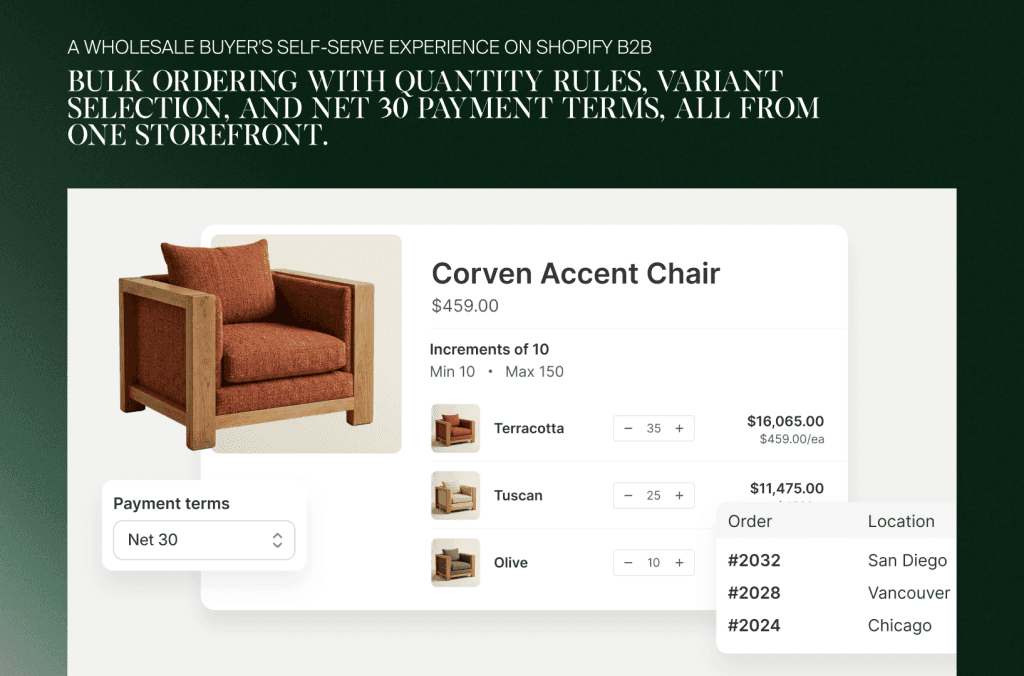
What has shifted is buyer behavior. B2B buyers now expect the same self-serve experience they get as consumers: log in, see negotiated rates, check out. Brands that cannot offer this lose orders to competitors who can. Merchants on Shopify B2B see up to a 4.1x increase in reorder frequency versus DTC. When wholesale buyers reorder four times more often, the lifetime value math changes the entire acquisition model.
Shopify B2B features now available on every plan
The most important thing to understand about this update: these are not new features. They are the same foundational Shopify B2B features that have been tested and refined with Plus merchants since 2022. What changed is access. Shopify democratized the infrastructure, bringing it down from Plus-exclusive to available across all tiers, including Basic, Grow, and Advanced, at no extra cost.
This is the democratization of enterprise-grade wholesale tooling. Capabilities that previously required a Shopify Plus contract are now the default. Here is exactly what non-Plus merchants can access natively:
Feature | Availability | Notes |
Company profiles | All plans | Multiple buyers, locations, permission levels |
Custom catalogs (up to 3) | All plans | Tailored pricing per buyer segment |
Volume pricing & quantity rules | All plans | Min/max orders, case packs, increments |
Vaulted credit cards | All plans | Stored securely for repeat checkout |
Payment terms (Net 30 / Net 60) | All plans | Reduces friction for business buyers |
Unlimited catalogs | Shopify Plus only | For complex, multi-tier pricing |
Partial payments & deposits | Shopify Plus only | High-value and custom order scenarios |
ACH payments + VAT invoicing | Shopify Plus only | EU/UK compliance, bank-to-bank |
Direct catalog assignment | Shopify Plus only | Assign per company and location directly |
The path between plans remains seamless. A merchant who starts on Basic and grows into Plus-level complexity does not need to replatform, the infrastructure is identical. Only the feature ceiling changes, and crossing that threshold requires no migration, no rebuild, and no disruption to existing operations.
One platform for B2C and B2B operations
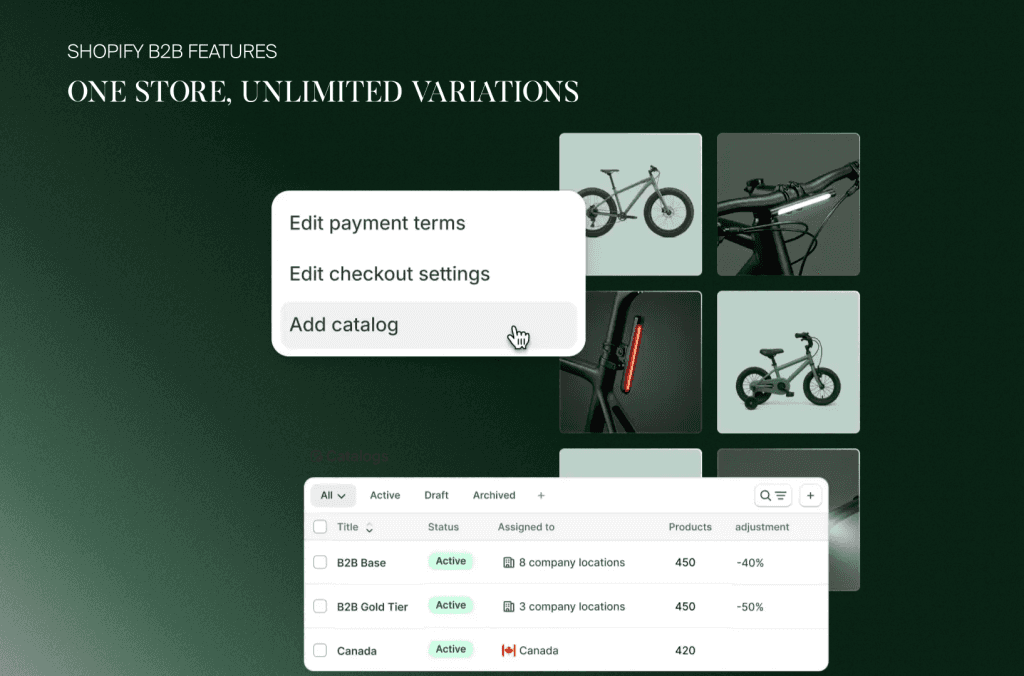
Shopify B2B features are built into the core platform, not a bolt-on. That means Shopify Flow, Markets, and Payments now work across both channels from a single admin. One data layer. No secondary system to reconcile.
Most brands running B2B on disconnected tools feel this in two specific ways: pricing mismatch where wholesale buyers see retail rates instead of their negotiated prices, sometimes never placing an order as a result, and manual order processing, where every transaction requires a rep or team member to intervene. Both are infrastructure problems, not process problems. Native Shopify B2B features solve them at the root.
The cost of disconnected B2B systems
The cost of fragmented B2B operations rarely shows up as a single line item. It accumulates in admin hours, in missed orders, in accounts that never convert because the buying experience is too difficult to navigate. Understanding that cost concretely is what makes the case for fixing it.
Manual processing at scale
Snyder Performance Engineering, an automotive aftermarket parts manufacturer grew from a home repair shop into a national wholesale operation. Every single B2B order came in by phone or email. No self-serve, no automation. Their team manually processed each transaction, and as their account base grew, so did the operational load. The business was scaling; the process was not. They were approaching a ceiling that had nothing to do with demand.
Data that cannot be trusted
DAX Eyewear ran into the pricing consistency problem. Managing wholesale through a system separate from their DTC store, negotiated buyer rates would sometimes fail to display correctly. Buyers saw retail prices instead of their agreed-upon wholesale rates. Some never raised the issue. They simply did not order.
A ceiling set by the tool, not by demand
When every new wholesale account means more manual work, growth has a real ceiling. The only way to scale is to hire more people to manage the same inefficient process, which erodes the margin that made the wholesale channel attractive in the first place. Native Shopify B2B features remove that ceiling by shifting the workload away from your team and toward a system that does not tire, make errors, or need a day off.
What Shopify B2B features unlock for merchants
The results from merchants already running Shopify B2B are consistent across the platform. These are not projections, they are outcomes from brands that have migrated from manual or disconnected operations to native wholesale infrastructure:
Metric | Result | Source | Timeframe |
|---|---|---|---|
Back-office admin time | 25% reduction | Snyder Performance Eng. | 18 months post-launch |
Avg. customer spend | 40% increase | Snyder Performance Eng. | 18 months post-launch |
Self-serve order volume | Up to 33% more | Shopify B2B platform | Within 6 months |
Reorder frequency vs. DTC | 4.1x higher | Shopify B2B platform | Ongoing |
Total cost of ownership | Up to 36% lower | vs. major competitors | Shopify-commissioned study |
The 33% increase in self-serve orders is the metric that matters most operationally. Every order a buyer places without contacting your team is time your team redirects toward account growth, outreach, and relationships. Self-serve is not just a UX improvement, it is a structural reallocation of your team’s capacity.
Faster fulfillment is the downstream effect. When orders arrive through a native channel with integrated payment and inventory, they flow directly into fulfillment without manual data entry in between. For Snyder Performance Engineering, that window collapsed from hours to minutes per order which, at wholesale volume, is a significant operational improvement.
The reorder frequency increase deserves particular attention. A 4.1x higher reorder rate compared to DTC is not a minor lift. It means your B2B customers are coming back far more often, spending more per transaction on average, and doing so through a self-serve process that requires minimal intervention from your team. That combination (frequency, spend, and low acquisition overhead) is what makes a wholesale channel genuinely profitable at scale.
What the data looks like when B2B runs natively
A useful reference point: a national wholesale manufacturer moved from fully manual B2B order processing, every order via phone or email, no self-serve to a native Shopify B2B features setup integrated with their back-office stack. Eighteen months in, back-office admin time dropped by 25% and average customer spend increased by 40%. Order fulfillment went from hours to minutes per transaction.
The pattern behind the numbers: when the order process stops depending on your team as the middleware, revenue scales with demand rather than with headcount. That structural shift is what native Shopify B2B features make possible and what is now accessible on every Shopify plan.
What this means for Shopify merchants today
The entry barrier for B2B on Shopify has dropped significantly. The Shopify B2B features on non-Plus plans; company profiles, custom catalogs, payment terms, self-serve checkout are sufficient to launch and grow a wholesale channel without needing an enterprise contract.
That said, access is not the same as architecture. How you structure catalogs, configure payment terms per buyer tier, and connect your ERP determines whether the channel scales cleanly or creates a new layer of complexity. This is exactly the structural work our ecommerce agency does with merchants before their B2B channel goes live, not after problems show up. The right setup from day one is what separates brands that grow through B2B from those that manage around it.
When to consider Shopify Plus for B2B
Shopify Plus is an architectural upgrade, not just a feature one. Here is a practical guide to where the threshold sits:
Situation | Recommendation | Reason |
|---|---|---|
Starting or formalizing wholesale | Non-Plus is enough | Company profiles + 3 catalogs cover most cases |
2–3 buyer tiers, simple pricing | Non-Plus is enough | Volume rules and payment terms handle it |
Multiple regions or currencies | Consider Plus | Markets + unlimited catalogs needed |
ERP integration or complex workflows | Plus recommended | Direct connectors + advanced Flow + partial payments |
As a Shopify Platinum Partner, Flatline helps merchants make this decision based on actual operational needs. Getting on Plus before you need it adds cost without value. Staying on non-Plus after you have outgrown it creates daily friction. The right answer depends on your wholesale structure, buyer complexity, and growth trajectory.
How to get started with Shopify B2B features
Shopify B2B features are rolling out to all accounts now. No migration, no new apps required. A logical starting sequence:
Identify your actual B2B demand. Understand who your wholesale buyers are and what they need before touching any settings.
Set up company profiles. Assign payment terms, tax exemptions, and product access per buyer segment. This structure determines how much manual intervention each order requires going forward.
Create catalogs deliberately. Use the three slots with intent, one per major buyer segment. Avoid overlapping rules early; they compound into maintenance problems.
Enable payment terms. Net 30 or Net 60 removes a real barrier for buyers on invoice cycles and converts hesitant accounts into committed ones.
Test as a buyer before launch. Verify pricing, checkout flow, and catalog visibility from the buyer’s perspective. What looks correct in the admin does not always render correctly in the storefront.
For a deeper look at how Flatline structures B2B builds from the ground up, visit our eCommerce services page.
Common mistakes when launching B2B on Shopify
Even with the right infrastructure in place, wholesale launches run into the same avoidable problems. Knowing them in advance is the fastest way to avoid them:
Treating B2B as secondary: Buyers notice when the wholesale experience feels like an afterthought. A harder-to-navigate portal will underperform regardless of how competitive your pricing is.
Overcomplicating the setup: Too many catalog rules before validating demand creates configurations that need rebuilding. Start simple and add complexity only when the operation requires it.
Skipping ERP integration: If inventory or pricing lives in an external system, connecting it early prevents data drift. This is where fragmentation typically starts for growing wholesale operations.
No buyer-side testing before launch: Log in as a wholesale buyer and check pricing, checkout, and payment term application before going live. Assumptions about what works in the admin are regularly proven wrong.
The tools are ready, now it comes down to execution
The Shopify B2B features now available on every plan represent a structural shift: one admin, one data layer, one operation, regardless of whether a merchant is selling to consumers or businesses. The infrastructure that previously required a Plus contract is now the default for every merchant on the platform.
Access to the tools is no longer the differentiator. How merchants configure, integrate, and optimize those tools is what determines whether B2B becomes a genuine growth channel or just another system to manage.
Not sure how to structure your Shopify B2B setup? Flatline is a Shopify Platinum Partner with hands-on experience configuring B2B operations for growing eCommerce brands. Get in touch, we will walk through it with you.
Related articles


