Migrate PrestaShop to Shopify: Why it's the best investment your eCommerce business will make

By Robin Laseur

Something shifted at PrestaShop on April 10, 2026. The company announced a formal collective restructuring process, a Plan de sauvegarde de l’emploi under French labor law. Eight weeks after a €53.7 million acquisition by Cyber_Folks closed, PrestaShop is now reorganising its workforce and realigning its strategy.
For merchants running their stores on PrestaShop, this news raises questions that don’t have clean answers yet: Who owns the roadmap now? What happens to the support structure? Where does the ecosystem go from here?
The trajectory is clear regardless. Active PrestaShop stores dropped from approximately 219,000 in early 2022 to around 168,700 by Q1 2026. A loss of roughly 50,000 stores, or 23% over four years. The platform that powered a generation of European eCommerce is contracting, not growing.
For merchants who are ready to migrate PrestaShop to Shopify, this is the moment to move from evaluation to action. This post makes the case: technically, operationally, and commercially.
This article explains:
Why PrestaShop’s “free” open-source model carries hidden costs that compound at scale
How Shopify’s managed infrastructure eliminates the operational overhead that makes PrestaShop expensive to run
What the migration process from PrestaShop to Shopify actually involves; timeline, SEO risks, and what to expect
Whether you’re actively evaluating a migration or just starting to question your current setup, this guide gives you the full picture before making any decisions.
The real PrestaShop problem: Total Cost of Ownership
Most PrestaShop vs Shopify comparisons start with licensing. PrestaShop is open source, so the software is free and framing is one of the more expensive misconceptions in eCommerce.
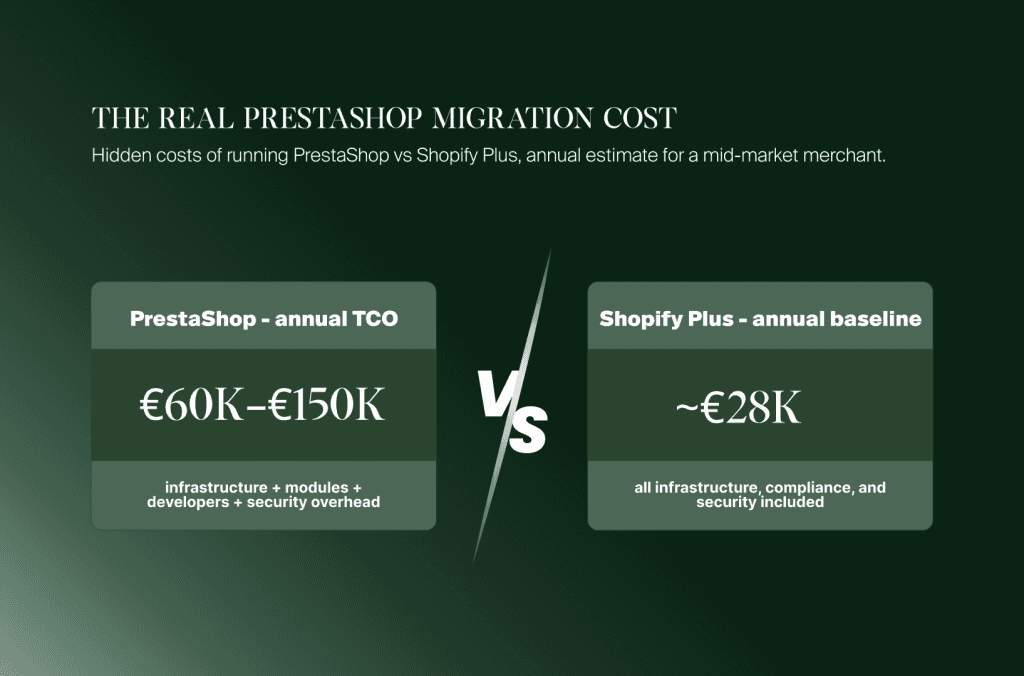
The true cost of running PrestaShop at scale shows up elsewhere:
Hosting and infrastructure
PrestaShop requires you to provision, manage, and scale your own server environment. For a store doing meaningful traffic, that means dedicated or cloud VPS setups, CDN configuration, database optimisation, and a team that knows how to maintain all of it. A properly configured PrestaShop environment at scale easily runs €500–€2,000 per month in infrastructure, before a developer touches it.
Modules
PrestaShop’s default functionality is intentionally minimal. Payment gateways, advanced search, loyalty programs, B2B pricing, all require third-party modules. The PrestaShop Addons Marketplace charges €50–€300 per module, many with annual licence renewals. A mid-sized store’s module stack can reach €5,000–€15,000 annually, plus ongoing integration maintenance.
Security and compliance
Because you own the infrastructure, you own PCI DSS compliance. Quarterly vulnerability scans, penetration tests, patch management, the liability sits with your team. For most eCommerce operations, this is an invisible but material overhead.
Developer dependency
PrestaShop development requires PHP expertise and deep familiarity with the platform’s override system, a pattern that becomes fragile when multiple modules interact. Bug fixes and feature development require either in-house PHP developers or agency retainers. When modules conflict after an update, the debugging cycle is expensive and slow.
The honest number: When Flatline maps out PrestaShop’s real annual cost for mid-market merchants “infrastructure, modules, developer hours, security overhead, and opportunity cost from delayed features” the total typically lands between €60,000 and €150,000 per year. Shopify Plus starts at $2,300/month on a 3-year term. The math becomes straightforward.
What makes this comparison even sharper is the opportunity cost. Every sprint your dev team spends patching a module conflict or debugging a slow query is a sprint not spent on improving your product pages, your checkout flow, or your international expansion roadmap. On PrestaShop, the platform itself competes for engineering attention. On Shopify, it doesn’t. That invisible tax; measured in delayed features and deferred growth, is often the most expensive line item of all, and the hardest to put on a spreadsheet.
Why merchants migrate PrestaShop to Shopify: The architecture gap
For CTOs evaluating this decision, platform architecture matters more than feature lists. PrestaShop is a traditional PHP monolith. Application logic, data layer, and presentation layer are tightly coupled. At scale, this creates structural problems that no module can solve:
Deployment friction. Any change; template modification or module update, touches the same codebase driving production. Maintaining staging and production parity requires DevOps investment that PrestaShop doesn’t provide natively.
The override system. PrestaShop customisation works through a class override pattern that intercepts core classes. For isolated modifications it functions. Under multiple modules, it creates a dependency web that breaks on every update.
Database performance under load. PrestaShop’s MySQL schema; particularly around product attributes, combinations, and multi-shop creates query complexity that becomes a bottleneck above roughly 20,000 SKUs and concurrent traffic spikes.
Multi-store limitations. PrestaShop’s multi-store feature shares a single database across shops. In a world of international market expansion and localised compliance requirements, this architecture introduces risk that Shopify Markets was designed to eliminate.
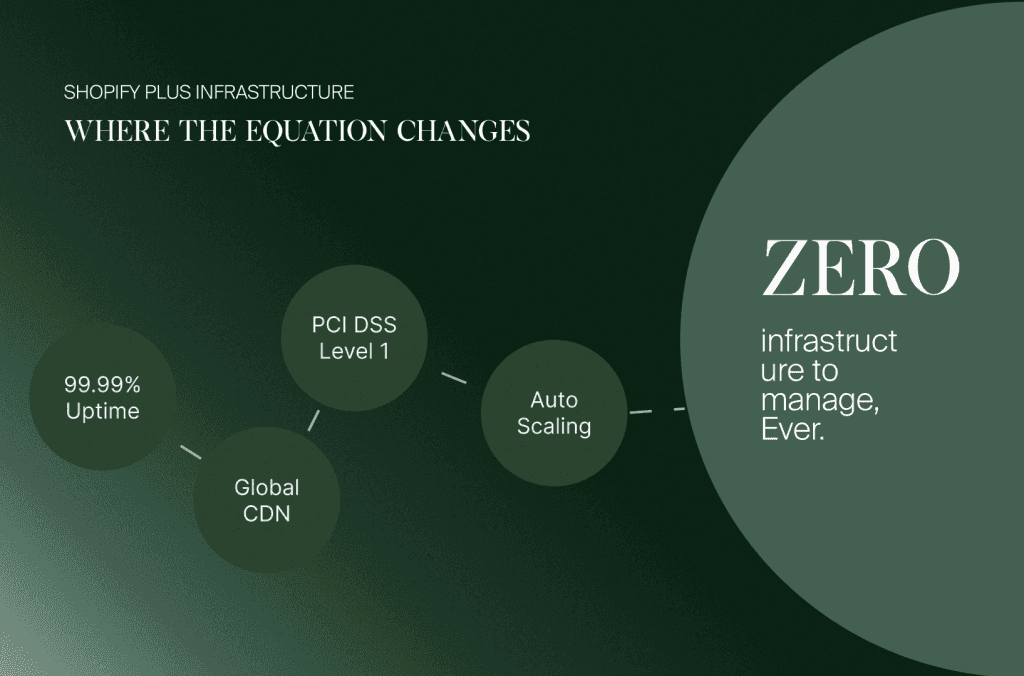
Where Shopify’s infrastructure changes the equation
99.99% uptime SLA for Shopify Plus, backed by Shopify’s own infrastructure, with financial credits for any breach
Automatic scaling; traffic spikes that would require emergency server provisioning are absorbed without any merchant action
Built-in CDN via Fastly, serving assets from edge nodes globally
PCI DSS Level 1 compliance handled by Shopify covering your entire checkout, with no action required from your team
For Shopify Plus specifically, Shopify Functions provides a serverless execution environment for customising checkout logic, discount algorithms, and delivery methods, replacing the fragile override model with something version-controlled, testable, and reversible.
Shopify Plus gives eCommerce teams the infrastructure foundation to move fast and for merchants building on top of it at scale, the way Flatline approaches that build matters as much as the platform itself.
PrestaShop vs Shopify: Where it actually matters for growing brands
Feature lists rarely tell the full story. These are the dimensions that move the needle for growing eCommerce operations:
Dimension | PrestaShop | Shopify Plus |
Checkout | Requires modules + dev work for one-page checkout, B2B, subscriptions | Native high-converting checkout; customisable via Shopify Functions, no core changes needed |
International commerce | Separate store instances per market, shared database, high operational overhead | Shopify Markets: single store, localised pricing, currency, language, and checkout from one admin |
Uptime & scaling | Depends on your hosting setup; traffic spikes require manual server provisioning | 99.99% uptime SLA for Plus; auto-scaling and global CDN, no merchant action required |
App / Module ecosystem | 4,000+ modules; inconsistent quality, frequent compatibility conflicts | 8,000+ apps with standardised review process and consistent quality bar |
PCI DSS compliance | Your responsibility — quarterly scans, penetration tests, patching | Level 1 compliance handled by Shopify; covers your entire checkout |
Developer dependency | PHP specialists required for every customisation and update | eCommerce team can operate independently; dev needed only for custom logic |
Platform cost baseline | €500–€2,000/month hosting alone, before modules and developer time | $2,300/month (3-year) or $2,500/month (1-year), all infrastructure included |
What a migrate PrestaShop to Shopify actually involves
This is where merchants often hesitate. Migration sounds disruptive. Done with a structured methodology, it doesn’t have to be.
A realistic enterprise migration runs 8–16 weeks depending on catalogue size, custom functionality, and integration complexity. The scope breaks into four phases:
Discovery and architecture (weeks 1–2): Mapping custom PrestaShop functionality, defining the Shopify theme and app stack, establishing the data migration approach and SEO strategy.
Build (weeks 3–6): Theme development, app configuration, Shopify Functions for custom logic, API integrations with ERP, CRM, or PIM systems.
Data migration and QA (weeks 7–10): Test migrations, content review, SEO audit, redirect implementation.
UAT and cutover (weeks 11–12+): Stakeholder testing, performance benchmarking, go-live checklist, 30-day monitoring setup.
What gets migrated
Product catalogue: products, variants, images, metafields, collections
Customer accounts: contact data, order history (password hashes cannot be migrated; customers reset on first login)
Order history: for reference and customer service continuity
SEO assets: all indexed URLs, meta titles, meta descriptions, structured data
Content pages: about, policy pages, blog posts
The SEO question
URL migration is the highest-risk element of any platform migration, the area where most DIY migrations cause lasting damage. PrestaShop generates URLs like /fr/chaussures/produit-homme-sneaker-blanc-38.html. Shopify’s default structure is /products/sneaker-blanc. Every URL that changes without a 301 redirect is a lost ranking signal.
A professional migration covers:
Full crawl of the live PrestaShop store to map every indexed URL
1:1 redirect map built before go-live
XML sitemap submission to Search Console on day one
Crawl error monitoring for 60 days post-launch
Done correctly, organic search performance is maintained. Done carelessly, recovery takes 6-12 months.
Choosing the right migration partner
Not all migrations are equal. The difference between a smooth cutover and a six-month recovery usually comes down to three things:
How the redirect mapping was handled
Whether the data was cleaned before import
How thoroughly the store was tested before go-live
Watch out for partners who propose migrating everything in a single sprint, treat redirect mapping as optional, or have no post-launch monitoring plan. A good migration partner understands both platforms, not just Shopify. That dual expertise is what separates a migration that preserves your SEO, data, and revenue from one that doesn’t.
The business case in summary
For the eCommerce director or CTO building the internal case:
Lower total cost of ownership. Managed infrastructure, built-in compliance, and a curated app ecosystem eliminate the hidden costs that make PrestaShop expensive at scale.
Faster feature velocity. Shopify Functions, a rich app ecosystem, and a stable API surface mean your developers ship features rather than maintaining infrastructure. A new market can go live in days, not months.
Reduced operational risk. No emergency server patching during peak periods. No module conflicts after updates. No single point of failure on a database your team manages.
Global commerce, built in. Shopify Markets, multi-currency, localised checkout, and Shop Pay give you the tools for international expansion without multi-store management overhead.
Ecosystem and talent availability. The Shopify developer ecosystem is the largest in eCommerce. Shopify Partners are significantly more available and more consistently skilled, than PrestaShop PHP specialists.
What to do next
The PrestaShop restructuring news is not a reason to panic, but it is a clear signal that the platform’s trajectory has changed. For merchants who have been weighing this decision, the case for moving now is stronger than it was six months ago.
Flatline Agency has guided merchants through complex platform migrations, from initial evaluation through go-live and beyond. As a certified Shopify Platinum Partner, we bring a structured methodology, deep technical expertise, and an honest assessment of what the migration will actually require for your specific store.
That structured approach is what our ecommerce agency applies to every migration, not just the technical cutover but the commercial case behind it.
Ready to evaluate what the move looks like for your catalogue and integrations? Get in touch with our team for a no-obligation migration assessment.
Related articles


