Developer-gated or marketer-editable: choosing a website stack your team can actually run

By Robin Laseur

You are about to rebuild the site, and every vendor demo tells the same story: marketing will own everything, changes go live in minutes, developers are freed for real work. It is a good demo. It is also only half a decision. Choosing between a marketer-editable website and a developer-gated one is not a choice between modern and outdated. It is a trade between speed and control, and the right side depends on who in your operation needs to move fastest and how often the site actually changes, not on which tool demos better. A stack that is right for a campaign-heavy marketing team is the wrong stack for a site wired into a regulated product, and neither fact is visible in a demo.
Most of what ranks for this comparison argues one side and sells the tool that serves it. This piece argues neither. It lays out what each model genuinely trades, where each is the correct choice including the operations where developer-gated wins, a matrix you can map your own site against, and a decision rule that turns on your team’s reality rather than on which platform is fashionable this year. The stakes are worth the honesty: this is a multi-year commitment you make right before a rebuild, and getting it wrong is expensive in either direction.
What each model is, and what it trades
A developer-gated website routes every change through people who work in the code, which buys tight control and stability at the cost of speed. A marketer-editable website gives marketing a guardrailed surface to change what the site says and assemble pages, which buys speed at the cost of some central control. That is the whole trade in one line. Everything below is the detail of when each side of it is worth making.
The reframe that keeps this decision clean is that it is a model choice, not a tool choice. WordPress can be built developer-gated or handed to a marketing team with a page builder. A Framer or headless build can be locked down or opened up. The tool influences how easily you can land on a given model, but it does not make the decision for you, so choosing the platform before choosing the model is how teams end up with a stack that fights their operation. Decide the model first: who is allowed to change what, and how fast that needs to happen. The tool comparison comes after, and there is a separate honest breakdown of the main tool pairing once the model is settled.
Neither model is the modern one. Developer-gated is not a legacy mistake, and marketer-editable is not automatically progress. They are two answers to a real question, and the question is about your operation, not the calendar.
The criteria that actually decide it
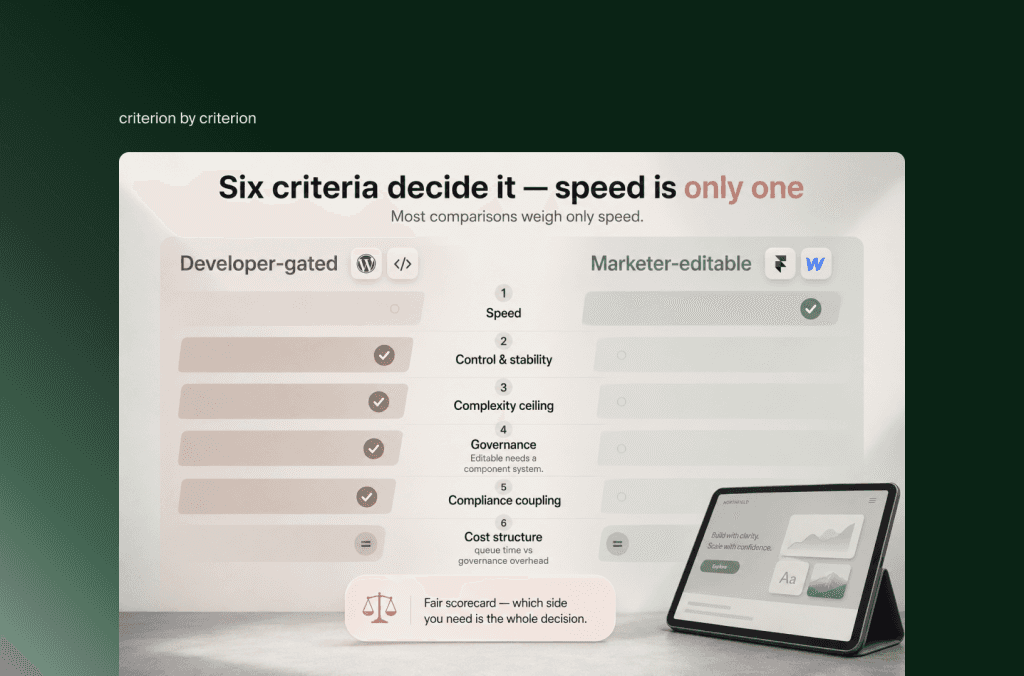
Six criteria decide the choice, and edit frequency crossed with who-needs-velocity is the pair that flips it. Speed to change, degree of control and stability, the complexity ceiling each model can carry, governance and brand consistency, compliance or product coupling, and cost structure. Most comparisons weigh only speed, which is why they make marketer-editable look like the obvious answer. Speed matters most when the site changes constantly and marketing owns the outcomes. It matters far less when the site is stable and the risk of a bad change is high.
Speed to change is how fast a routine edit reaches the live site. Control and stability is how confidently you can guarantee a change will not break something else. The complexity ceiling is how much a given model can handle before it needs a developer anyway. Governance is whether more hands making more pages stays on-brand or drifts. Compliance or product coupling is whether the site shares infrastructure or regulatory exposure with something that cannot casually change. Cost structure is where you spend: developer time in a queue, or governance overhead keeping an open system coherent. Hold these six, because the honest comparison is just these applied without deciding the winner in advance.
Developer-gated vs marketer-editable, criterion by criterion
On speed marketer-editable wins, on control and complexity ceiling developer-gated wins, and which of those you need more is the entire decision. A marketer-editable stack publishes content in minutes and lets a team assemble a campaign page in an afternoon. A developer-gated stack moves slower but guarantees that nothing ships without someone who understands the whole system, which is exactly what you want when the site is load-bearing for a product or a compliance regime.
The honest cost of each being wrong is the part the demos skip. Put a fast, campaign-driven marketing team on a developer-gated stack and you get the backlog: edits queue, experiments stop, and the team quietly stops proposing changes. Put a site that shares infrastructure with a regulated product on a freeform marketer-editable stack and you get the opposite trouble: a well-meaning content edit takes down a page, or a compliance-relevant change ships without review, or the brand drifts as more people build more pages with no shared system. Both errors are expensive. They are just expensive in different currencies, one in lost momentum and one in lost stability.
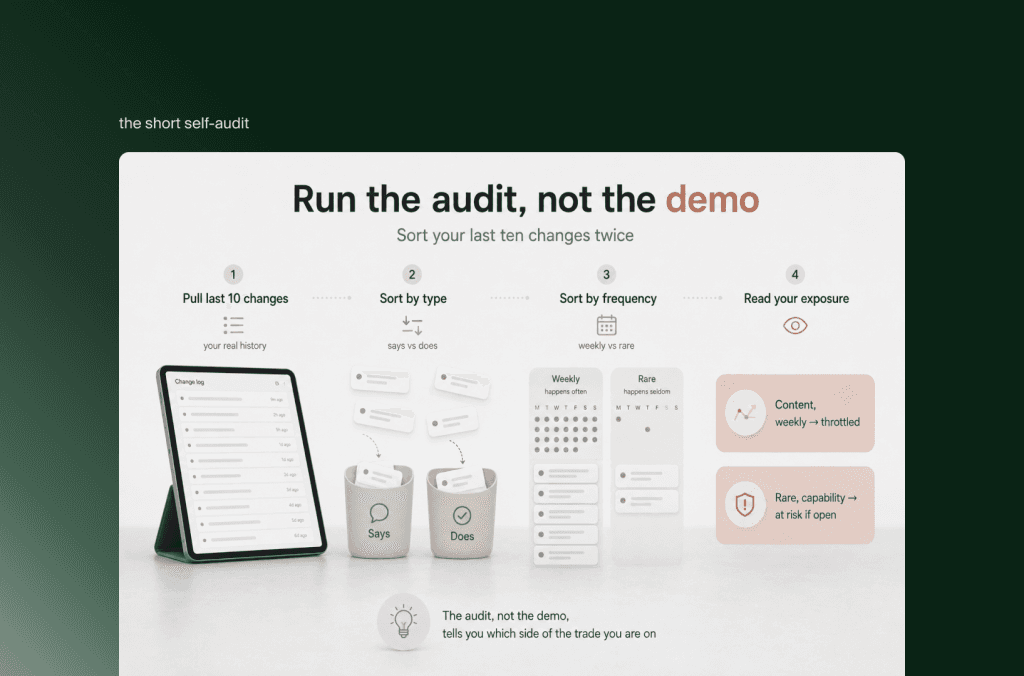
You can tell which currency you are exposed to with a short self-audit, and it is more reliable than any vendor’s pitch. Pull your last ten site changes and sort them twice. First by type: did each change what the site says, or what it can do. Second by frequency: how often does that kind of change actually happen. A stack whose most frequent changes are content, happening weekly, is being throttled by developer-gating. A stack whose changes are rare and mostly touch capability or compliance is being put at risk by broad editable access. The audit, not the demo, tells you which side of the trade you are on.
Choose developer-gated if, choose marketer-editable if
Choose developer-gated if your site is coupled to a product, carries compliance or accessibility obligations, or changes rarely and mostly in ways that touch capability rather than content. In those operations the control is not friction, it is the point, and the slower pace is a fair price for knowing nothing ships unreviewed. A site where the marketing team files a handful of content edits a quarter is not being throttled by a queue, and opening it up would trade a stability you rely on for a speed you do not need.
Choose marketer-editable if your site is content-led and changes constantly, if marketing owns growth outcomes that depend on shipping fast, and if most of your edit volume changes what the site says rather than what it can do. When a team is running campaigns, testing messaging, and launching landing pages every week, the queue is a direct tax on the work, and a guardrailed editable stack removes it. The decision variable is not the tool’s power. It is the answer to two questions: who in your operation needs to move fastest, and how often does the site actually change. High-frequency, marketing-owned, content-heavy points one way. Low-frequency, product-coupled, capability-heavy points the other.
The common error is choosing by fashion rather than by fit: adopting a marketer-editable stack because it is where the industry is heading, then discovering the site needed the control, or clinging to developer-gating out of caution while a fast marketing team burns months in the queue. Both are the same mistake, which is deciding on the trend instead of the operation.
The edge cases: hybrids and the middle
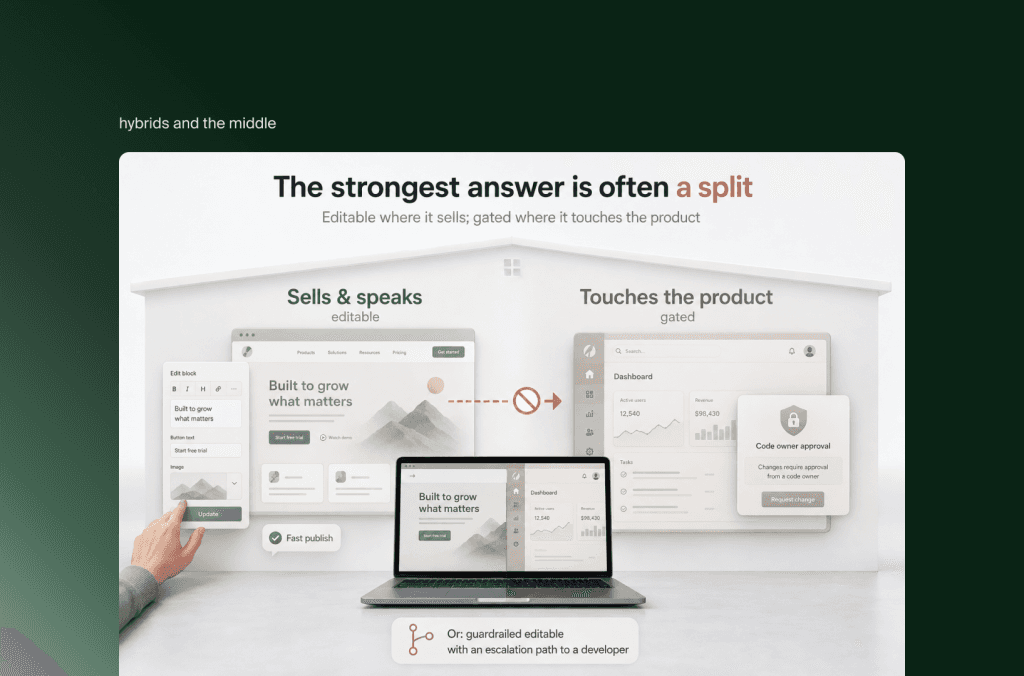
The strongest answer for many companies is not one model for the whole site but a split by domain: marketer-editable where the site sells and speaks, developer-gated where it touches the product. In practice that means the marketing site runs on an editable stack the team owns, while the product or app lives on a separate, developer-controlled domain, so a campaign edit can never reach the thing that must not casually change. This single split resolves most of the tension the choice creates, because it stops forcing one model onto two jobs that have opposite needs.
A second hybrid is guardrailed editable with a clear escalation path: marketing owns content and page assembly from a tested component library, and anything touching capability, integrations, custom logic, or compliance, routes to a developer by design rather than by accident. A well-built Framer or component-based site can land here, giving the team on-page editing for what the site says while keeping structure and code with the people who own them. The edge case worth naming is the design-led team with no developer support: it should lean editable, because a developer-gated stack with no developer nearby combines the downsides of both models, all of the control and none of the speed. If you are weighing the tool layer of this, the WordPress question in particular turns on exactly how much of your stack you are willing to maintain yourself.
When to revisit the choice
Revisit the model whenever your edit frequency or team composition shifts, not on a fixed schedule. The right answer is correct only for a range of operational realities, and those realities move: a marketing team grows and starts shipping weekly, a product integration turns a simple site into a coupled one, a design-led team hires its first engineer. Each of those can move you across the line you drew at the last rebuild.
The practical trigger is the same self-audit from earlier, run again. If your most frequent changes have shifted from capability to content, or the reverse, the model that fit last year may be quietly throttling or endangering you now. Getting the timing of the switch right matters more than getting the first choice perfect, because the cost of the wrong model compounds week over week until you move.
If your team’s velocity is capped by your stack, this is the choice to weigh before the next rebuild rather than after it. Flatline is a Framer Enterprise Partner that builds both developer-gated and marketer-editable stacks, so we can look at your edit frequency and team composition and tell you which model your operation actually needs. If you want a second read on where your site should sit, we are happy to walk through the trade with you.
Frequently asked questions
What is the difference between a marketer-editable and a developer-gated website?
A developer-gated website routes every change through people who work in the code, which gives high control and stability but slows routine edits. A marketer-editable website gives marketing a guardrailed surface to change content and assemble pages without touching code, which is fast but places more of the risk on governance. It is a trade between speed and control, not a difference in quality.
Is a marketer-editable website always better?
No. It is better when the site is content-led, changes constantly, and marketing owns outcomes that depend on shipping fast. It is the wrong choice when the site is coupled to a product, carries compliance obligations, or rarely changes, because broad editable access then trades a stability you rely on for a speed you do not need. Fit depends on your operation, not on which model is newer.
When should a website stay developer-gated?
Keep it developer-gated when the site shares infrastructure with a product, operates under compliance, security, or accessibility requirements, or changes infrequently and mostly in ways that touch capability rather than content. In those cases the control is the point, and the slower pace is a fair price for knowing nothing ships without review by someone who understands the whole system.
What should marketing own on a website, and what should developers own?
Marketing should own what the site says and shows: copy, images, calls to action, SEO fields, and new pages assembled from approved components. Developers should own what the site can do: integrations, custom logic, forms with complex behavior, anything touching an API or authentication, and structural change. A good stack makes that line obvious rather than arbitrary.
Does choosing Framer or Webflow make a website marketer-editable?
Not on its own. The model is set by how the site is built and governed, not by the platform name. A Framer or Webflow site can be locked down, and a WordPress site can be opened up. Choose the operating model first, who changes what and how fast, then pick the tool that makes that model easiest to run.
Key takeaways
Marketer-editable versus developer-gated is a trade between speed and control, not modern versus outdated. Both can be built well, and neither is the default right answer.
It is a model choice, not a tool choice. Decide who changes what and how fast first; the platform comparison comes after.
The decision variable is who in your operation needs to move fastest, and how often the site actually changes. High-frequency and content-led points to editable; low-frequency and product-coupled points to gated.
Run the self-audit: sort your last ten changes by type (says versus does) and by frequency. It tells you which side of the trade you are exposed to, more reliably than any demo.
The strongest answer is often a split: marketer-editable where the site sells and speaks, developer-gated where it touches the product. Revisit the model when edit frequency or team composition shifts.
The demo is not wrong that marketing can own the site. It is just silent on whether your site is one marketing should own outright, or one where the control is doing real work. Answer that with your own edit history rather than the vendor’s pitch, and the choice stops being a matter of taste and becomes a matter of fit, which is the only basis on which it holds up over the years you will run it.
Related articles


