Klaviyo in ChatGPT and Claude: how conversational AI is changing marketing workflows

By Robin Laseur

Marketing teams still rely heavily on dashboards, exports, and scheduled reports to understand performance. When questions arise “why revenue shifts, which flows underperform, or where to optimize” answers are often buried behind filters, spreadsheets, and delayed refresh cycles. The result is slow feedback and fragmented decision-making.
The arrival of the Klaviyo in ChatGPT integration signals a different way of working. By bringing real-time Klaviyo campaign and flow data directly into ChatGPT, marketers can access performance insights through natural language, inside the same environment where planning, analysis, and execution already happen. This integration is powered by Klaviyo’s Model Context Protocol, which securely connects first-party marketing data to large language models without manual exports or custom reporting layers.
Klaviyo has extended this approach beyond ChatGPT by making its data available in Claude through an official connector. Together, these integrations reflect a broader shift in how marketing intelligence is accessed: fewer static dashboards, more direct interaction with live data. Insights surface through questions, analysis happens in context, and next steps are suggested without breaking workflow.
This article examines:
What Klaviyo’s ChatGPT and Claude integrations enable today
How they differ from traditional reporting setups
and what this shift means for eCommerce teams that want faster, more informed marketing decisions without increasing operational complexity.
What Klaviyo in ChatGPT actually unlocks for marketers
Klaviyo in ChatGPT introduces a new way for marketers to interact with their data without relying on dashboards or exports. Through the official Klaviyo app in ChatGPT, marketers can access real-time campaign and flow insights using natural language, directly inside a conversational interface, as outlined in Klaviyo’s announcement of the app in ChatGPT.
Core capabilities unlocked by Klaviyo in ChatGPT
With Klaviyo ChatGPT connected, marketers can:
View real-time campaign performance
Ask questions like “How are my campaigns performing this week?” and receive interactive tables showing sends, delivery status, open and click rates, conversion metrics, and attributed revenue, all pulled from live Klaviyo data.Analyze flow performance without dashboards
Request performance data for specific flows, including recent trends, engagement changes, and revenue impact. Each table links back to Klaviyo for deeper inspection and validation, as described in Klaviyo’s official product documentation.Generate contextual insights with one click
Every performance table includes an Analyze option that produces metric comparisons, highlights performance shifts, and surfaces micro-insights. These insights are grounded in actual account data, not generic benchmarks, as explained in Klaviyo’s guide on using the app for ChatGPT.Move from insight to next steps inside the same thread
After reviewing data, marketers can ask follow-up questions such as “What should I do next?” to receive optimization suggestions related to timing, messaging, or segmentation, based on observed performance.
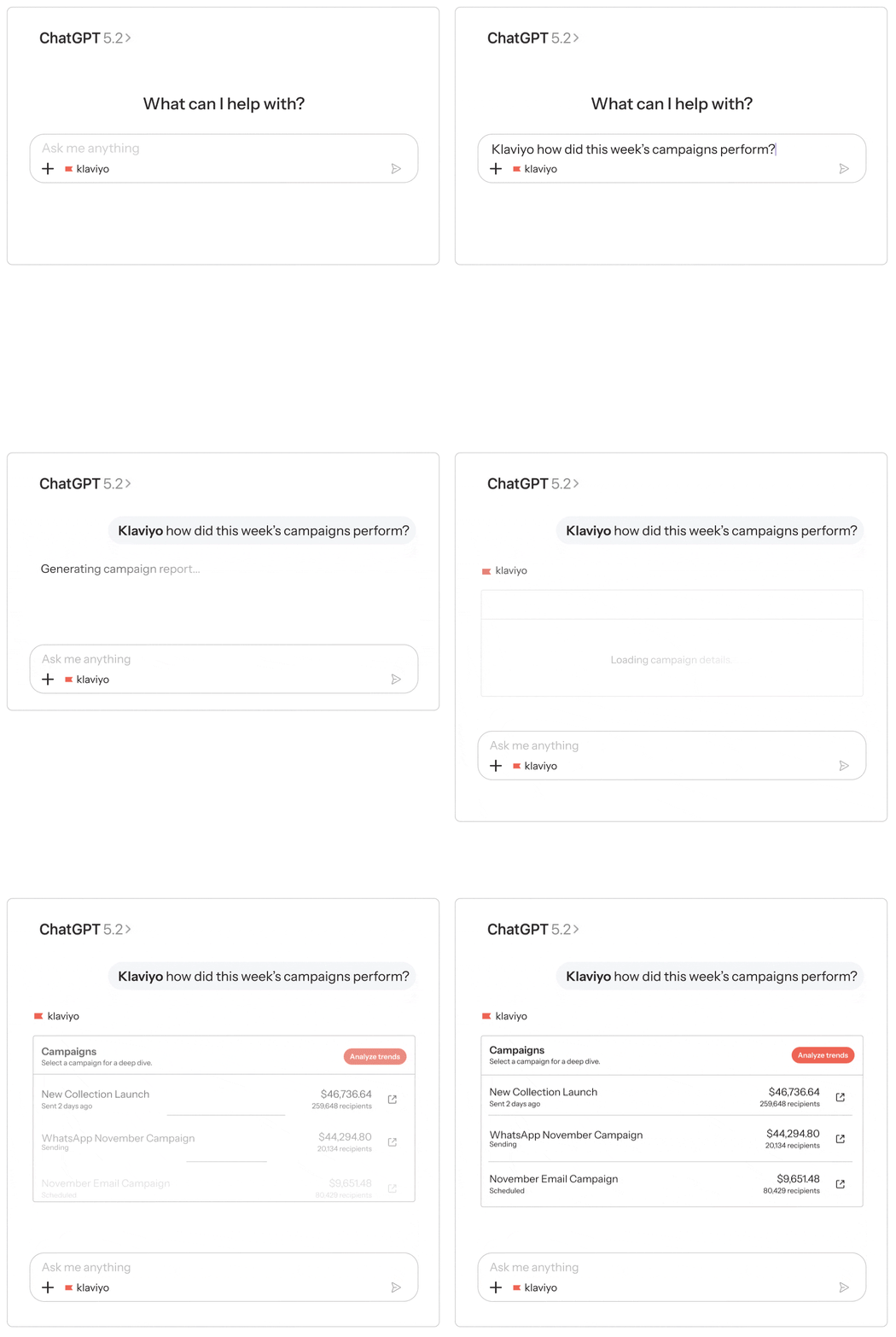
How Klaviyo AI enables this workflow
All of these capabilities are powered by Klaviyo AI through the Model Context Protocol. MCP allows ChatGPT to securely query supported Klaviyo APIs and return verified results from first-party customer and engagement data. When a request is supported, Klaviyo AI ensures responses are data-backed rather than inferred, establishing clear boundaries between accurate reporting and unsupported use cases.
In practice, Klaviyo in ChatGPT shifts reporting from a separate task into an integrated part of daily decision-making. Performance visibility, analysis, and recommendations live in a single conversational flow, reducing the time spent navigating tools and increasing the speed at which marketers can act on real insights.
Klaviyo in Claude and why model-agnostic AI matters
Klaviyo’s expansion into Claude shows that its conversational AI strategy is not limited to a single interface. Through an official connector, Klaviyo now allows teams to access real-time marketing and customer data directly inside Claude, without exporting reports or rebuilding dashboards, as announced in Klaviyo’s update on bringing Klaviyo data into Claude.
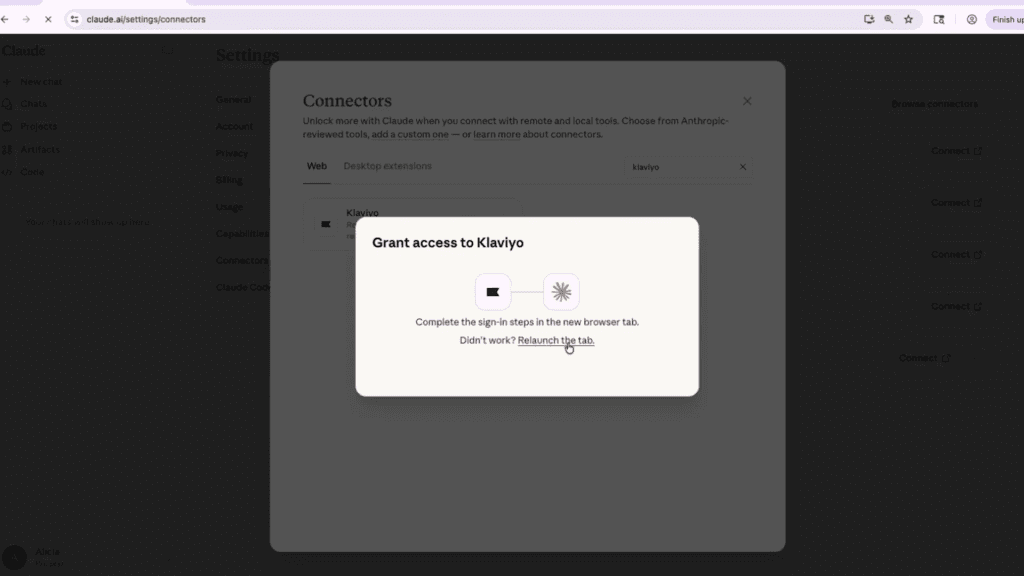
What Klaviyo in Claude enables
By connecting Klaviyo to Claude, marketers and service teams can:
Query real customer and performance data inside Claude
Teams can ask Claude for campaign performance reports, flow comparisons, or customer profile insights using natural language. Responses are grounded in live Klaviyo data rather than generic assumptions, because the model has secure access through Klaviyo’s MCP server.Move from reporting to recommendations in one conversation
Beyond pulling data, teams can ask for summaries, insights, and suggested actions based on their historical performance and ongoing conversations in Claude. This allows analysis and decision-making to stay connected instead of being split across tools.Work across marketing and service contexts
Claude can surface insights spanning campaigns, engagement behavior, and customer lifecycle moments. This aligns marketing reporting with broader customer experience signals such as repeat purchases or re-engagement opportunities, without switching platforms.
Why model-agnostic AI is a strategic choice
Klaviyo’s Claude integration reflects a deliberate model-agnostic approach to AI. Rather than locking brands into a single large language model, Klaviyo focuses on making trusted first-party data available wherever teams already work. As described in Klaviyo’s announcement, the same MCP infrastructure that powers Klaviyo in ChatGPT also enables secure access from other AI tools.
This matters for several reasons:
AI tools will continue to change
Different models will specialize in different tasks, from analysis to content generation. A model-agnostic setup ensures brands can adopt new tools without restructuring their data layer.Data ownership stays with the brand
Klaviyo’s approach keeps customer and engagement data centralized in its platform, while AI models act as interfaces rather than data owners.Workflow flexibility increases
Teams can choose the conversational AI that fits their preferences or use cases, while relying on the same underlying data context.
Within Klaviyo’s broader AI roadmap, ChatGPT and Claude function as access points to the same intelligence layer. The value lies less in the choice of model and more in the consistency of data, insight quality, and the ability to act quickly without introducing new operational complexity.
From dashboards to dialogue: A new marketing workflow
For years, marketing work has revolved around dashboards. Performance questions are answered by opening reports, applying filters, exporting data, and reviewing results after the moment has passed. Insight exists, but it often arrives late and disconnected from the decision it is meant to support.
Conversational AI changes where that process starts
Instead of navigating a reporting interface, teams begin with a question. Performance data, comparisons, and trends surface in response, inside the same environment where planning and execution already happen. The interaction feels closer to how marketers think, not how systems are structured.
This shift alters the pace of analysis
In a conversational workflow, insight builds step by step. A marketer asks how campaigns performed. Then why did the metric change? Then what to adjust next? Each answer shapes the next question, without breaking context or switching tools. Analysis becomes continuous rather than episodic.
The impact shows up in how time is spent
When reporting friction is reduced, teams spend less effort assembling information and more time evaluating options. Decisions are made closer to the data, with fewer handoffs and less delay. Speed improves, but clarity improves with it, because insights appear at the moment they are needed.
Moving from dashboards to dialogue does not remove the need for structure or measurement. It changes how complexity is accessed. Conversational interfaces sit on top of existing systems, allowing teams to interact with detailed data without being buried in it. Over time, marketing workflows begin to look less like periodic reporting exercises and more like an ongoing conversation with performance data.
Why better prompts lead to better decisions
Many marketers assume that working with AI means learning how to write long, technical prompts. In reality, effective prompts are usually simple. They mirror how marketers already think about performance, optimisation, and strategy.
You already ask questions like:
Why did engagement drop on a specific flow this week?
Which campaigns underperformed compared to last month?
What should be optimised before a major sales moment?
With Klaviyo in ChatGPT, those same questions can be asked directly in a conversational interface, using real performance data instead of dashboards or spreadsheets.
The goal is not to learn a new language for a new tool. The goal is to ask clearer versions of the questions you are already asking.
As Klaviyo explains in its guide on writing better LLM prompts, strong prompts focus on intention and context rather than complexity.
When AI can hallucinate and why it matters
Hallucinations tend to happen when an AI is asked to interpret or explain data it does not actually have access to. If a prompt is too broad, lacks a clear timeframe, or requests a type of analysis that is not supported, the model may attempt to fill in the gaps using general knowledge instead of real account data.
This becomes risky in a marketing context. Decisions based on assumed performance trends, unsupported comparisons, or fabricated explanations can lead teams to optimize the wrong campaigns, deprioritise the wrong audiences, or misread what is actually driving results.
Clear prompts help reduce this risk. By first pulling supported performance data and then adding context or intent, marketers ensure that insights stay grounded in what is verifiably happening in the account. When prompts align with what the system can reliably answer, conversational AI becomes a decision-support tool rather than a source of misleading confidence.
What marketers can and cannot do with Klaviyo in ChatGPT
Klaviyo in ChatGPT is designed to support analysis and decision-making, not to replace the core Klaviyo platform. Understanding where the boundaries are is essential to using it effectively and avoiding misleading conclusions. Klaviyo documents these boundaries clearly in its official help documentation for the Klaviyo app for ChatGPT.
What marketers can do
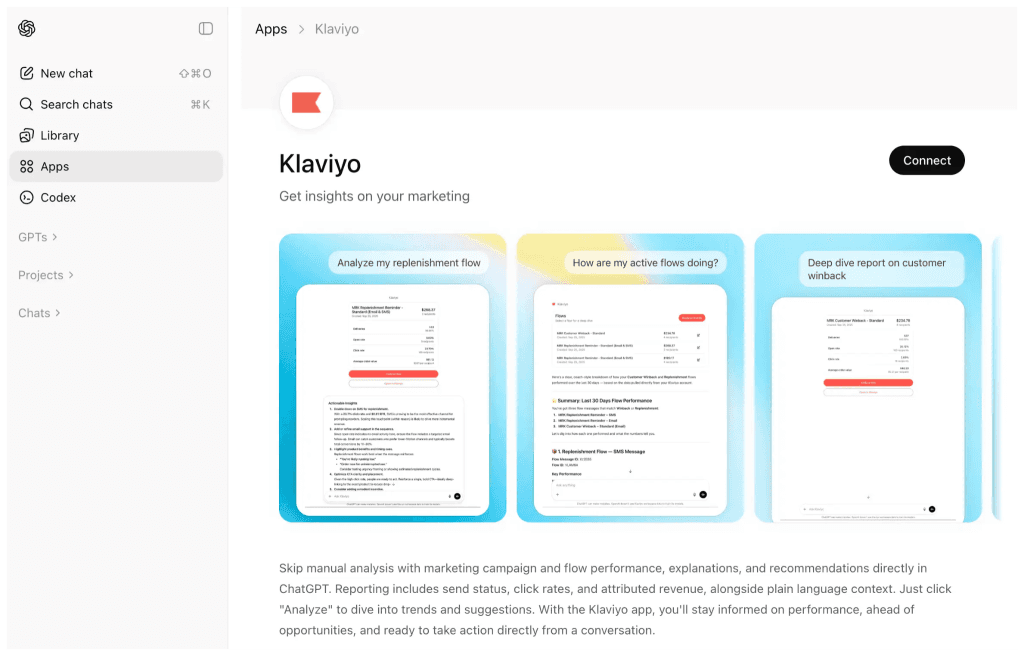
With Klaviyo in ChatGPT connected, marketers can:
View campaign performance in real time
Ask for recent or historical campaign results and receive interactive tables with sends, delivery status, open and click rates, conversion metrics, and attributed revenue.Analyse flow performance and trends
Pull flow data over specific timeframes, review engagement changes, and identify drop-offs or performance shifts without navigating reporting dashboards.Generate contextual insights and next steps
Use the Analyze option or follow-up questions to surface explanations, comparisons, and optimisation suggestions based on actual account data.Draft content and ideas using live context
Request email drafts, templates, or campaign ideas informed by performance data and previous conversations, while keeping final execution in Klaviyo.
What Klaviyo in ChatGPT cannot do
There are clear limitations to what the app supports today:
It cannot send campaigns or SMS messages
Execution remains within the Klaviyo platform to maintain control and compliance.It cannot build or edit flows directly
Flows can be analysed and discussed, but structural changes must be made in Klaviyo.It cannot modify segments or lists
Segment logic and list management are read-only from a ChatGPT perspective.It does not support every type of reporting breakdown
Some comparisons or views are not available through the underlying APIs. Unsupported requests may result in generic responses rather than data-backed insights.
Why these boundaries matter
These constraints are intentional. Klaviyo in ChatGPT is built to surface insight, not to automate execution without oversight. Treating it as a decision-support layer rather than an all-in-one control panel helps teams maintain accuracy, governance, and trust in the data.
When marketers understand what Klaviyo in ChatGPT is designed to do and where it stops, they can use it confidently as part of their daily workflow without over-relying on it or misinterpreting its output.
How this connects to Klaviyo’s broader AI strategy
Klaviyo’s integrations with ChatGPT and Claude are not isolated features. They are part of a wider AI strategy focused on making customer intelligence easier to access and act on.
Conversational AI is only one layer
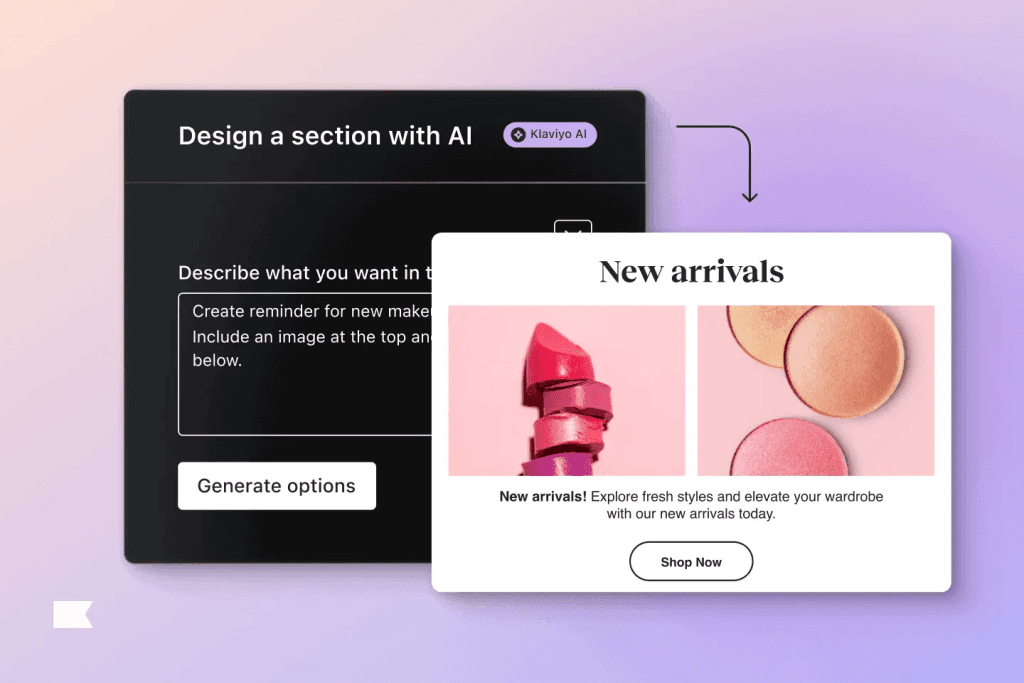
At the core sits K:AI, Klaviyo’s AI layer that works directly with first-party customer data across marketing, service, and analytics. Instead of treating AI as a separate tool, Klaviyo embeds it into existing workflows, as outlined in Klaviyo’s broader AI strategy.
This is where the distinction matters
Conversational interfaces like ChatGPT and Claude help teams ask questions, explore performance, and interpret results faster. AI agents, such as Marketing Agent and Customer Agent, focus on execution at scale, creating campaigns, supporting customers, and optimising interactions using the same data context.
Both rely on the same foundation
Many of these capabilities are not new. Predictive insights, AI-assisted segmentation, and personalisation have been part of Klaviyo for years. What has changed is access. As we covered in our overview of existing Klaviyo AI features, conversational interfaces simply make that intelligence easier to reach without adding friction.
For eCommerce teams, the takeaway is alignment. ChatGPT and Claude change how insights surface. K:AI defines how those insights are generated and applied. When these layers work together, AI supports faster decisions without fragmenting data or ownership.
Using Klaviyo AI effectively requires the right foundation
AI can accelerate decision-making, but it cannot compensate for a weak foundation. Before conversational workflows and AI-driven insights can deliver value, the underlying data, structure, and governance need to be in place.
Area | When the foundation is weak | When the foundation is solid |
Customer data | Events inconsistent and incomplete | Events are tracked consistently and reliably |
Segmentation | Overlapping segments with unclear intent | Clear, purpose-driven segments tied to lifecycle goals |
Flows & campaigns | Built reactively without clear objectives | Designed with defined goals and success metrics |
Decision-making | AI surfaces noisy or misleading insights | AI supports clear, actionable recommendations |
Conversational workflows | Fast answers, low confidence | Fast answers, high confidence |
Business impact | Optimisation feels random | Optimisation compounds over time |
When the foundation is solid, Klaviyo AI supports clearer decisions across ChatGPT, Claude, and K:AI. This is where AI shifts from experimentation to a reliable part of daily operations.
As a Master Platinum Klaviyo partner, Flatline helps eCommerce teams build this foundation so AI-driven insights translate into measurable results. Learn more about our Klaviyo services.
As a digital marketing agency in Amsterdam, we fold this kind of AI-assisted reporting into the same marketing operations we already run for clients, not a separate experiment.
Turning conversational AI into real impact
Conversational AI is changing how marketers interact with data, but the real shift is not the interface. It is the workflow. Klaviyo’s integrations with ChatGPT and Claude show what happens when insights surface where decisions are made, instead of being buried in dashboards.
The opportunity lies in clarity. Faster access to performance data only matters when teams understand what to ask, what the system can reliably answer, and how insights connect to broader business goals. Without that alignment, AI simply accelerates existing complexity.
For eCommerce teams, the next step is not adopting more AI tools. It is understanding whether the current setup is ready to support them.
Before rolling out conversational AI or AI-driven workflows, it helps to assess whether your website and data foundation can actually support them. Flatline’s AI Readiness Checker scans your eCommerce setup to identify gaps in data structure, performance signals, and technical foundations that can limit AI-driven insights.
Use it to get a clear, practical view of where you stand and what to prioritise next. Check your AI readiness. See if your eCommerce stack is AI-ready.
Related articles


F.A.Q.

What can marketers do with Klaviyo in ChatGPT and Claude?
Marketers can ask natural-language questions about real-time campaign, flow, customer, and performance data without exporting reports or rebuilding dashboards. This makes comparisons, trend analysis, and planning faster inside the conversational tools where teams already work.
Why does Klaviyo support both ChatGPT and Claude?
Supporting multiple conversational interfaces makes Klaviyo's AI strategy model-agnostic. Teams can access the same first-party customer intelligence through the AI environment that best fits their workflows instead of being locked into one interface.
Can ChatGPT or Claude replace the Klaviyo platform?
No. These integrations support analysis and decision-making, but core campaign creation, flow management, governance, and execution still belong in Klaviyo. Teams should also validate AI-generated conclusions before acting on them.
What foundation is needed for reliable Klaviyo AI insights?
Reliable insights depend on consistent event tracking, clean customer data, purposeful segmentation, well-structured flows, and clear campaign goals. AI can accelerate a strong marketing system, but it cannot repair incomplete data or unclear strategy by itself.