ChatGPT 4 vs 5: what changed, and where ChatGPT stands in 2026

By Robin Laseur

Since its release, ChatGPT 5 has continued to spark debate across the internet. Some describe it as a significant step forward from its predecessor, while others argue the improvements are less groundbreaking than promised. This ongoing conversation makes the comparison of ChatGPT 4 vs 5 especially relevant for professionals and businesses who rely on AI in their daily operations.
We will examine the changes between GPT-4 and GPT-5, including advanced reasoning, faster coding, expanded memory, and user reactions. The goal is to distinguish genuine progress from overblown expectations and determine whether GPT-5 represents a minor step or a significant shift in how we work with AI.
ChatGPT 4 in retrospect
When GPT-4 launched, it set a new standard for what a large language model could achieve. It quickly became the default choice for professionals who needed reliable output in tasks ranging from content creation to code generation. Its ability to handle reasoning, write with a more natural flow, and support longer conversations marked a clear leap from GPT-3.
For businesses, GPT-4 opened the door to practical applications at scale. Teams used it to draft marketing copy, build customer support scripts, and even prototype software solutions. Its versatility turned AI from an experimental tool into an operational asset.
Still, GPT-4 was not without limitations. The context window, roughly 8,000 words in most settings meant it struggled with longer documents or projects requiring sustained memory. Hallucinations, or confidently incorrect outputs, remained a recurring frustration. And while response quality was high, the speed often slowed down when processing more complex tasks.
These strengths and shortcomings defined the baseline against which GPT-5 is now judged.
What’s new with ChatGPT 5
GPT-5 arrived with the promise of being smarter, faster, and more capable than any model before it. Compared to GPT-4, it was designed to reduce errors, expand memory, and bring reasoning closer to expert-level problem solving.
Key upgrades include:
Smarter reasoning: GPT-5 is better at pausing, breaking down complex problems, and providing structured answers.
Improved coding: cleaner, more complex scripts with quicker debugging, making it more reliable for developers.
Better writing: outputs feel more expressive and less generic, which helps in drafting articles, reports, and creative copy.
Reduced mistakes: hallucinations are less frequent, increasing trust in its results.
Expanded memory: with over 2,000 words of context, GPT-5 can maintain coherence in longer conversations and documents.
Faster responses: even complex queries feel almost instant.
Customisable interface: users have more control over workspace settings and modes.
Model options:
GPT-5 Default: balances speed and quality.
GPT-5 Thinking: slower, but designed for deep reasoning tasks.
GPT-5 Pro: premium tier for complex, long-form projects.
GPT-5 Mini: lightweight, faster, and cheaper for bulk tasks.
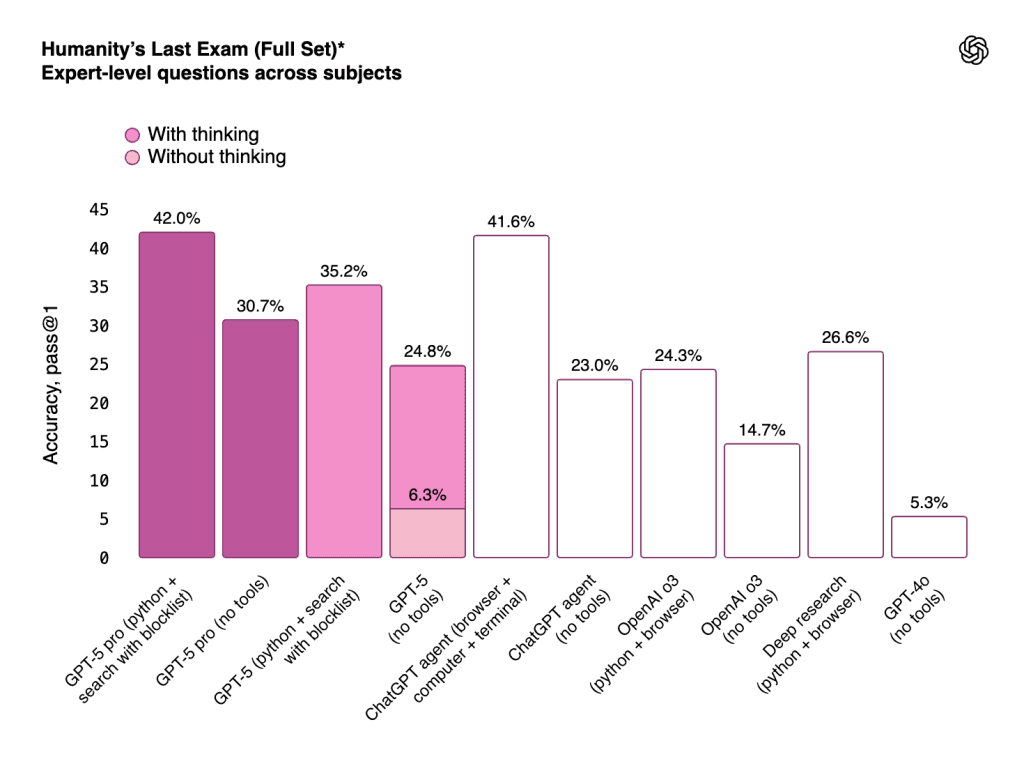
Figure: Accuracy rates on expert-level tasks. GPT-5 shows a significant jump in performance compared to GPT-4, especially when using advanced modes like Pro with reasoning.
Public reception
Reactions have been mixed. On LinkedIn and YouTube, early users praised the performance boost and improved reliability. At the same time, critics pointed out that despite the upgrades, GPT-5 is far from Artificial General Intelligence. The launch itself was described as “bumpy,” even acknowledged by OpenAI’s Sam Altman, but adoption has since stabilized as users experiment with its new modes and capabilities.
ChatGPT 4 vs 5: comparison in action
Side by side, GPT-5 shows clear improvements over GPT-4, but not without caveats. While GPT-4 set the standard for natural language generation, GPT-5 builds on that foundation with sharper reasoning, longer memory, and faster performance.
Comparison table
Feature | ChatGPT 4 | ChatGPT 5 |
Reasoning | Good, but often linear | Smarter, can pause and break down complex tasks |
Coding | Strong, but less consistent debugging | Cleaner code, faster debugging, supports more complex workflows |
Writing | Natural, but sometimes generic | More expressive, structured, and stylistically adaptive |
Memory / Context | ~8,000 words | 2,000+ words (opt-in memory for longer use) |
Speed | Slower on complex queries | Noticeably faster, even with heavy prompts |
Multimodal abilities | Limited integration | Stronger vision and multimodal potential |
Example tasks
One of the most striking differences is how each model approaches problem-solving. GPT-4 tends to provide an immediate answer, while GPT-5 is able to pause, analyze, and deliver a more structured response. This is particularly useful in coding, strategy planning, or research-heavy tasks. See it in action bellow:
Criticism and negative feedback
Despite the improvements, GPT-5 has not escaped criticism. Some users argue OpenAI oversold it as a step toward AGI, only to deliver what one critic called an “Artificial Guessing Interface.” The model still stumbles on basic tasks like counting or handling decimals, creating a gap between high-level reasoning and simple accuracy.
Pricing & accessibility
Another major point of comparison between GPT-4 and GPT-5 lies in how they are priced and made available to users. OpenAI structured GPT-5 to reach a broader audience with tiered access, while reserving advanced features for paid plans.
Free access
GPT-5 Mini and basic GPT-5 are available at no cost.
These versions are suitable for casual use but come with slower response times and limited memory.
Plus plan ($20/month)
Unlocks the full GPT-5 model, including Thinking Mode for deeper reasoning.
Prioritizes speed and reliability, making it the most popular option for professionals.
Pro plan ($200/month)
Designed for heavy workloads, enterprise teams, and advanced projects.
Offers the longest memory, fastest performance, and best access to complex reasoning.
Compared to GPT-4, which was mostly tied to the same Plus plan structure, GPT-5 introduces more flexibility through modes like GPT-5 Mini and GPT-5 Pro. This allows users to choose based on workload, whether they need speed for quick tasks, or depth for detailed analysis.
Still, accessibility remains uneven. Some features, such as opt-in memory and advanced reasoning, are limited to paid tiers. This continues the debate around whether cutting-edge AI should be democratized or kept behind a paywall.
Implications for users & businesses
The leap from GPT-4 to GPT-5 is not just a technical update, it reshapes how individuals and companies can apply AI in daily workflows.
For individual users
Productivity: faster responses and better reasoning make GPT-5 more reliable for research, writing, and learning.
Creativity: the model’s ability to adapt tone and style helps writers, designers, and creators produce more authentic content.
Learning curve: with multiple modes (Default, Thinking, Pro, Mini), users must experiment to find the right balance between speed and depth.
For businesses
Automation: GPT-5 enhances automation in areas like customer support, reporting, and project management.
Coding and development: cleaner code generation and debugging reduce bottlenecks for engineering teams.
Decision-making: improved reasoning makes it more practical for strategy sessions, scenario planning, and data interpretation.
eCommerce impact: in digital commerce, GPT progress connects directly with the rise of AI agents that take over repetitive workflows, streamline support, and drive personalization. This evolution has already started reshaping how online stores operate, as explored in ChatGPT Agent for eCommerce blog.
Performance benchmarks also confirm this shift. On tasks with direct economic value, such as those spanning law, logistics, sales, and engineering, GPT-5 consistently outperforms other models like ChatGPT Agent and OpenAI’s O3. This places it closer to the performance baseline of industry experts, a signal that businesses can derive measurable impact when adopting it.
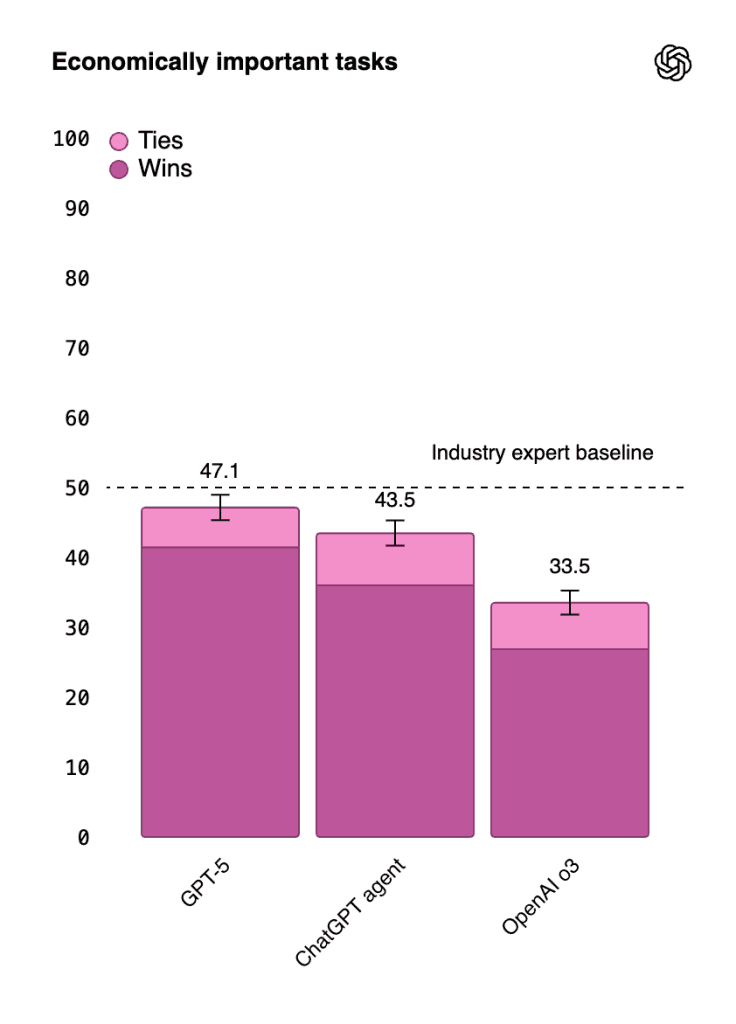
Figure: GPT-5 outperforms ChatGPT Agent and O3 on economically important tasks, approaching the industry expert baseline. Results based on evaluations at high reasoning effort as of August 2025.
Limits to keep in mind
Reasoning Mode can still be slow, which may frustrate teams needing instant answers.
Vision-based tasks are heavily dependent on image quality.
Browsing remains plugin-dependent, limiting out-of-the-box functionality.
Memory is opt-in, meaning users need to actively enable it for long-term recall.
The overall picture is one of opportunity with caution. GPT-5 empowers professionals to work faster and smarter, but its flaws remind us that human oversight remains essential.
Future outlook
GPT-5 demonstrates meaningful progress, but it also shows how far AI still has to go. While the model feels like a PhD-level expert in reasoning and writing, its struggles with simple logic or factual accuracy prove that Artificial General Intelligence is still out of reach.
Looking ahead, there are several dynamics to watch:
Evolution of LLMs: GPT-5’s upgrades signal a steady, incremental path forward rather than a sudden leap to AGI. Future releases will likely focus on stability, efficiency, and safer use cases.
Competition: rivals like Google’s Gemini, Anthropic’s Claude, and Perplexity are pushing the limits in their own ways, creating a rapidly changing AI ecosystem.
Adoption curve: businesses will continue experimenting with GPT-5, testing whether its added reasoning and memory justify shifting workflows from earlier models.
Integration: expect to see more GPT-5 integrations in productivity platforms, CRMs, and custom enterprise tools, making it a background technology rather than a standalone app.
The takeaway is clear: GPT-5 is not a final destination but part of an ongoing evolution. Users and companies who learn to adapt with each generation will stay ahead of the curve, while those waiting for a “perfect” model may risk falling behind.
Turning insights into action
The comparison of ChatGPT 4 vs 5 shows both meaningful progress and ongoing limitations. GPT-5 delivers smarter reasoning, longer memory, and faster output, yet it also highlights that AI is still far from flawless. For individuals, the choice between models depends on how deeply AI is integrated into daily work. For businesses, the question is how to turn these capabilities into measurable value.
Adopting GPT-5 is not just about upgrading to the latest tool, it is about designing processes that leverage its strengths while compensating for its weaknesses. That means experimenting with automation, applying it in decision-making, and integrating it with existing systems.
At Flatline, we help brands do exactly that. Through our AI consultancy, we translate the latest AI developments into practical solutions that support growth. The release of GPT-5 is another reminder that AI is moving fast, partnering with experts ensures you can capture the upside without getting lost in the noise.
Related articles


F.A.Q.

What is the difference between ChatGPT 4 and ChatGPT 5?
GPT-5 reasons more carefully than GPT-4: it can take time to break a complex problem into steps and return a more structured answer. It also writes cleaner code, makes fewer factual errors and handles far more context, up to 400,000 tokens in the API against 8,192 for the original GPT-4. GPT-4 answered more directly and linearly.
Is GPT-5 better than GPT-4?
For most professional work, yes. At launch, GPT-5 scored clearly higher than GPT-4 on expert-level tasks, with fewer hallucinations and stronger coding. Reactions were mixed, though. Critics pointed out that GPT-5 still stumbles on simple tasks such as counting or handling decimals, and that it is far from artificial general intelligence. Important output still needs human review.
Can you still use GPT-4 in ChatGPT?
No. OpenAI retired GPT-4 from ChatGPT on 30 April 2025, and GPT-5 became the default in August 2025. The original GPT-5 was itself retired from ChatGPT in February 2026. As of September 2026, paid plans run on GPT-5.6 Sol, Free and Go on GPT-5.6 Luna, and GPT-6 Pro is available on Pro, Business and Enterprise plans.
What are the GPT-5 modes?
At launch, GPT-5 was a default model that switched automatically to GPT-5 Thinking for harder questions, with GPT-5 Pro for the most demanding work and GPT-5 mini as a fallback when limits were reached. ChatGPT now uses a thinking slider instead: Instant, Medium, High, Extra High and Pro, depending on your plan. The trade-off between speed and depth remains.
Is ChatGPT 5 free to use?
Partly. The original GPT-5 is no longer in ChatGPT, but free users get its successors: as of September 2026, Free and Go run on GPT-5.6 Luna with unlimited everyday text chats. Paid plans add GPT-5.6 Sol with more thinking and, on Pro, the Pro models including GPT-6 Pro. Plans change regularly, so check OpenAI's current overview before you choose.