A Shopper Asked ChatGPT for the Best in Your Category. You Weren’t in the Answer.

By Robin Laseur

Running the prompt takes four seconds. Understanding why your name was absent takes about a week, and the week is worth considerably more than the four seconds. Absence from an AI answer is almost never a single missing thing. It is the accumulated state of a catalog, a crawl history, and a body of third-party writing about your category, and that state was set months before anyone typed the question. The useful part is that all of it is inspectable now.
What follows is a reconstruction: a composite of how that week usually goes, assembled from the pattern rather than from any one brand. The details are illustrative. The sequence is not.
The four seconds, and the week that follows
Marije runs eCommerce at a mid-market outdoor brand. She types her own category question into a chat interface on a Tuesday afternoon, mostly out of curiosity, because someone in the leadership meeting mentioned it. Three products come back with short explanations of why each suits the described use. None of them is hers.
The reflex response is a content brief. Somebody suggests publishing a buying guide, someone else suggests a piece on materials, and within twenty minutes there is a plan to produce eight articles by the end of the quarter. That plan is not wrong. It is the slowest available response to a question nobody has diagnosed yet, and it commits a quarter of budget to a hypothesis.
Marije does something less satisfying instead. She spends the week finding out what actually happened.
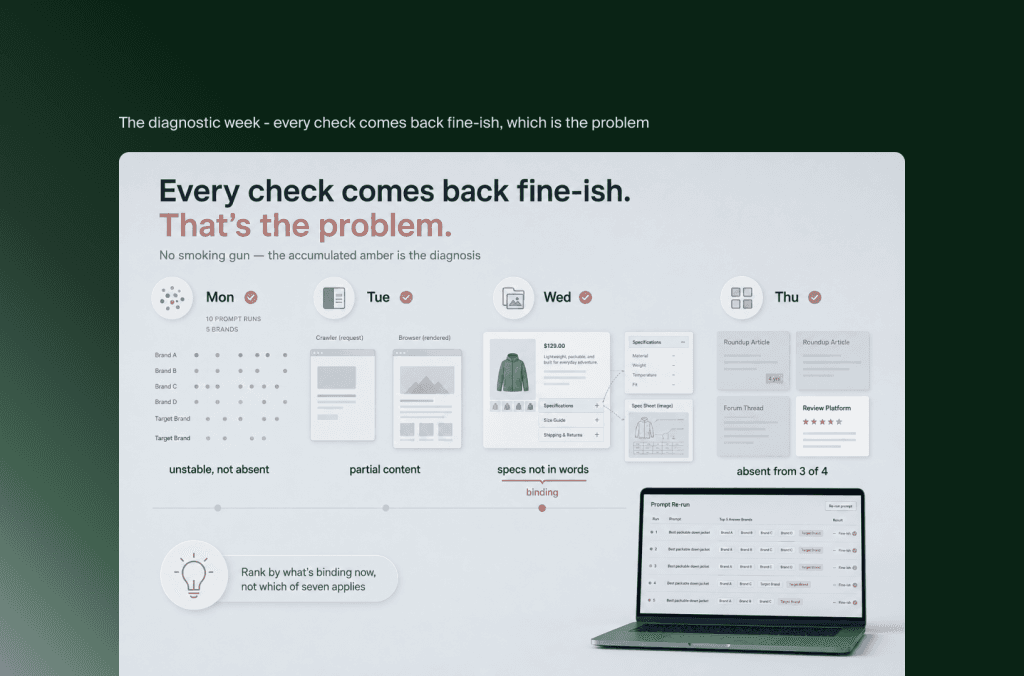
Everything checks out, which is the problem
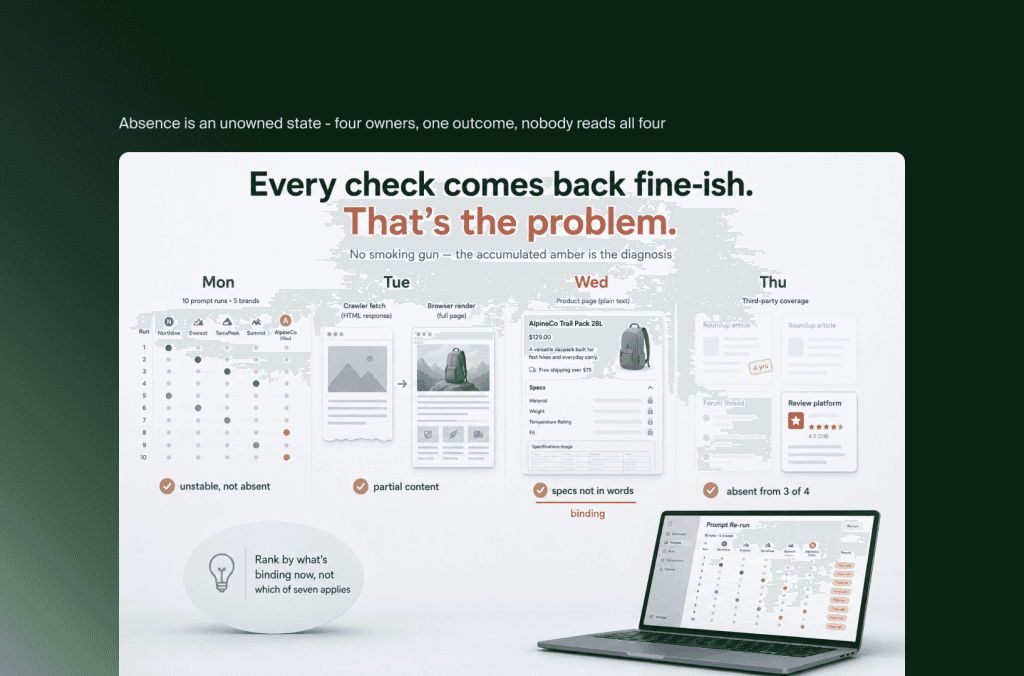
Day one, she runs the prompt nine more times. The answers vary: five names appear across ten runs, the order changes, and her brand shows up twice near the bottom. So the situation is not binary absence. It is low and unstable presence, which is a different problem with different causes than being unknown.
Day two, the technical review. The site is indexed, rankings are healthy, page speed is respectable, the sitemap is clean. Nothing here explains anything, and the temptation to declare the technical layer fine is strong. She asks the developer to request a product page while presenting an AI crawler user agent rather than a browser. It returns partial content. Not blocked, not broken, just thinner than what a browser receives, because part of the page assembles after load.
Day three, the product pages. Reading one as plain text, stripped of layout, she can find the price and the marketing copy. She cannot find the material composition, the weight, the temperature range, or the fit guidance, because those live in a collapsed tab and a specification image. The information exists. The page does not say it in words.
Day four, the outside view. She reads the sources her competitors were drawn from: two publisher roundups, a specialist forum thread, and a review platform. Her brand is present on the review platform with good scores. It is absent from the other three, and one of the roundups is four years old.
Every individual check came back somewhere between fine and mildly imperfect. That is the characteristic experience of this diagnosis, and it is why the published lists of five or seven reasons are hard to use in practice. In a real store, every reason on those lists is partly true at once. The question worth answering is not which of the seven applies. It is which one is binding right now.
Three forks
By Friday the week has produced three genuine decisions rather than a to-do list.
Fork one: fix rendering, or write content
The rendering issue is a few days of developer time and affects every page in the catalog. The content plan is a quarter of work affecting the pages it covers. Both are legitimate; only one of them changes what every AI system can read about every product she sells. Sequencing is the whole decision, and the answer is unusually clear once the two are placed side by side.
Fork two: describe products, or promote them
The specification information sitting in tabs and images is not new content. It exists and needs moving. That is a merchandising and template job rather than a writing job, and it competes for different people’s time than the content plan does, which means it can run in parallel rather than in sequence.
Fork three: pursue coverage, or wait
Publisher roundups are slow, relationship-dependent, and outside her control. They also carry disproportionate weight in exactly the kind of comparison question that started the week. The honest read is that this one takes quarters, which makes it the thing to start now rather than the thing to do first.
None of these forks is a tactic from a list. Each is a resource allocation with an owner and a sequence, which is what a diagnosis produces and a taxonomy does not.
What she found
The binding constraint was the second one, and it was dull.
Her catalog described products beautifully in prose and specified them almost nowhere in machine-readable text. Systems answering a question like “warm enough for early spring, packs small, under two hundred euros” were matching against constraints her pages never stated in words. The brand was not distrusted or blocked. It was unmatched.
That finding cost a week and no budget. The remedy was a template change and a merchandising sprint on the top two hundred products, which is smaller than eight articles and finishes sooner. The content plan survived, reduced and resequenced, aimed at the comparison questions the reconstruction had surfaced rather than at the topics the room had guessed at in the first twenty minutes.
Six weeks later the same ten prompts produced her brand in six answers instead of two. That is not a triumph and she has not reported it as one, because ten prompts is a small sample and generated answers move on their own. It is enough to justify continuing, which is the only claim a sample that size can carry.
What generalises
Three things, and the first is the one worth arguing about.
Absence is a symptom of an unowned state, not of a missing tactic
Product data belongs to merchandising, page rendering belongs to development, third-party presence belongs to marketing, and crawler access belongs to whoever last configured the firewall. Four owners, one outcome, and no single person who can see all four. Brands do not appear in answers because someone forgot a technique. They stay out of answers because the state that decides those answers accumulates in four places nobody reads together.
The published cause lists are accurate and close to unusable
Entity clarity, structured data, authority, content structure, third-party mentions, freshness: all real, all partly true in every store. A list of everything that could be wrong is not a diagnosis. Ranking those causes against your own evidence is.
Inspection is cheap and comes first
A week of looking costs a fraction of a quarter of publishing, and it routinely reveals something ordinary and quickly fixable. In AI consultancy work the first genuine finding usually arrives in the first three days, and it is almost never the thing the room predicted in the meeting where the question was raised.
The four seconds felt like a verdict. It was closer to a symptom, and symptoms are worth investigating before they are worth treating.
Frequently Asked Questions
Why does my brand appear in some AI answers and not others?
Generated answers vary by prompt wording, platform, personalisation, and the sources available at the moment of generation. Running one prompt once tells you very little. Running the same set of prompts several times across two platforms tells you whether you have stable presence, unstable presence, or genuine absence, and those three situations have different causes.
Is my brand being blocked by AI systems?
Occasionally, and it is worth checking early because it is cheap to test and it invalidates everything else. Request your own pages while presenting AI crawler user agents and compare the response to what a browser receives. Partial content is more common than an outright denial, and it produces the same outcome more quietly.
Should I publish more content to fix this?
Possibly, but not first. Content is the slowest and most expensive response available, and it is frequently aimed at topics guessed at rather than diagnosed. Spend a week inspecting rendering, product data completeness, and which third-party sources are actually being drawn from, then decide what to publish with that evidence in hand.
Key Takeaways
Absence from AI answers is accumulated state rather than a missing technique. Catalog data, page rendering, crawl access, and third-party coverage all contributed, and all of it was set before the question was asked.
Distinguish absence from unstable presence. Ten runs of the same prompt across two platforms separates a brand nobody knows from a brand that appears inconsistently, and the two need different work.
The published lists of causes are accurate and hard to act on, because every cause is partly true in a real store. Rank them against your own evidence rather than working down the list.
Inspection before publication. A week of looking is a fraction of a quarter of content production, and it usually surfaces something ordinary, template-level, and fast to repair.
The uncomfortable part of this diagnosis is also the encouraging part. The answer that excluded you was not a judgement on your brand. It was a description of what your systems said about your products, assembled by something that could only work with what it found.
Related articles


