AI Overviews and Your Product Pages: What Gets Cited and What Gets Skipped

By Robin Laseur
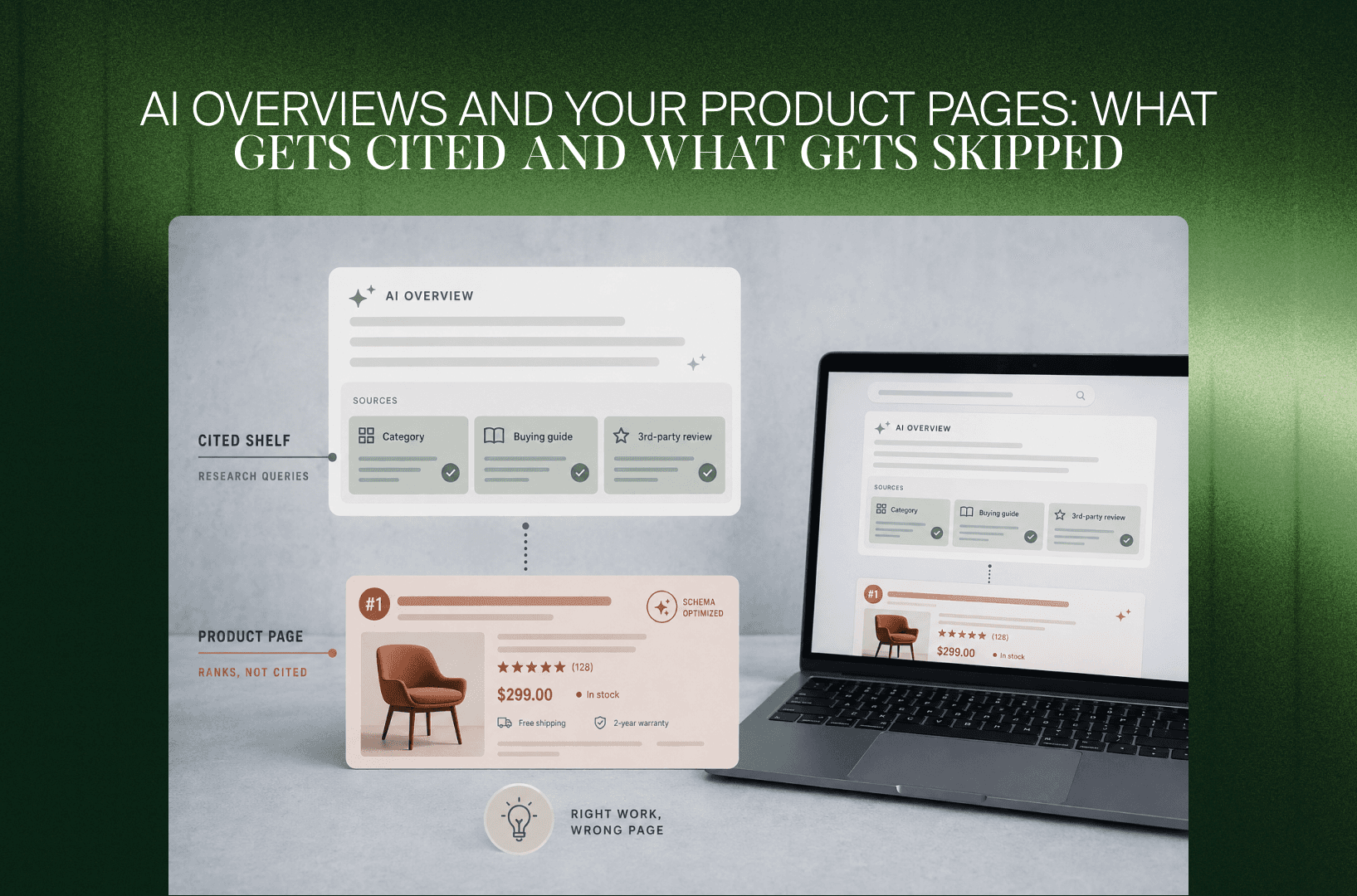
A merchandiser rewrites forty product descriptions for AI Overviews, adds schema, waits six weeks, and sees nothing. The work was competent. It was aimed at the wrong page. For most eCommerce catalogs, AI Overviews on product pages are the exception rather than the rule, because the queries that trigger an Overview are research questions, and the pages cited for research questions are usually category pages, buying guides, and third-party reviews. Product pages earn their place in that answer differently.
This is a gap between a reasonable expectation and how the system behaves. The expectation is not foolish, and the work it produces is not wasted. It is misdirected in a specific, correctable way.
The expectation: product pages can be optimized for AI Overview citation
The reasoning runs like this. AI Overviews sit above organic results. Our products are what we sell. Therefore our product pages should be optimized to appear inside those Overviews, which means adding structured data, restructuring copy for extraction, and treating citation as the new position one.
Each step sounds right, and the middle step is where most published guidance concentrates. Search the topic and you will find a consistent instruction set: extend Product schema past the theme default, write answer-first intros, use a clean heading hierarchy, refresh pages on a cycle. The instructions come attached to benchmark percentages from vendor studies whose prompt sets and page samples are not published.
The instruction set is not wrong so much as unplaced. It describes what makes any page extractable. It does not say which of your pages is competing for the Overview in the first place, and that omission is where the six wasted weeks come from.
The reality: your product page is often not the page being considered
Two things have to be true before a product page can be cited in an AI Overview. The query has to trigger an Overview at all, and the product page has to be the most useful source for that particular question.
Overviews appear where a question implies synthesis: comparisons, suitability questions, problem framing, category education. Queries that are clearly navigational or transactional, including specific product names and model numbers, more often return a conventional results layout with shopping surfaces. That pattern is directly opposed to how a catalog is structured, because product pages are built to answer exactly the narrow, high-intent queries least likely to produce an Overview.
For the research questions that do produce one, the candidate set is a different shelf of pages entirely.
Read down the last column and the picture reorders itself. Product pages appear once as the primary asset. Everywhere else they are a supporting source: the place a specific fact gets verified, the page a category or guide links to, the record that lets a system connect a brand to an attribute with confidence.
Google’s own documentation adds a further correction that cuts against most of what is written on this topic. Its guidance on AI features and your website states that no new machine-readable files, AI text files, or special schema.org structured data are required to appear in these features. There is no separate AI Overview markup to install. Structured data still matters for what it always did, which is helping Google understand and verify what a page sells, and Google’s product structured data documentation describes how page markup and a Merchant Center feed together broaden eligibility for product experiences. That is a real reason to complete your markup. Winning an Overview citation is not the reason.
Why the gap exists
Three mechanisms produce the divergence, and each has a different implication.
Ranking and citation are separate decisions
One system orders results. Another assembles an answer from sources it judges useful for the specific question asked. A page can hold a strong organic position and contribute nothing to the generated answer, because the answer needed a comparison and the page is a purchase surface.
Extraction rewards labeled facts, not persuasion
A generated answer is assembled from statements that can be lifted with their meaning intact. “Engineered for the modern commute” carries no liftable content. “Water-resistant to IPX4, 1.2 kg, fits laptops up to 16 inches” does. The second sentence is worse brand copy and better source material, which is the tension at the centre of this whole topic.
Product pages hide their most citable content
The facts most likely to be extracted from a catalog page are frequently the ones a template puts out of reach: specifications inside a collapsed tab, dimensions only present in an image, materials only visible after selecting a variant, review content injected by a third-party widget after page load. The page contains the answer. The page does not present the answer as text in the document.
Notice that only the third mechanism is a content problem. The first is a targeting problem and the second is a discipline problem, which is why “write better product copy” is such an unreliable instruction here.
What gets skipped, specifically
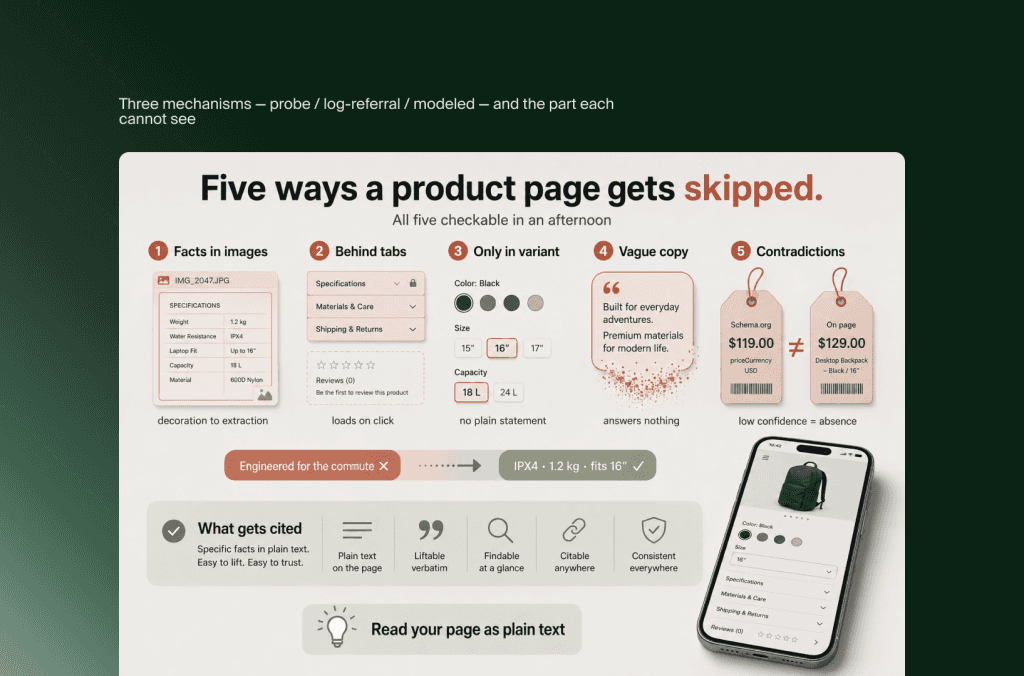
Five patterns account for most product pages that never contribute to a generated answer, and all five are checkable in an afternoon.
Facts that exist only in images
A specification chart rendered as a graphic is invisible as text. If the size guide, the materials list, or the compatibility matrix lives in a JPEG, it is decoration as far as extraction is concerned.
Content behind interaction
Tabs, accordions, and modals that load their contents on click frequently keep those contents out of the retrieved document. The same applies to review sections rendered by a widget after the main page has loaded.
Attributes that exist only in the variant selector
Sizes, colours, capacities, and materials encoded as selectable options and nowhere in the body text leave the page with no plain statement of what it actually offers.
Copy that answers nothing
Benefit language with no specifics gives an answer engine nothing to carry. This is the most common one, and the most defended, because it usually tests well with humans.
Unresolved contradictions
Schema that says one price while the page says another, a description that contradicts the specification table, a product name that differs across the page title, the schema, and the feed. Contradiction lowers confidence, and low confidence is indistinguishable from absence in a generated answer.
What gets cited is the inverse: a specific claim, stated once, in plain text, in a labeled section, consistent with the structured data underneath it, on a page the query was plausibly about.
What to check before you rewrite anything
Four checks, in this order, before a single description is touched.
Confirm the query actually generates an Overview
Take your twenty highest-value commercial queries and look. Record which produce an Overview and which do not. Queries without one are a conventional SEO and merchandising problem, and no amount of extraction work will change them.
Identify which of your pages could plausibly be the source
For each query that does produce an Overview, note the pages currently cited and their type. If every citation goes to editorial roundups and category guides, your gap is a missing asset, not a weak product page.
Read your own product page as text
View the rendered source, or copy the page into a plain text document. Whatever survives that operation is what an extraction system has to work with. This single check surfaces most of the five patterns above.
Check your Search Console figures for what they already contain
AI Overviews and AI Mode activity is included in overall Search Console search traffic under the Web search type rather than reported separately, so existing performance data already contains this behaviour without labelling it. Read impressions and clicks by query type instead of expecting a dedicated report.
The order matters because check one frequently ends the project. A catalog whose commercial queries produce no Overviews has a different problem than the one it came in with, and finding that out first is worth more than any rewrite.
Revised expectations, and the trade-off nobody costs
Three expectations survive contact with the mechanism.
Product pages earn citation on specific queries, mainly product-name and attribute questions where your page is the authoritative record. That is a narrow band, and it is worth holding, because those queries sit closest to purchase.
For everything wider, the product page’s job is corroboration rather than citation. It supplies the verifiable facts that let a system connect your brand to an attribute, and those facts get used when the cited source is a category page, a guide, or a third party writing about your category. Third-party corroboration carries more of that weight than most brands expect, a pattern we covered from the trust side in getting a skincare brand cited by AI.
And the asset that most often produces citation in research queries is the one many catalogs treat as furniture: the category page, with real explanatory copy above the grid rather than a sentence of SEO filler. Our GEO for commerce piece covers where that fits in the broader picture.
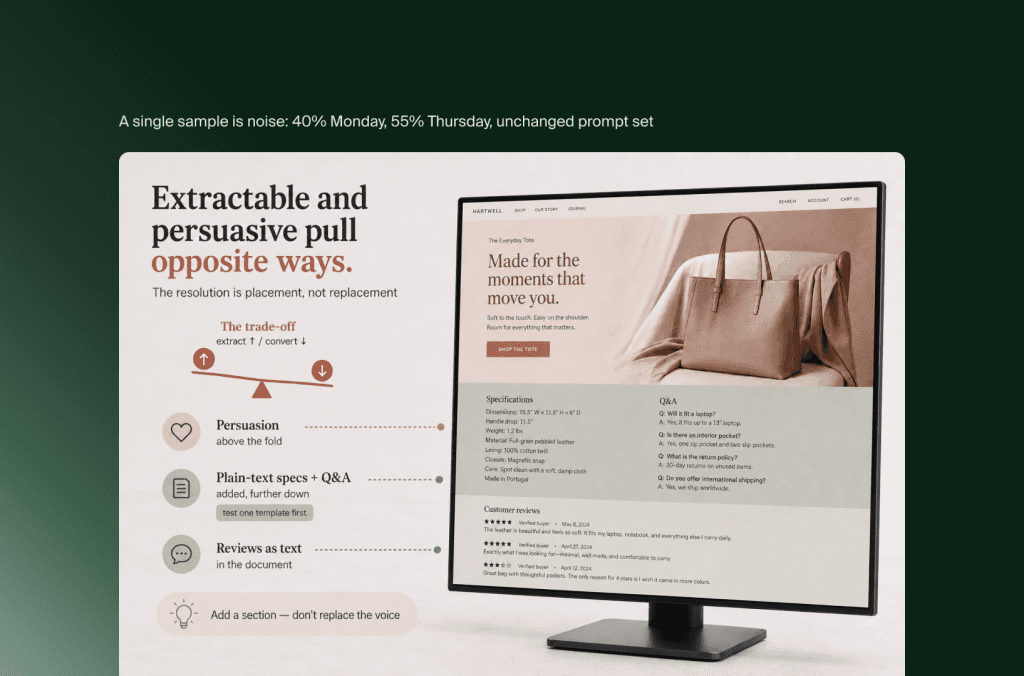
Now the trade-off, which the published guidance on this topic almost never costs out. Extractability and persuasion pull in different directions. A page rewritten into a dense specification block extracts beautifully and can convert worse, because the sensory and emotional work that sells a product is precisely the copy that carries no liftable facts. Anyone promising that these two goals always align is selling the easy version.
The workable resolution is placement rather than replacement. Keep the persuasive copy where it does its job, above the fold and around the imagery. Add a labeled, plain-text specification and question block further down the page, written in complete statements rather than fragments. Make the review content render as text in the document. Treat this as an addition to the page rather than a rewrite of it, and measure conversion on the template before rolling it across the catalog. Across Flatline’s eCommerce work, the version that survives is the one that added a section rather than the one that replaced the voice.
Frequently Asked Questions
Do I need special schema markup for AI Overviews?
No. Google’s documentation states that no new machine-readable files, AI text files, or special schema.org structured data are needed to appear in AI features. Complete Product structured data remains worth implementing because it helps Google understand and verify what a page sells, which supports product experiences and merchant listings, but there is no separate AI Overview markup.
Why does my competitor get cited when I rank higher?
Ranking and citation are decided by different processes. Position reflects the ordering of results; citation reflects which sources are useful for assembling an answer to that specific question. A comparison-shaped query pulls from explanatory content, so a page ranking below yours can be a better source while your page holds the higher position.
Should product pages be rewritten to be more extractable?
Add rather than replace. Keep persuasive copy where it drives conversion and add a labeled plain-text block of specifications and pre-purchase answers further down the page. Test conversion on one template before rolling changes across the catalog, since dense specification copy extracts well and can sell less effectively.
Can I see AI Overview citations in Search Console?
Not as a separate report. Activity from AI Overviews and AI Mode is included in overall search traffic under the Web search type rather than split out. Analyse impressions and clicks by query type, and use separate prompt-based sampling if you need a specific read on which pages are being cited.
Key Takeaways
Overviews cluster on research and comparison queries. Product-name and transactional queries more often return a conventional layout, so most product pages are competing for citation less often than assumed.
No special AI markup exists. Google’s own documentation states that no new files or schema types are required for AI features, which makes complete Product structured data a data-quality investment rather than a citation tactic.
What gets skipped is checkable: facts trapped in images, content behind tabs and widgets, attributes only in the variant selector, benefit copy with no specifics, and contradictions between page and schema.
For wide research queries the product page corroborates rather than gets cited. Category pages with genuine explanatory copy, guides, and third-party coverage are the assets competing for those answers.
The rewrite is rarely the first move. Look at twenty queries, note which produce an Overview and which pages they cite, then read your own page as plain text. Most catalogs discover that the work needed is smaller and better aimed than the one they were about to start.
Related articles


